T-Mobile Parent Company CEO on Musk's Telecom Ambitions: Welcome, But You'll Need $200 Billion

Deutsche Telekom CEO questions that SpaceX needs at least $200 billion to become a major U.S. wireless carrier.
Deutsche Telekom CEO Höettges responded to SpaceX's Starlink Mobile ambitions at an earnings call, saying "welcome to the party" but stating that becoming a major U.S. wireless carrier requires at least $200 billion in investment. He acknowledged SpaceX's disruptive potential but stressed the telecom industry's high capital expenditures, spectrum barriers, and operational complexity as major obstacles. Starlink currently offers satellite direct-to-phone service via its T-Mobile partnership with limited capacity and use cases, still far from replacing high-density urban cellular networks. The article analyzes the cost structure behind the $200 billion estimate—including spectrum licenses, base stations, backhaul, and customer acquisition—and notes that while SpaceX's vertical integration and Starship cost-reduction potential deserve attention, it cannot quickly challenge the big three.
Introduction: The Skepticism Behind a "Welcome"
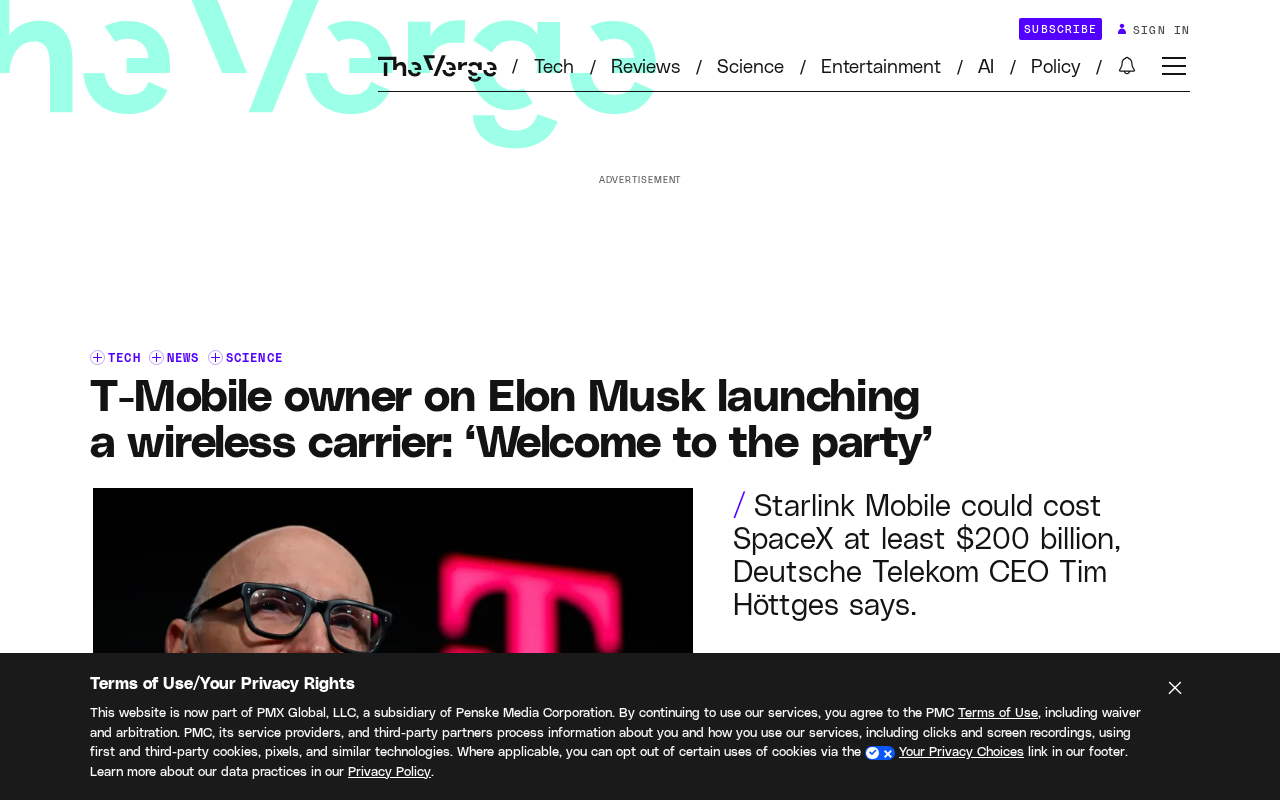
When Elon Musk's SpaceX declared its intention to make Starlink Mobile a "major" wireless carrier in the United States, Tim Höettges, CEO of T-Mobile's parent company Deutsche Telekom, offered a measured response during an earnings call: "Welcome to the party." Yet behind that pleasantry lies deep skepticism about SpaceX's plans—Höettges stated plainly that achieving this goal would require at least $200 billion in investment.
This statement came during Thursday's earnings call, as reported by tech media outlet The Verge. Höettges emphasized that he takes Musk's company "very seriously," but the cost threshold makes Starlink Mobile's "major carrier" ambitions appear far out of reach.
Höettges' Dual Stance: Taking It Seriously While Questioning the Cost
Höettges' remarks reveal two intertwined sentiments: on one hand, he acknowledges SpaceX's potential as a disruptor, stating that Deutsche Telekom takes this competitor "very seriously"; on the other, he uses a staggering figure—$200 billion—to draw the chasm between reality and vision.
What does "at least $200 billion" actually mean? It equates to the combined capital expenditures of the three major U.S. national carriers over several years. Höettges did not break down this figure in detail, but clearly he believes that building a mobile network covering the entire U.S. and rivaling existing carriers is far from simply launching a few satellites.
Why $200 Billion?
Although Höettges did not elaborate, the telecom industry's cost structure explains his assessment. Wireless carriers' major expenses include spectrum licenses, terrestrial base station construction, backhaul networks, operations manpower, and customer acquisition. Starlink currently relies on satellites to provide broadband service, but mobile communications must handle high-concurrency, low-latency scenarios in dense urban areas—placing entirely different demands on satellite constellation capacity and ground station layout.
Moreover, most spectrum resources in the U.S. market have already been divided among existing carriers. If SpaceX wants to obtain sufficient mobile spectrum, it must either acquire it at high cost or wait for regulators to reallocate it—either path means enormous capital.
Spectrum licenses are the most core scarce asset for wireless carriers. In the U.S., spectrum is primarily allocated through FCC (Federal Communications Commission) auctions. In recent years, mid-band (such as C-band) auctions have totaled tens of billions of dollars, and licenses are often split by region—nationwide coverage requires bidding on numerous fragmented licenses. Spectrum held by existing carriers is mostly accumulated historically or obtained through long-term auctions. New entrants seeking comparable contiguous spectrum not only face high bidding prices but may also be subject to regulatory conditions such as foreign ownership restrictions and coverage commitments. Additionally, spectrum requires equipment development, testing, and deployment cycles from auction to commercial use—time costs are equally high.
Backhaul networks refer to the terrestrial transmission links that aggregate base station traffic to the core network. In mobile communications, high-capacity fiber or microwave connections are needed between base stations and the core network, with dense urban areas especially dependent on fiber backhaul. If Starlink uses satellites as an access method, it still needs ground stations to land satellite traffic and connect to the internet backbone. Ground station site selection, fiber laying, and capacity expansion all require continuous capital investment and are constrained by land, approvals, and geographical conditions.
SpaceX's Starlink Mobile Ambitions
SpaceX's plans for Starlink Mobile are not unfounded. In recent years, Starlink has demonstrated satellite direct-to-phone capabilities through its partnership with T-Mobile (called "Coverage Above and Beyond"), achieving SMS and basic data services in some scenarios. Musk has publicly stated that Starlink will eventually provide full mobile communication services and even challenge traditional carriers.
However, from "satellite direct-to-phone" to "major carrier," there is a massive gap. Currently, Starlink's direct-connect service has limited capacity, mainly targeting remote area coverage and emergency communications rather than replacing high-density cellular networks in cities.
Direct-to-Cell refers to satellites communicating directly via radio frequency with ordinary smartphones, without dedicated terminals or external antennas. Its technical challenges include: phones have low transmission power and small antenna gain, while satellites are hundreds to thousands of kilometers from the ground, causing severe signal attenuation; simultaneously, high-speed satellite movement brings Doppler frequency shift, requiring complex synchronization and compensation algorithms. Currently, this technology mainly uses existing cellular spectrum (such as PCS bands) with spectrum reuse on the satellite side. Capacity is far lower than terrestrial base stations, and the number of concurrent users and data rates supported per satellite are limited—hence it is mostly used for SMS, voice, and low-speed data, making it difficult to carry high-density urban traffic.
Low Earth Orbit satellite constellations consist of thousands of satellites operating at altitudes of 500-1,200 kilometers. Compared to geostationary satellites, their propagation delay is lower (about 20-50 milliseconds), but individual satellite coverage is small, requiring large-scale networking for continuous coverage. Constellation capacity depends on the number of satellites, inter-satellite links, and ground station distribution. Expansion requires continuous satellite launches and ground infrastructure upgrades, with costs growing non-linearly with coverage density and capacity demands.
Telecom Industry Barriers and Competitive Landscape
Höettges' skepticism reflects the high-barrier nature of the telecom industry. The U.S. wireless market is dominated by the big three—Verizon, AT&T, and T-Mobile—which possess vast spectrum assets, millions of base stations, and decades of accumulated operational experience. New entrants must not only face capital expenditure pressure but also deal with regulatory approvals, spectrum auctions, and the inertia of user habits.
However, SpaceX's advantage lies in its vertical integration capabilities and rapid-iteration engineering culture. If Starship significantly reduces launch costs, Starlink constellation deployment speed could far exceed the pace at which traditional carriers build terrestrial networks. Höettges' "welcome to the party" may also carry a hint of caution—he doesn't want to underestimate an opponent that has repeatedly disrupted industry rules.
Starship is SpaceX's super-heavy reusable launch vehicle, designed to reduce launch costs to the order of hundreds of dollars per kilogram—far below currently operational rockets. If Starship achieves high-frequency reuse, Starlink constellation deployment and replenishment speed will greatly increase, and per-satellite launch costs will drop significantly. However, rocket launch costs are only part of total constellation costs. Satellite manufacturing, ground station construction, spectrum acquisition, and operations manpower still constitute major expenses. Moreover, mobile communications demand far higher capacity and reliability than broadband access—Starship's cost-reduction effects alone cannot dissolve the $200 billion-level investment threshold.
Conclusion: A Game Worth Watching
Currently, this game remains in its early stages. SpaceX has not yet announced a specific timeline or business model for Starlink Mobile, and Deutsche Telekom's $200 billion estimate is just one opinion. But what is certain is that Musk's intention to enter the wireless communications field has already stirred the entire industry. Höettges' "welcome" is both a courteous acceptance of a competitor and a public cost reminder: the entry ticket to the telecom party is far more expensive than imagined.
One-line Summary
Deutsche Telekom CEO questions that SpaceX would need at least $200 billion to become a major U.S. wireless carrier.
Paragraph Summary
Deutsche Telekom CEO Höettges responded to SpaceX's Starlink Mobile ambitions during an earnings call, saying "welcome to the party" but stating plainly that becoming a major U.S. wireless carrier would require at least $200 billion in investment. He acknowledged SpaceX's potential as a disruptor but emphasized that the telecom industry's high capital expenditures, spectrum barriers, and operational complexity pose enormous obstacles. Starlink currently provides satellite direct-to-phone services through its T-Mobile partnership, with limited capacity and scenarios, and remains far from replacing high-density urban cellular networks. The article analyzes the cost structure behind the $200 billion estimate—including spectrum licenses, terrestrial base stations, backhaul networks, and customer acquisition—and notes that while SpaceX's vertical integration and Starship cost-reduction potential warrant vigilance, it is unlikely to shake the big three's dominance in the short term.
Related articles

Claude Sonnet 6 Suspected Leak: Anthropic's Internal Model Acceleration Is Astonishing
Anthropic suspected leak of Sonnet 6; Meter reports its AI R&D accelerated 1.9x; OpenAI releases GPT-6 Cyber, GPT-6.2 Astra may be coming; Google Gemini Omni 1.2 Flash tops video generation leaderboard; Meta stealth models and real-time avatars unveiled; despite market volatility, Google still invests $17 billion in data centers.

How Accurate Are Sci-Fi's Predictions About AI?
How accurate are sci-fi's predictions about AI? Drawing on a Hacker News discussion, this article analyzes sci-fi's foresight and blind spots in AI development, arguing its true value lies in inspiring thought rather than precise prediction.

SwarmEvolve: Latent-Space Agent Swarms Accelerate Evolutionary Search
SwarmEvolve lets hundreds of low-cost agents swarm-reason in latent space, sharing info via KV caches to achieve fast evolutionary search for math and science problems—reaching in a median of 3–8 minutes the best scores other frameworks need 60 minutes for.