T3 Code: Orchestrating Multiple AI Coding Agents to Work as a Team

T3 Code lets multiple AI coding Agents like Codex and Claude Code collaborate with distinct roles in one project.
T3 Code is an open-source workbench that brings multiple AI coding Agents into the same project for role-based collaboration. In practice, Codex handles feature development while Claude Code serves as an independent reviewer, catching issues the developer Agent missed. This multi-Agent approach mirrors real software engineering team dynamics, though challenges around context management, API costs, and stability remain as the tool matures.
From Solo Coding to Team Collaboration
Most AI coding tools today focus in one direction: making a single model stronger, faster, and better at understanding code. But a more intriguing approach is emerging—rather than pushing the limits of any single Agent, why not let multiple AI coding Agents collaborate within the same project, just like a human development team?
Multi-Agent Systems (MAS) aren't an entirely new concept in AI programming. Their theoretical foundations trace back to distributed artificial intelligence research. In classic MAS architectures, multiple autonomous Agents coordinate through communication protocols, each possessing independent perception, decision-making, and execution capabilities. In recent years, as large language models (LLMs) have made dramatic leaps in capability, researchers have begun exploring the application of MAS principles to code generation scenarios—Microsoft's AutoGen framework, Stanford's Generative Agents experiment, and projects like MetaGPT are all validating the feasibility of "having multiple LLM Agents play different roles to accomplish complex tasks."
T3 Code is a practitioner of this very approach. It's an open-source workbench whose core capability is bringing multiple AI coding Agents (such as Codex and Claude Code) into the same project, each with their own responsibilities: one writes the code, while another specifically finds flaws and conducts reviews. The essence of this model is upgrading AI programming from "solo combat" to "team collaboration." What makes T3 Code distinctive is that it doesn't lock you into a single model provider—instead, it serves as an open orchestration layer, allowing developers to freely combine Agents from different vendors.
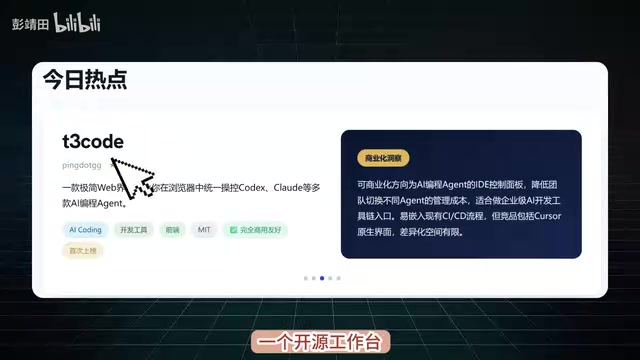
For developers accustomed to single Copilot-style completions, this represents a paradigm shift worth paying attention to. Code quality assurance has never relied solely on writing fast—it also depends on review, quality checks, and multi-perspective inspection—and this is precisely the gap that multi-Agent collaboration can fill.
Real-World Testing: Role Division Between Development and Review
In an actual test, the author used an "AI tool collection" project to validate T3 Code's multi-Agent collaboration capabilities. The entire workflow was clearly split into two roles.
Codex Handles Feature Development
The development tasks were assigned to Codex, which was asked to implement three features: category-based tool filtering, tab navigation (JTAB), and light/dark mode switching. According to the demo, these features were essentially completed within minutes—impressive efficiency.
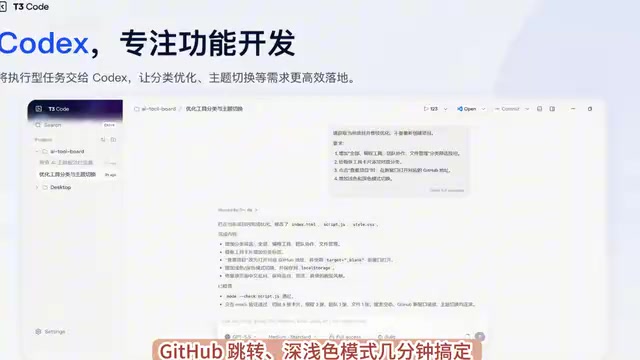
This step is actually similar to the experience with mainstream AI coding tools today—rapid generation, rapid iteration. The real differentiation appears in the next phase.
Claude Code Serves as Independent Code Reviewer
After the features were written, the author switched to Claude Code, assigning it a clear identity—independent reviewer. Its task wasn't to continue writing code, but to re-examine the entire project from three dimensions: structure, security, and maintainability.
Codex is a code generation model from OpenAI, originally fine-tuned from GPT-3 with subsequent versions continuously iterated, excelling at rapidly generating functional code from natural language descriptions, with training data that includes massive amounts of GitHub open-source repositories. Claude Code comes from Anthropic, based on the Claude model family. Anthropic is known for its "Constitutional AI" methodology, emphasizing model safety, honesty, and harmlessness. This philosophical difference in training leads to different behavioral tendencies in code generation: Codex tends to more aggressively complete feature implementation, while Claude-series models tend to be more conservative and rigorous in examining potential issues. This complementarity provides a natural foundation for the "development + review" role division.
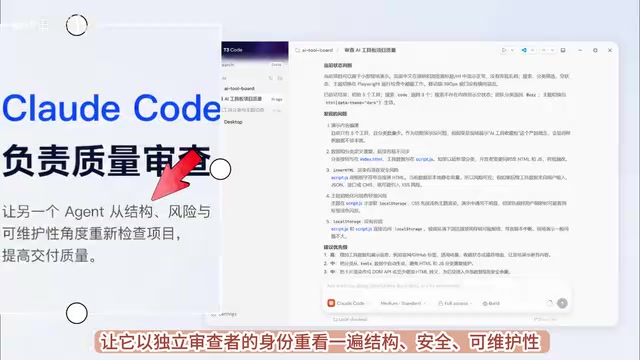
The results were quite valuable: Claude Code did find several issues that Codex hadn't noticed, such as thin demo content and duplicate definitions between data and category structures. These problems are often difficult for the development Agent to self-identify, because the code-writing party easily falls into its own cognitive patterns, while a "bystander" perspective reviewer can spot blind spots.
This is exactly where multi-Agent collaboration is most convincing: different models have different training emphases and judgment tendencies. Letting them check and balance each other, filling each other's gaps, is more effective than a single model repeatedly self-checking.
The Value and Limitations of Multi-Agent Collaboration
Value: Restructuring AI Programming Workflows from a Quality Assurance Perspective
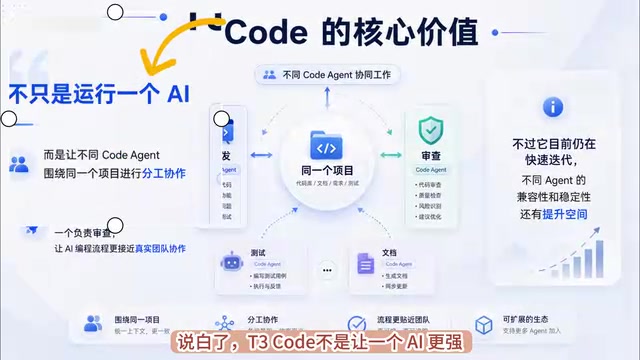
T3 Code's core philosophy deserves repeating: it's not about making any single AI stronger—it's about transforming AI programming from solo coding into team collaboration.
This mirrors the organizational logic of real software engineering. In human teams, developers write code, code reviewers ensure quality, and security engineers check for vulnerabilities—the division of labor brings higher overall reliability. Code Review is a widely recognized quality assurance practice in modern software engineering. Google disclosed in its engineering practices whitepaper that every line of code entering production must be reviewed by at least one engineer who isn't the author. Research shows that code review can catch 60%-90% of defects, far exceeding the standalone coverage rate of automated testing. The traditional pain point of code review is time consumption—a single review averages hours to days and depends on the reviewer's domain expertise and energy levels. The introduction of AI reviewers isn't meant to replace human review, but to provide a "pre-filtering layer" that flags obvious structural issues, duplicate code, and security vulnerabilities before human review, thereby improving overall R&D efficiency.
When AI Agents can play these different roles, the output quality of AI programming can achieve similar improvements. For individual developers or small teams, this means gaining "multi-role review" effects at lower cost, without actually assembling a complete team.
Limitations: Still in Early Stages, Stability Needs Polish
It must be objectively noted that T3 Code is still in its early stages. The author acknowledges that compatibility between different Agents and overall stability still need further refinement.
The challenges facing multi-Agent collaboration are real: How do you smoothly connect different models' interfaces, context management, and task handoff mechanisms? When the reviewer suggests modifications, how does the development Agent accurately understand and execute them? These engineering details directly impact the actual effectiveness of collaboration.
One of the most critical technical challenges is context window management. Current mainstream LLMs have context windows ranging from 128K to 200K tokens, but a medium-sized project's complete codebase often far exceeds this limit. This means the orchestration layer needs to intelligently decide: which files and code snippets to pass to which Agent, and how to transfer "working memory" between Agents. Information loss during task handoffs is also a key issue—after the development Agent completes code, the review Agent needs to understand not just the final code, but also design intent, constraints, and tradeoffs already made. Solutions currently being explored in the industry include: shared structured metadata files, project knowledge indexes based on vector databases, and standardized inter-Agent communication protocols.
Additionally, running multiple Agents simultaneously means higher API call costs and more complex orchestration logic. Using late-2024 pricing as reference, GPT-4-level model API calls cost approximately $2-10 per million input tokens, with output tokens being more expensive. A complete multi-Agent collaboration workflow—development Agent generating code, review Agent analyzing file by file, development Agent making revisions based on feedback—might consume hundreds of thousands of tokens. In comparison, a single Agent's one-shot generation might cost only 1/3 to 1/5 of that. Therefore, multi-Agent collaboration is better suited for critical modules and core business logic where quality requirements are extremely high, rather than running every piece of code through a full multi-Agent pipeline. This is also why intelligent orchestration—determining which code deserves multiple rounds of review—will become a core competitive advantage for such tools.
Conclusion: Multi-Agent Collaboration Is the Next Step for AI Programming
Despite its immaturity, the multi-Agent collaboration direction that T3 Code represents still holds enormous potential. As capabilities across major models trend toward homogenization, how to organize and orchestrate these Agents may become the key competitive differentiator in the next phase of AI coding tools.
For developers hoping to leverage AI to amplify their individual output, understanding and experimenting with multi-Agent collaboration tools like this may represent a mental upgrade from "using AI" to "directing an AI team." Of course, before large-scale deployment in production environments, it's still advisable to thoroughly validate stability in smaller projects first.
Key Takeaways
Related articles

DeepCell: One-Click AI Generation of Documents, Spreadsheets, and Slides
DeepCell tops Product Hunt with one-click generation of documents, spreadsheets, and slides, using the .deepcell format for linked updates, designed for System 2 tasks like modeling and sales reviews.

Doneas: 15-Minute Daily Accountability Calls That Keep Indie Developers From Procrastinating
Doneas is a daily accountability tool for indie developers: plan tasks on Monday, join a 15-minute call with five builders each day, and log deliveries on a public progress page. This article analyzes its core mechanics, effectiveness, and potential issues around retention and matching.

Fastlane 2.0: Fully Automated AI Ad Campaigns, From Creative to Optimization
Fastlane 2.0 is an AI ad automation tool: enter your website and it learns your brand, generates video and image ads, and runs and optimizes them on Meta, TikTok, Instagram, and YouTube.