Taku AI: Turn Expert AI Workflows Into Your Desktop App with One Click

Taku AI turns expert AI workflows into one-click desktop apps anyone can remix and run.
Taku AI topped ProductHunt's daily chart by addressing a key friction point: while powerful AI workflows abound in open-source communities, reusing them requires complex environment setup that blocks most users. Taku packages these workflows into runnable desktop apps via three paths — borrowing expert configs, skipping setup entirely, or assembling with natural language. Its remix-oriented approach and usage-based recommendations show promise, though questions around security, cost transparency, and personalization depth remain to be validated.
AI Is More Powerful Than Ever — So Why Is It Harder to Use?
AI capabilities are expanding at a visible pace — models are smarter, Agents are more autonomous, and workflows are more complex. But a paradox has emerged alongside this progress: the more powerful the features, the higher the barrier for ordinary users to get started. Want to replicate an AI workflow shared by an expert? You might first need to clone a GitHub repository, configure environment variables, install dependencies, and debug API keys. By the time you're done with all that, your enthusiasm has long since evaporated.
It's worth explaining why these steps constitute such a high barrier. Cloning a repository means using Git commands to download source code locally; environment variables typically store sensitive information like API keys; dependency installation involves package managers like pip or npm, and different projects may require different runtime versions — version conflicts are a daily occurrence; API keys require registering on platforms like OpenAI or Anthropic and linking a payment method. The entire process might take a developer 30 minutes to several hours, while for non-developers it's nearly impossible to complete independently. Even Docker containerization, which alleviates environment issues to some extent, carries its own non-trivial learning curve.
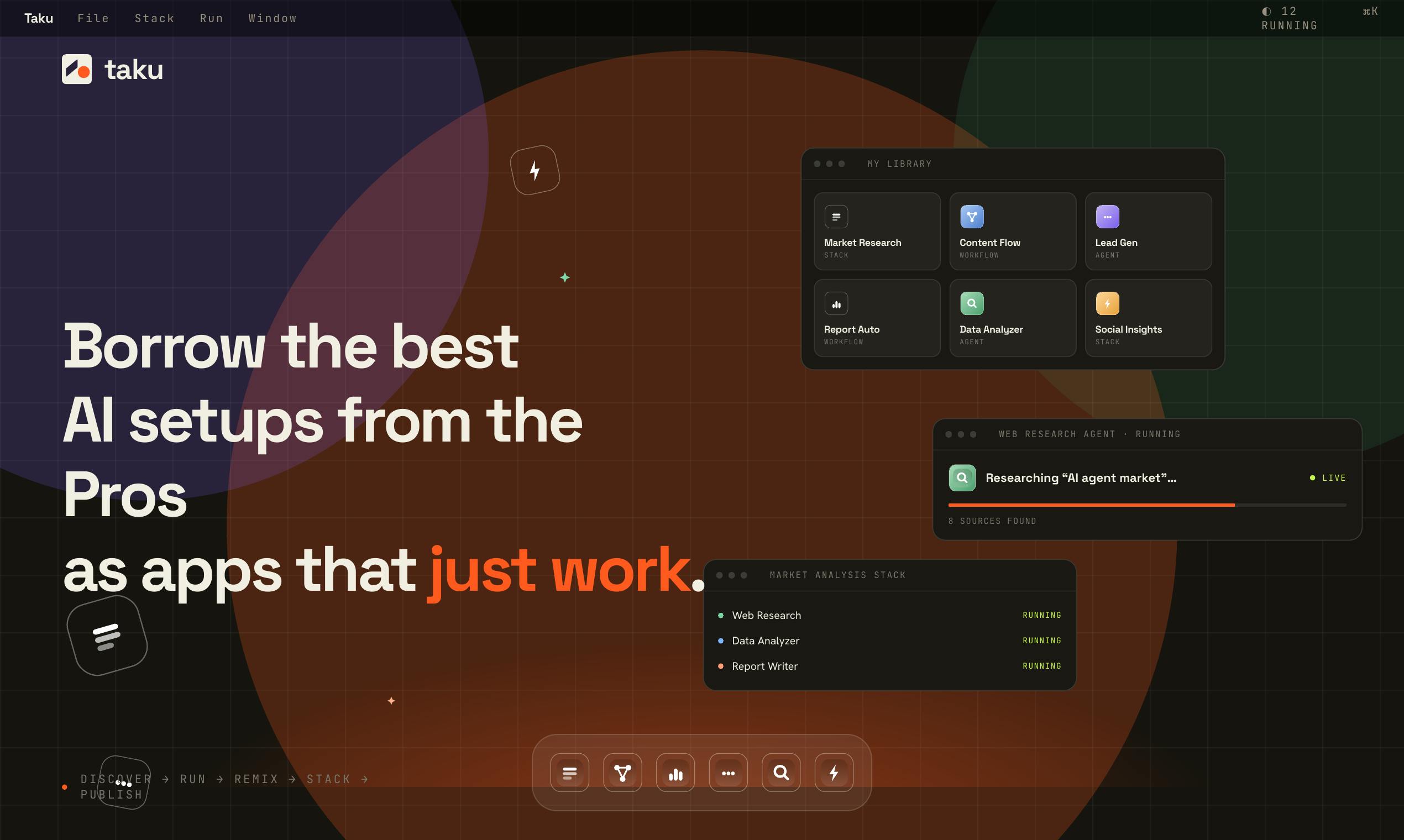
Taku AI, which recently hit #1 on the ProductHunt daily chart, targets precisely this "last mile" problem. Its positioning is straightforward: turn the best skills, agents, and workflows into desktop apps anyone can run, letting you "borrow expert configurations and make them your own." On launch day it garnered 157 upvotes, 12 comments, and the #1 ranking, appearing simultaneously in the Productivity, Artificial Intelligence, and No-Code categories.
What Problem Does Taku Actually Solve?
If you dissect today's AI ecosystem, the problem isn't capability itself — it's distribution and reuse. The open-source community contains vast amounts of carefully tuned Agent configurations, Prompt templates, and automation workflows, but most exist as code repositories that are virtually unusable for non-developers. Even for developers, getting from "seeing a good solution" to "running it locally" involves a pile of tedious environment configuration.
It's worth adding that the complexity of the current AI Agent ecosystem far exceeds what most people imagine. Unlike traditional single-turn Q&A AI, an Agent possesses autonomous decision-making, tool invocation, and multi-step reasoning capabilities — it can decompose tasks based on objectives, select appropriate tools for execution, and dynamically adjust strategies based on intermediate results. Typical Agent frameworks like LangChain, AutoGen, and CrewAI allow developers to define Agent roles, available toolsets, and collaboration methods. Workflows, meanwhile, orchestrate multiple Agents or AI capabilities into pipelines in a specific order. For example, a content creation workflow might include: Research Agent → Outline Generation Agent → Writing Agent → Proofreading Agent. These configurations typically exist as YAML files, Python scripts, or JSON configs, creating a natural barrier for non-technical users.
Taku's core approach is to "productize" all of this. It offers three main usage paths:
- Borrow: Directly adopt AI configurations that professional users have already tuned, without building from scratch.
- Skip setup: Bypass GitHub cloning, dependency installation, and similar steps, turning configurations directly into desktop apps you can double-click to run.
- Assemble with natural language: Simply tell Taku what you want in natural language, and it handles assembling the appropriate tech stack.
These three paths are essentially different entry points to the same goal — reducing the friction of reusing other people's work.
"Remix"-Style AI Workflows
One notable concept from Taku is treating AI configurations as objects that can be "remixed" (creatively reworked). The official description emphasizes that users can "run, remix, and make their own."
This Remix philosophy has deep cultural roots in the tech world. It traces back to the Unix philosophy of "composing small tools to accomplish complex tasks," later championed in the web space by the Glitch platform — where users could one-click remix others' web apps and freely modify the copies. Figma's community templates, Notion's template marketplace, and Hugging Face's model spaces follow similar logic. In the AI domain, this means a proven Prompt chain, tool configuration, and model selection can be packaged as a standardized "recipe," and others need only swap out variables — such as changing the underlying model, adjusting parameters, or replacing data sources — to adapt it to their own scenario. The key to this model's success lies in the degree of standardization: the more unified the configuration interfaces, the lower the remix friction.
Behind this is essentially a distribution logic combining app store and open-source community models. In the traditional paradigm, an AI workflow's value is often locked inside the author's machine and documentation; in Taku's envisioned model, that workflow becomes an "artifact" that can be packaged, shared, modified, and redistributed. If you see someone's writing Agent or data analysis pipeline working well, you can take it directly, swap out the model, adjust the Prompt, add or remove tools, and create your own version.
This "standing on others' shoulders" approach to reuse could theoretically shorten the cycle from inspiration to execution significantly. It's especially appealing for creators, operations staff, and product managers who aren't skilled at configuring environments.
It Learns You Over Time
The team also mentions a progressive personalization mechanism: "The more you work, the more Taku understands what you need, and brings the right tools to you."
In other words, Taku isn't just a static app packager — it also has recommendation capabilities based on usage behavior. It attempts to observe your work patterns and proactively match you with suitable skills and agents. If this direction truly materializes, it would be the key differentiator from an ordinary "configuration store," because tool discovery itself is one of the major pain points in the current AI application ecosystem.
The severity of this pain point is often underestimated. By rough estimates, there are tens of thousands of open-source AI Agent-related projects on GitHub alone, plus various paid SaaS tools, browser extensions, and API services. The problem ordinary users face isn't "no tools available" but information overload of "not knowing which tool suits them." Traditional solutions include curated recommendations (like ProductHunt itself), community word-of-mouth, and algorithmic recommendations. But AI tool suitability is highly dependent on users' specific use cases, technical level, and budget constraints — simple category tags are far from sufficient to solve the matching problem. Taku's proposed "usage behavior-based recommendation" is essentially an attempt to build a recommendation system for AI tools, similar to Spotify's music recommendations — inferring tools you might need but haven't yet discovered by observing which capabilities you actually use and what types of tasks you complete.
A Sober Assessment: Clear Vision, Details Pending Verification
It should be noted that currently available public information comes mainly from ProductHunt's product description — a single source — and many technical details remain unclear. The following points are worth examining closely during actual use:
-
Quality and security of configuration sources: "Borrowing expert configurations" sounds great, but when third-party configurations are packaged into runnable desktop apps, permission boundaries, data access, and potentially malicious configurations become unavoidable issues. An application that can automatically assemble tech stacks and invoke various tools inherently carries a high trust threshold.
This security challenge is similar to the dilemma faced by early browser extension ecosystems. A desktop app that can access the local file system, execute code, and access the network — if its internal logic is defined by third-party users — poses multiple risks: malicious Prompt injection could cause Agents to perform unintended operations; improper file system access permissions could leak sensitive data; API keys intercepted by a configuration author's backend constitute credential theft. Solving these problems requires sandbox isolation (similar to browser restrictions on web pages), tiered permission granting (similar to mobile app permission prompts), and community review mechanisms (similar to app store review processes). The quality of this security infrastructure directly determines whether such a platform can support large-scale users.
-
Model and cost attribution: Behind natural language tech stack assembly, questions arise about which models are called, who pays the API costs, and how keys are managed — all of which directly affect practical usability. Current mainstream LLM API pricing varies enormously — GPT-4o costs a few dollars per million tokens, while more advanced reasoning models may cost several times more. If a workflow involves multiple Agents chained together, cumulative token consumption may far exceed user expectations. Taku needs to provide clear answers on "whose keys, who pays, and whether costs are transparent."
-
Depth of "learns you over time" implementation: Such personalized recommendations easily remain at the level of marketing rhetoric; truly delivering valuable proactive recommendations is no easy feat. Classic recommendation system challenges — cold start problems (how to recommend when new user data is insufficient), long-tail coverage (how niche but precisely relevant tools get discovered), and balancing recommendation diversity with precision — exist equally in the AI tool recommendation scenario. And because the functional dimensions of tools are far more complex than products or content, implementation difficulty may be even higher.
These aren't criticisms — they're questions any AI distribution platform targeting the general public must answer. Taku has chosen the right track direction — AI's adoption bottleneck truly lies in "last mile" usability.
Conclusion
Taku AI has seized a real and widespread pain point: AI capability is abundant, but reuse capability is scarce. With its three moves — borrow, remix, and natural language assembly — it attempts to transform AI workflows scattered across GitHub and expert minds into desktop apps anyone can use.
Hitting #1 on ProductHunt's daily chart shows this direction resonates with many people. Whether it can truly become the "app distribution layer" for the AI era depends on the product's execution quality around security, cost, and personalization. But at minimum, it poses a question that's both clear and tantalizing: What if reusing a top-tier AI configuration could be as simple as downloading an app?
Related articles

@ai-sdk/vue 3.0.306 Patch Release Syncs with [email protected] Update
@ai-sdk/vue 3.0.306 released, synced with [email protected]. A routine patch release for the Vercel AI SDK ecosystem with no public API changes; the Vue adapter layer stays version-aligned with the core package.

Gemini 4 Argon API Launches: The Era of Million-Token Output Begins
Google launches Gemini 4 Argon with sparse MoE architecture, up to 1M output tokens, and a 68.90% Vals Index score, available across API, AI Studio, and the Gemini app.

DukaanAI: Turning Product Photos into Inventory Lists with Open-Source AI
DukaanAI is an AI inventory tool for small retailers that turns product photos into inventory entries using the open-source Gemma 3 model, with local inference, editable fields, and CSV export.