Tapo Launches Indoor Camera with Touchscreen: Video Calling Beyond Security

Tapo C825 adds a 4-inch touchscreen to a 2K pan-tilt camera, attempting to turn a security device into a home communication terminal.
TP-Link brand Tapo has launched the indoor security camera C825, integrating a 4-inch touchscreen into a 2K pan-tilt camera so that it performs monitoring when away and becomes a video calling terminal when at home. This reflects the trend of smart home devices moving from single-purpose security tools to home interaction nodes. The article analyzes its hardware combination and dual-scenario switching logic, noting that screens are becoming a new differentiation lever while blurring boundaries with smart displays. Screen-equipped devices also raise new privacy boundary issues; success depends on call experience, natural mode switching, and clear privacy design. Price and launch date are not yet announced.
From Security Device to Home Communication Terminal
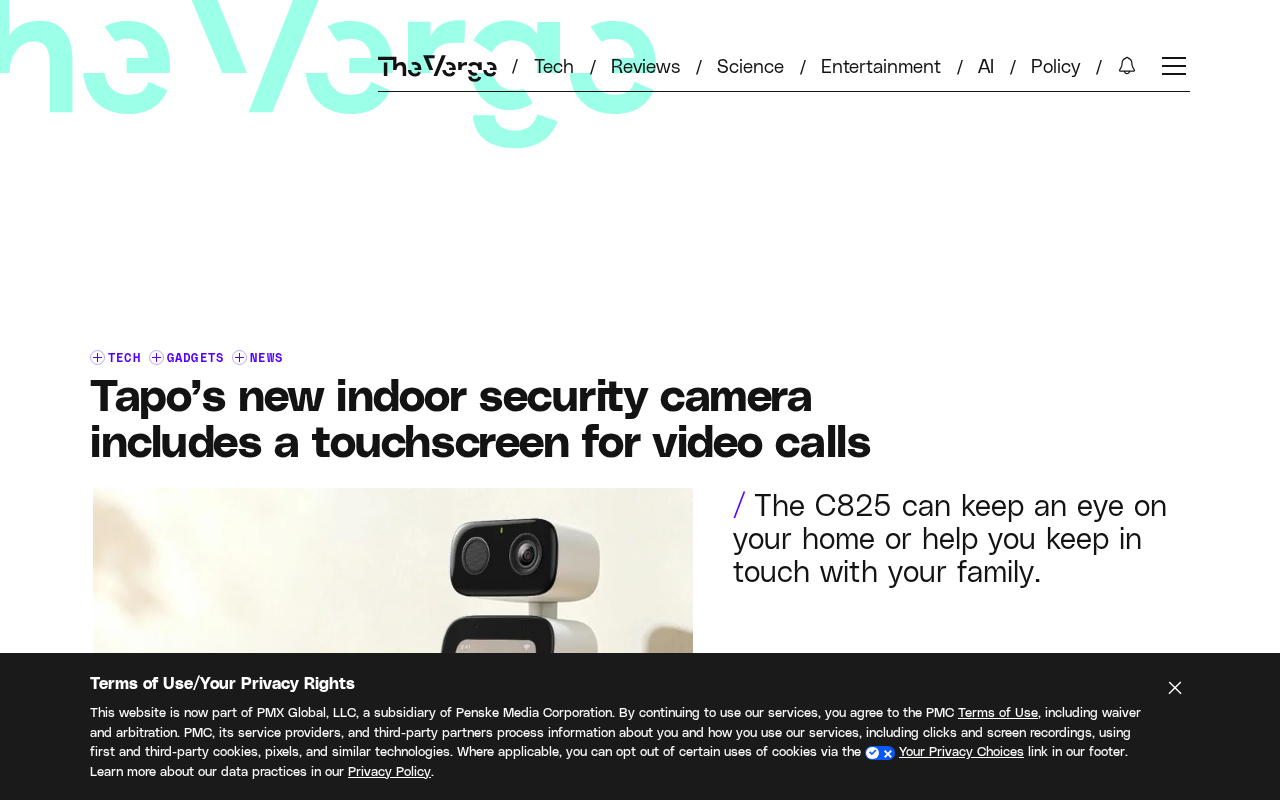
Tapo, the smart home brand under TP-Link, recently launched an indoor security camera called the C825, whose standout feature is a 4-inch touchscreen integrated into a 2K pan-tilt camera. This means that when users are away from home, it serves as a diligent "electronic eye"; and when users are at home, it transforms into a video calling terminal connecting family and friends.
This product concept reflects a positioning shift that smart home devices are undergoing: security cameras are no longer just "home-watching" tools but are attempting to become a node for in-home communication and interaction. Tapo is not the first manufacturer to try adding a screen to a camera, but combining a touchscreen with a pan-tilt structure in a consumer-grade product is still a combination worth watching.
Hardware Form Factor and Functional Trade-offs
The Combination of 2K Pan-Tilt + 4-Inch Touchscreen
In terms of hardware, the C825 continues the core capabilities of Tapo's pan-tilt cameras—2K resolution and a rotatable viewing angle, which is the mainstream configuration for indoor monitoring. The additional 4-inch touchscreen takes on another role: users can directly operate video calls on the device without relying on a phone app. For scenarios with elderly people or children at home, this "zero phone barrier" interaction method has practical value.
Pan-tilt camera refers to a camera equipped with an electric pan-tilt (PTZ, Pan-Tilt-Zoom), which can achieve horizontal rotation (Pan), vertical tilt (Tilt), and optical zoom (Zoom) through motor drive. Consumer-grade indoor pan-tilt cameras typically support horizontal 355° and vertical 90°+ viewing angle coverage, combined with motion detection for automatic tracking. Compared with fixed-view cameras, the pan-tilt structure can reduce monitoring blind spots, but it also brings engineering challenges such as mechanical wear, rotation noise, and power wiring. Combining a touchscreen with a pan-tilt requires accommodating the motor, screen, and motherboard within a limited body, placing higher demands on heat dissipation and structural design.
Product Logic of Dual-Scenario Switching
According to the official description, the C825 has two typical usage states. In away mode, it performs security monitoring tasks, watching for intruders or pets behaving unusually at home; in home mode, the screen and calling functions are activated, becoming an entry point for family social interaction. This "one device, two uses" design attempts to increase the device's daily usage frequency—traditional cameras are often idle after users return home, but with the addition of a screen, its usage scenarios are extended to time spent at home.
Away/home mode is a common scenario-based linkage mechanism in smart homes, usually triggered based on geofencing or manual switching. In away mode, the camera enables motion detection and video push notifications; in home mode, some devices turn off the lens or enter a privacy-shielding state. The C825's differentiation lies in the fact that home mode is not simply "sleep" but activates the screen and calling functions, turning the device from passive monitoring to active interaction. The key to the experience of this mode switching lies in the degree of automation—if it relies on manual user operation, it is easy to cause privacy or security vulnerabilities due to forgetting; if it switches automatically based on phone location, it needs to solve misjudgments and coordination issues in multi-member households.
The Category Boundaries of Security Cameras Are Blurring
Screens Become a Differentiation Lever
The indoor camera market has long been in a state of homogeneous competition, with parameters such as resolution, night vision capability, and pan-tilt range leveling out year by year. Tapo's choice to add a touchscreen to the C825 essentially shifts the competitive dimension from "seeing clearly" to "being usable." The video calling capability brought by the screen blurs the category boundaries between cameras, smart speakers, and smart displays.
The Balancing Challenge of Privacy and Practicality
Screen-equipped cameras entering indoor home spaces also push privacy issues into a more prominent position. Whether the camera remains on standby in non-monitoring states and how video call data is transmitted and stored—these details will directly affect users' trust in the product. Tapo needs to provide clear privacy boundaries in product design; otherwise, a "screen permanently in the living room" may trigger stronger psychological resistance than traditional cameras.
The privacy risks of screen-equipped cameras are mainly concentrated at three levels: first, the lack of physical shielding—traditional cameras can achieve "complete disconnection" through physical lens covers or turning toward the wall, while screen-equipped devices may still have active screens and microphones during standby; second, data link security—video calls involve the collection, encoding, transmission, and storage of audio and video streams, and if end-to-end encryption is incomplete, there is a risk of interception; third, the psychological pressure of a permanently present device—a screen in the living room can easily make visitors or family members feel "watched." Industry responses include hardware-level microphone disconnect switches, physical lens covers, localized storage and end-to-end encrypted calls, and clear indicator light specifications.
Market Prospects and Points to Watch
From the perspective of category evolution, the C825 represents an attempt by security devices to move closer to becoming a home interaction hub. Its success depends on two factors: whether the video calling experience is smooth and stable enough, and whether switching between security and communication modes is natural enough. If users need to frequently jump between the app and the device screen, the convenience of "one device, two uses" will be diminished.
At present, the information officially disclosed by Tapo focuses on product positioning and core functions, while key commercial information such as price and launch time has not yet been clarified. For consumers interested in smart homes, this product is worth noting, but actual purchasing decisions should wait for more complete reviews and pricing information.
One-line Summary
Tapo C825 adds a 4-inch touchscreen to a 2K pan-tilt camera, attempting to turn a security device into a home communication terminal.
Paragraph Summary
TP-Link brand Tapo has launched the indoor security camera C825, integrating a 4-inch touchscreen into a 2K pan-tilt camera so that the device performs monitoring tasks when away from home and transforms into a video calling terminal when at home. This design reflects the trend of smart home devices migrating from single-purpose security tools to home interaction nodes. The article analyzes its hardware combination and dual-scenario switching logic, pointing out that screens have become a new lever for differentiated competition in the camera category while also blurring the boundary with smart displays. Screen-equipped devices entering indoor home spaces also bring new privacy boundary issues, and the product's success depends on call experience, the naturalness of mode switching, and the clarity of privacy design. Price and launch time have not yet been announced.
Related articles
GTA VI's Instagram Clone: A Time Waster That's Worth Trying
*GTA VI* includes an Instagram-like social app dubbed "a time waster but worth it." This article explores how it enhances immersion, satirizes social media, and appeals to players tired of real-world socializing.

5.0 Magnitude Earthquake Near Manhattan Beach: USGS Quick Report and HN Buzz
USGS quick report: 5.0 magnitude earthquake ~5 km SW of Manhattan Beach, CA. HN post gets 200 points, 134 comments. Key takeaways and how to read quake reports.

Google Account Banned for Using Gemini?
A Hacker News user reports a Google account banned for using Gemini, raising concerns about AI service account security. We analyze possible causes and offer developer advice.