Tcl/Tk 9.1 Released: New Developments in a Veteran Scripting Language

Tcl/Tk 9.1 released and trends on Hacker News, reaffirming the veteran scripting language's lasting role in specialized domains.
The release of Tcl/Tk 9.1 reached the Hacker News front page with 280 upvotes and over 100 comments — remarkable for a scripting language born last century. Tcl's lean, embeddable nature has kept it entrenched in EDA tools, network devices, and industrial software for decades, making it nearly irreplaceable infrastructure. Tk continues to serve engineers who need rapid cross-platform GUIs with minimal code. Version 9.1 builds on 9.0's modernized architecture, focusing on stability and compatibility — offering legacy system maintainers continued official support. The community discussion reflects a broader truth: engineering value isn't proportional to hype, and a solid foundation with a clear niche is the real secret to longevity.
Tcl/Tk 9.1 Sparks Discussion
A post announcing the release of Tcl/Tk 9.1 made it to the Hacker News front page, earning 280 upvotes and over 123 comments. For a scripting language and GUI toolkit combination that has been around for decades and maintains a relatively low profile today, this level of community engagement speaks volumes about its enduring base of loyal users and technical followers.
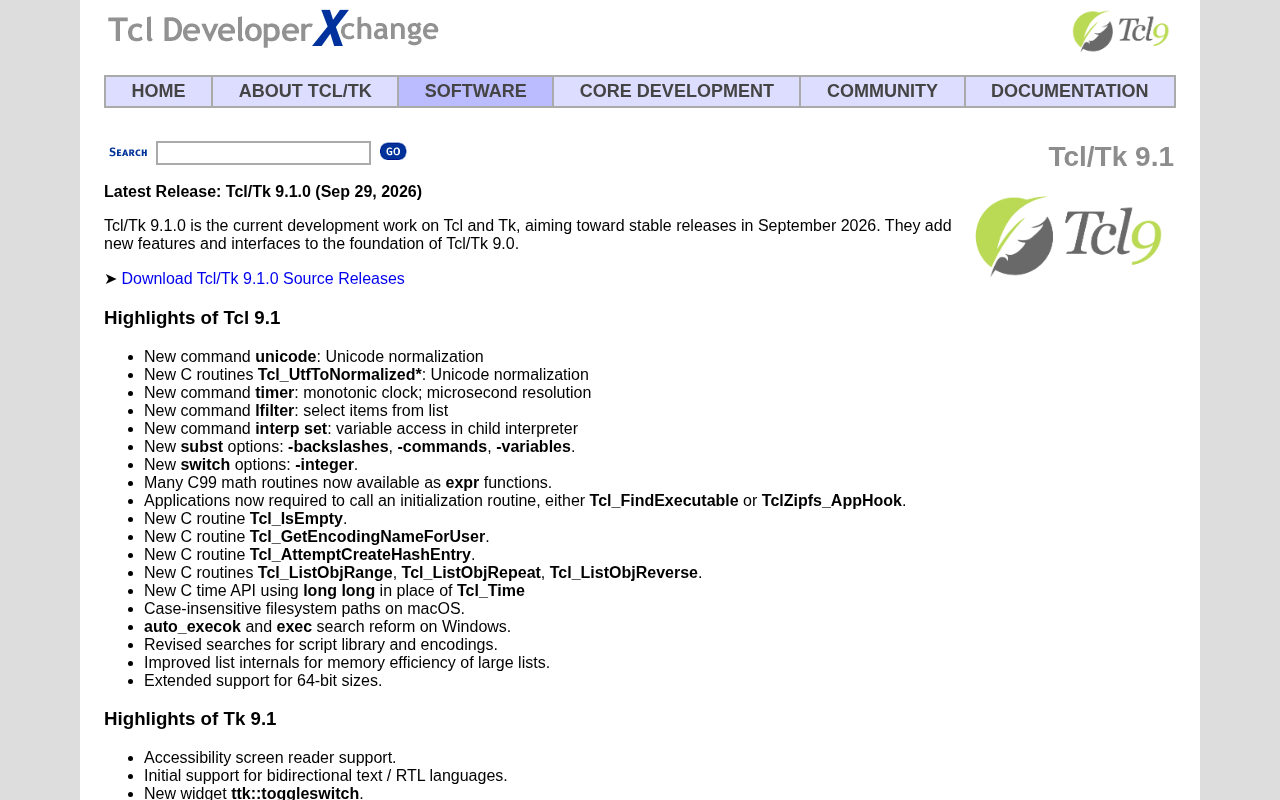
Tcl (Tool Command Language) is a scripting language known for its simplicity and embeddability, while Tk is its companion graphical interface toolkit. Together, they once played a significant role in scientific research, industrial control, and rapid prototyping during the latter half of the last century. They continue to serve critical functions in numerous legacy systems and specialized professional software. This 9.1 release represents another iteration following the major 9.0 version.
Why an "Old" Language Still Deserves Attention
In a landscape dominated by Python, JavaScript, and their ecosystems, the continued updates and community discussion around Tcl/Tk raise an interesting question: where does the staying power of veteran tools actually come from?
The answer often lies in their unique positioning. The Tcl language core is extremely lean with high syntactic consistency. Its "everything is a command" design philosophy makes it particularly well-suited as an embedded scripting engine. Many commercial software products, EDA tools, and network device management interfaces still use Tcl as a built-in extension language. This role — deeply embedded within infrastructure — makes it far harder to replace than consumer-facing technologies.
Tk, meanwhile, excels at "quickly building cross-platform GUIs with minimal code." While its visual style may look a bit plain by modern standards, its development efficiency remains genuinely attractive to engineers who need to rapidly assemble utility-style interfaces.
EDA (Electronic Design Automation) tools represent one of Tcl's most important real-world strongholds. Major EDA platforms from Synopsys, Cadence, and Mentor Graphics all use Tcl as their preferred scripting language. Chip design engineers use it daily to write synthesis scripts, timing constraints, and automation workflows. This choice traces back to the 1990s, when Tcl's embeddability and stable API allowed EDA vendors to deeply integrate it into their tool cores. The semiconductor industry has accumulated an enormous asset base of Tcl scripts over decades, making the switching cost prohibitively high — which is the fundamental reason Tcl remains nearly irreplaceable in this vertical. Additionally, Cisco's IOS operating system family and similar network device vendors have long supported Tcl as an automation scripting interface, further cementing its position in the infrastructure domain.
The Significance of Version 9.1
As a continuation of the 9.x series, Tcl/Tk 9.1 typically carries the task of refining the architectural foundation established by the 9.0 major release. The 9.0 series previously introduced significant improvements to 64-bit data structures, full Unicode support, and modern platform compatibility. Subsequent minor version releases focus on stability, bug fixes, and incremental feature enhancements.
For existing users, these updates mean better platform compatibility and long-term maintenance assurance without requiring substantial code rewrites. For maintainers of legacy systems that depend on Tcl/Tk, continued official releases are themselves an important confidence signal.
Tcl/Tk 9.0 was a milestone major release. One of its most important changes was the complete removal of legacy 32-bit integer limitations, allowing core data structures like strings, lists, and dictionaries to break through the 2GB capacity ceiling — particularly significant for scientific computing and EDA scenarios that handle large-scale datasets. The comprehensive improvement to Unicode support resolved longstanding character encoding issues that had plagued non-English users. Notably, 9.0 was not fully backward compatible — some long-deprecated legacy interfaces were officially removed, meaning projects migrating from 8.x may require minor code adjustments. Building on this foundation, 9.1 focuses primarily on compatibility fixes and platform adaptation, making it a smooth maintenance upgrade for most users.
Community Discussion Reflects Technical Nostalgia and Reality
The 100+ comments on Hacker News reflect the complex feelings the tech community holds toward projects like this. On one hand, there's appreciation and nostalgia for a classic tool that continues to survive; on the other, there's realistic discussion about its degree of modernization and ecosystem activity.
This kind of discussion is quite representative. In a software industry that constantly chases new frameworks, projects that genuinely survive long-term and receive continued maintenance are relatively rare. Tcl/Tk's decades of stable evolution demonstrates one thing clearly: a technology's value is not always proportional to its popularity. A solid engineering foundation and a well-defined applicable domain can sustain a tool's standing in its niche for a very long time.
Summary
The release of Tcl/Tk 9.1 may not reshape the mainstream development landscape, but it is a signal worth noting: classic tools are still being seriously maintained and used. For developers working in embedded scripting, tooling development, or maintaining related legacy systems, paying attention to the specifics of this release still carries practical value. Interested readers can visit the official release page for the complete changelog.
Related articles

Chain of Thought Isn't Just for AI: How Humans Can Use CoT to Improve Thinking Quality
Chain of Thought isn't just a prompt trick for large models. Starting from a Hacker News discussion, this article analyzes why CoT works for human thinking too, breaks down actionable ways to transfer it, and highlights the key differences between human CoT and machine CoT.
Cloudflare Teams Up with OpenAI: Closi…
Cloudflare Teams Up with OpenAI: Closing the Loop from Vulnerability Discovery to Defense with AI
Cloudflare uses OpenAI Daybreak to investigate security vulnerabilities and generate reviewable remediation plans, while developers use Codex to boost coding efficiency and quality.

Orca Multi-Agent Orchestration in Practice: A Guide to Parallel Collaboration with Claude and Codex
Orca is Stable AI's free open-source agent workbench supporting 34 agents like Claude Code and Codex in parallel. Learn its Git worktree isolation, multi-model orchestration, and mobile management.