Teaching Language Models to Explain Themselves: Multi-Type Explanations and an Evaluation Framework

A dissertation argues that combining multiple explanation types is key to improving human understanding of model decisions.
This paper systematically studies language model explainability across three explanation forms: highlight explanations, natural language explanations, and chain-of-thought reasoning. It breaks explanation quality into faithfulness, plausibility, and utility, noting the tension among them. It argues the three forms are complementary and better used in combination. Methodological contributions include a multi-attribute evaluation framework for highlight explanations, a meta-evaluation framework for chain-of-thought faithfulness metrics, and two techniques for generating faithful yet concise natural language explanations. A fact-checking human-computer interaction experiment tests explanations' practical value for users verifying model judgments.
Language models are increasingly involved in complex reasoning tasks, helping humans make judgments. But their predictions are often hard to interpret and verify—users struggle to understand why a model gives a certain answer, and therefore cannot judge whether to trust it. Explainability techniques exist precisely to address this pain point: revealing the basis of a model's decisions, exposing potential errors, failure modes, and biases, and enabling users to make an informed decision about whether to accept the model's output.
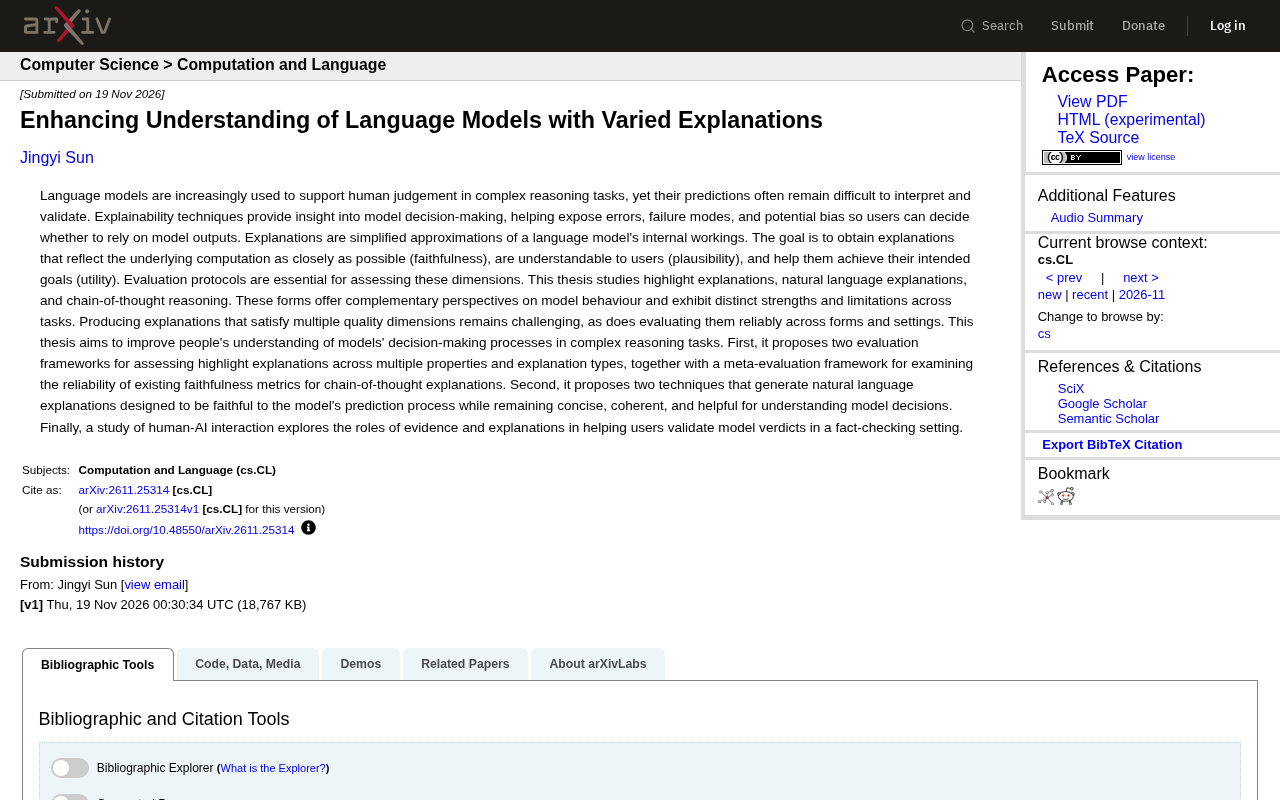
A recent dissertation systematically studies this problem, focusing on three types of explanations: highlight explanations, natural language explanations, and chain-of-thought reasoning. The paper's core claim is: no single explanation form can satisfy all needs on its own—combining multiple explanation types is the key path to improving human understanding of model decisions.
Three Dimensions of Explanation Quality: Faithfulness, Plausibility, and Utility
The paper first clarifies a fundamental question: what counts as a "good explanation."
The author points out that an explanation is essentially a simplified approximation of a language model's internal workings. Since it is an approximation, it involves bias. Ideally, an explanation should stay as close as possible to the underlying true computation—this is faithfulness; it should also be understandable to users—plausibility; and it should genuinely help users complete their target task—utility.
There is tension among these three dimensions. An explanation highly faithful to the model's internal mechanism may be full of technical detail and hard to understand; an explanation that reads fluently and naturally may not truly reflect the model's computational path. The paper acknowledges that simultaneously satisfying multiple quality dimensions remains an open problem, and that reliable evaluation across explanation forms is equally difficult.
The value of this framework lies in breaking down the vague question of "is this explanation good" into operational evaluation dimensions. For those who actually use models, this means that when evaluating explainability tools, one should not just ask whether the explanation "reads like the real thing," but whether it is truthful, easy to understand, and useful.
Three Explanation Forms: Complementary, Not Substitutes
The three explanation forms covered by the paper each offer a different perspective on model behavior, with distinct strengths and weaknesses.
Highlight explanations provide attribution by marking the input segments that most influence the output. They are intuitive and easy to present, but their granularity is coarse and they struggle to express complex reasoning chains. Natural language explanations describe the model's decision rationale in words and are highly readable, but the generation process itself may introduce content that is unfaithful to the true computation. Chain-of-thought reasoning shows the model's step-by-step derivation and suits complex reasoning tasks, but whether the displayed reasoning steps truly reflect the model's internal computation has long been debated.
The paper's position is clear: these forms complement one another. A single explanation form tends to give users a one-sided understanding, whereas multi-perspective explanations let users cross-validate the model's decision logic and thereby more accurately identify the model's errors and failure modes.
Common methods for highlight explanations are typically based on attention weights or gradient attribution. Attention weights reflect how much the model focuses on each input segment when processing it, while gradient attribution measures the effect of small input changes on the output. These methods are cheap to compute and easy to visualize, but attention weights are not equivalent to causal importance, and gradient attribution can be distorted by saturation issues. Thus the "intuitiveness" of highlight explanations often comes at the cost of precision, which is why the paper emphasizes their coarse granularity.
The chain-of-thought faithfulness debate centers on the possibility that the reasoning steps a model generates are post-hoc rationalizations rather than the true computational path. Prior work has tested this through intervention experiments—for example, inserting an erroneous step into the chain of thought and observing whether the final answer changes accordingly. If the answer does not change, the displayed reasoning may not be the logic the model actually relies on. Such tests provide direct context for the paper's meta-evaluation framework.
Evaluation Framework: Making Explanation Quality Measurable
The paper's first contribution is its evaluation methodology. The author proposes two evaluation frameworks for assessing highlight explanations across multiple attributes and explanation types, along with a meta-evaluation framework for testing the reliability of existing chain-of-thought faithfulness metrics.
The meta-evaluation step is especially critical. If the metrics used to measure "faithfulness" are themselves unreliable, conclusions drawn from them do not hold up. By re-examining existing faithfulness measures, the paper effectively quality-checks the evaluation tools themselves.
The practical significance of this approach for explainability research is that evaluation protocols are a prerequisite for judging explanation quality: without reliable evaluation, any claim that "our explanations are more faithful" lacks persuasiveness.
Meta-evaluation refers to testing the reliability of evaluation metrics themselves. In explainability research, common faithfulness metrics include perturbation tests based on deletion/insertion: delete a highlighted input segment and observe how much the model output changes—the larger the change, the more faithful the explanation. But such metrics are sensitive to perturbation strategy and baseline choice, and different implementations may yield contradictory conclusions. Meta-evaluation judges whether a metric is trustworthy by checking its agreement with human judgments or known ground truth. The paper's re-examination of chain-of-thought faithfulness metrics is precisely meant to avoid the circular reasoning of "measuring things with an unreliable ruler."
Generating More Faithful Natural Language Explanations
The second contribution concerns generation techniques. The paper proposes two techniques for generating natural language explanations, with the goal of making explanations faithful to the model's prediction process while remaining concise, coherent, and genuinely helpful for understanding model decisions.
The design orientation here is noteworthy: faithfulness is usually seen as trading off against conciseness and readability, and the paper attempts to strike a balance between them. For practitioners, this means explainability need not come at the expense of user experience—explanations can be both accurate and readable.
Human-Computer Interaction Experiment: How Explanations Help Users Verify Model Judgments
The third contribution is a human-computer interaction study set in the context of fact-checking. The study examines the respective roles of evidence and explanations in helping users verify model judgments.
Fact-checking is a typical scenario for testing the utility of explanations: faced with a model's true/false judgment, users need to decide whether to accept it. Whether explanations can help users spot model errors and calibrate trust directly bears on the practical value of explainability. By connecting explanation research with real-world usage scenarios, the paper addresses the fundamental question of "do explanations actually help."
Implications for Practitioners
Taken together, the paper offers several signals of value to AI application developers.
First, explainability evaluation requires multi-dimensional criteria—faithfulness, plausibility, and utility are all indispensable, and relying on a single metric easily leads to misjudgment. Second, different explanation forms suit different tasks, and combining them is more reliable than relying on any single form. Third, evaluation tools themselves need to be evaluated; the reliability of faithfulness metrics is the starting point of the entire chain of trust.
A language model's ability to explain itself does not automatically produce trust. Only explanations that have been rigorously evaluated and validated as effective in real scenarios can truly help users understand and correctly use models. The evaluation frameworks and generation techniques in this paper add a methodological piece to that puzzle.
One-line Summary
A dissertation argues that combining multiple explanation types is the key path to improving human understanding of model decisions.
Paragraph Summary
This paper systematically studies language model explainability, focusing on three forms: highlight explanations, natural language explanations, and chain-of-thought reasoning. It first breaks explanation quality into three dimensions—faithfulness, plausibility, and utility—noting the tension among them and the difficulty of satisfying all at once. On this basis, it argues that the three explanation forms have distinct strengths and weaknesses, complement one another, and work better in combination than alone. Methodological contributions include: a multi-attribute evaluation framework for highlight explanations, a meta-evaluation framework for chain-of-thought faithfulness metrics, and two techniques for generating faithful yet concise natural language explanations. Finally, a human-computer interaction experiment in a fact-checking scenario tests the practical role of explanations in helping users verify model judgments, pointing explainability practice toward multi-dimensional evaluation and combined use.
Related articles

Prompt Engineering for Beginners: From Writing Prompts to Engineering Thinking
Starting from the essence and four functions of prompts, this article systematically explains the six-step process, four success criteria, learning value, and practical limitations of prompt engineering to help you build a complete understanding.

Anthropic Launches Nasdaq IPO: AI Giant's Listing and Risk Disclosures
Anthropic officially launches its Nasdaq IPO under ticker ANT, with market valuation expected to potentially exceed SpaceX's record. The prospectus devotes nearly 100 pages to AI risks, while first-half revenue grew over 14x but net losses widened sharply, reigniting the AI bubble debate.

Rust cURL Clone Uses 4,832 unsafe Blocks—Is the Memory Safety Myth Broken?
A Rust cURL clone uses 4,832 unsafe keywords, challenging Rust's memory safety narrative. We analyze what unsafe really means, compare Fil-C, and examine rewrite motives.