Teaching Robots to Assemble the GB300 Test Tray: Practical Lessons from Machine Learning and Mechanical Intelligence

NVIDIA's GB300 tray assembly case shows industrial robots need machine learning, mechanical intelligence, and engineering in tandem.
NVIDIA's engineering case study *The Machines that Make the Machines* uses robot-assisted assembly of the GB300 test tray to reveal the true complexity of deploying industrial robots. The article introduces the concept of mechanical intelligence — using chamfered guides, compliant mechanisms, and passive alignment hardware to resolve assembly errors at the physical level rather than delegating everything to algorithms. It argues that machine learning, mechanical intelligence, and traditional engineering are all indispensable: learning algorithms handle perceptual generalization, hardware design eliminates foreseeable uncertainties, and engineering intuition fills the blind spots of data-driven methods. This pragmatic, multidisciplinary perspective offers direct value for practitioners tackling high-precision, low-volume automation challenges.
Teaching Robots to Assemble the GB300 Test Tray: Practical Lessons from Machine Learning and Mechanical Intelligence
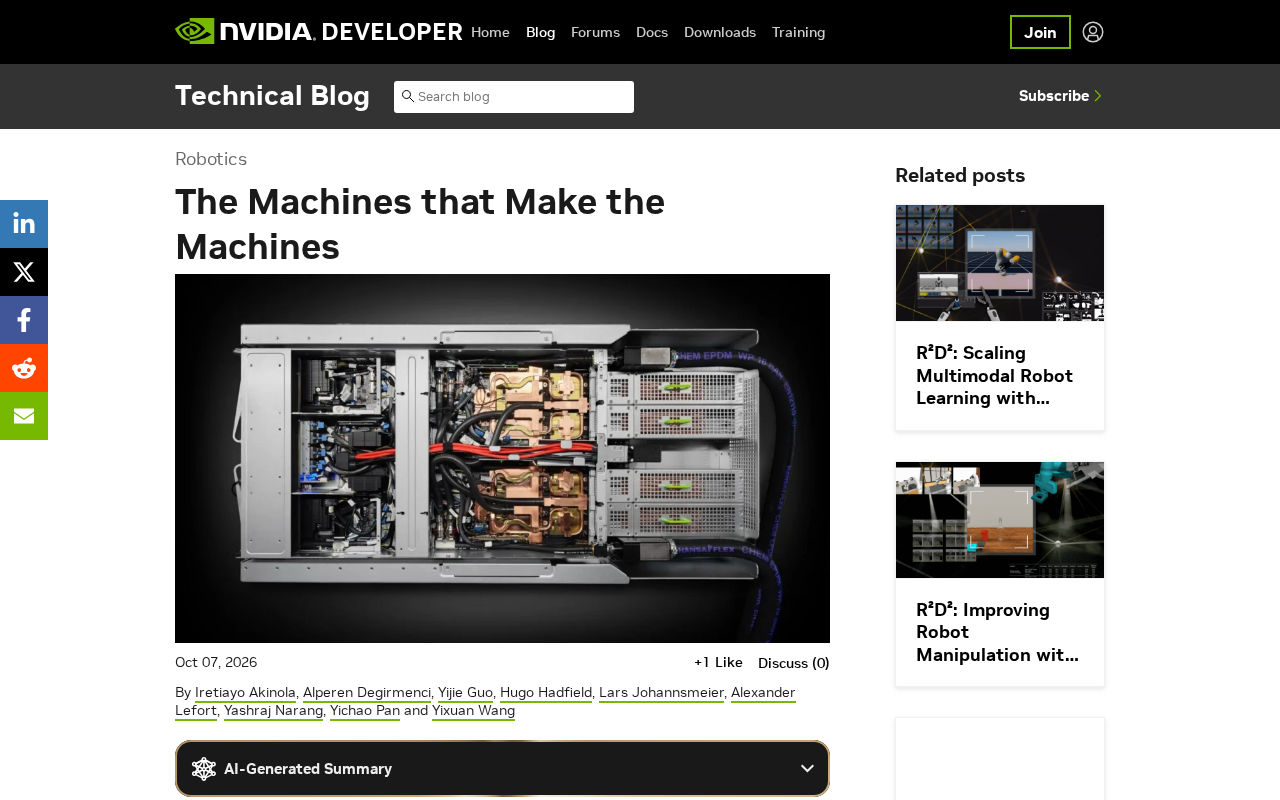
When we talk about AI-driven industrial robots, the conversation tends to center on algorithms and models. But NVIDIA's engineering case study, titled The Machines that Make the Machines, offers a more grounded perspective: in a real manufacturing environment, teaching a robot to assemble a GB300 test tray is not just a machine learning challenge — it's the result of machine learning, mechanical intelligence, and good old-fashioned engineering working in concert.
The Real Challenges of Robot Learning in Assembly Tasks
Assembling a tester tray might look like simple, repetitive insertion work to a human operator, but for a robot it's a highly complex systems engineering problem. The central narrative of the original article revolves around "how we taught the robot to do this" — and it exposes a fundamental tension in deploying industrial robots: there is a vast gap between laboratory algorithms and the physical realities of the production line.
During grasping, alignment, and insertion, a robot must contend with tolerance stack-up, minor part deformation, and contact force feedback — all sources of uncertainty. A purely software-centric approach that relies on visual recognition plus path planning often falls short, which is precisely why the article emphasizes the concept of mechanical intelligence.
Tolerance stack-up is a foundational concept in precision assembly engineering. It refers to the phenomenon where dimensional errors across multiple parts or process steps accumulate, causing the final assembled position to exceed the allowable range. Even if each individual part is within tolerance, when a dozen parts are mated in sequence, individual ±0.05 mm errors can compound into a ±0.5 mm total deviation — enough to cause an insertion failure. For robots, this problem is especially acute: the repeatability error of the robotic arm, the gripping error of the end effector, and the positional variation of parts in the tray all stack simultaneously. This is exactly why open-loop path planning (following a preset trajectory without real-time feedback) naturally fails in such tasks, and why closed-loop strategies like force control and visual servoing are indispensable in high-precision assembly.
Mechanical Intelligence: The Underrated Engineering Wisdom
One of the article's key arguments is that a robot's "intelligence" doesn't reside solely in its brain (the algorithm) — it also lives in its body (the mechanical structure). Mechanical intelligence refers to the use of clever fixture design, compliant mechanisms, and passive alignment structures to resolve complexity at the hardware level, before software even gets involved.
For example, a chamfered guide on an insertion structure can allow a part to self-locate into the correct position upon contact, dramatically reducing the reliance on precise visual localization and force-control algorithms. This philosophy of "embedding intelligence into the mechanism" is the hallmark of seasoned mechanical engineers — yet it is frequently overlooked in today's technology discourse, which tends to overemphasize deep learning.
Compliant mechanisms are a key component of mechanical intelligence and deserve a closer look. They use the elastic deformation of materials to transmit motion or absorb error, without requiring additional sensors or active control. A well-known example in industrial assembly is the Remote Center Compliance (RCC) device — a passive adaptation tool specifically designed for peg-in-hole tasks. When a workpiece experiences lateral offset or angular deviation, the RCC automatically compensates by converting lateral forces into self-aligning motion. Originally developed by MIT's Draper Laboratory in the 1970s, these devices remain standard equipment in precision assembly today. Compared to "active compliance" solutions that depend on torque sensors and real-time control algorithms, passive compliant structures are lower cost, faster in response, and less prone to failure — embodying the engineering philosophy of "letting the laws of physics do the computing."
The Synergy of Machine Learning and Traditional Engineering
The original article's title deliberately juxtaposes three concepts: robot learning, mechanical intelligence, and good old-fashioned engineering. This triad is the thesis of the entire piece.
Real-world industrial deployment is not an either/or choice. Machine learning excels at perception and generalization — recognizing subtle differences between production batches, adapting to changes in ambient lighting. Traditional engineering, on the other hand, offers irreplaceable value in determinism, reliability, and cost control. The most effective solutions let learning algorithms handle variables that are difficult to model in advance, while leaving problems that can be addressed through mechanical design to the hardware itself.
This division-of-labor mindset is highly instructive for any team trying to introduce AI into manufacturing: don't try to brute-force every problem with algorithms. First ask, "Can this challenge be eliminated by improving the hardware design?"
Implications for Industrial AI Deployment
As a high-performance computing product from NVIDIA, the GB300's test tray automated assembly represents a classic high-precision, low-volume scenario. This is precisely the kind of use case where robot learning is both hardest to crack and most valuable — volume is insufficient to amortize the cost of fully custom automation, yet precision requirements exceed the capability of traditional teach-pendant programming.
Several generalizable lessons can be drawn from this case. First, training data and simulation environments for robot learning must closely reflect physical reality; otherwise, the Sim-to-Real gap will erode any algorithmic advantage. Second, hardware and software must be co-designed rather than developed sequentially. Third, manufacturing engineering intuition remains a precious asset that purely data-driven methods cannot replace.
Sim-to-Real (simulation-to-reality) transfer is one of the core challenges in robot learning. It refers to the significant performance drop that occurs when a model trained in simulation is deployed on real hardware. The root cause is the reality gap: simulation engines systematically mismodel friction, contact dynamics, material deformation, and light reflection. Common mitigation strategies include domain randomization (randomly perturbing simulation parameters during training to improve generalization), domain adaptation (fine-tuning the model with a small amount of real-world data), and building higher-fidelity physics simulation environments. For assembly tasks, the accuracy of contact force simulation is especially critical — insertion actions depend heavily on force feedback at the millinewton scale, which is precisely what current mainstream simulation engines struggle most to reproduce accurately.
Closing Thoughts
The Machines that Make the Machines does not offer a flashy algorithmic breakthrough. Instead, it delivers an honest engineering retrospective. It reminds the industry that the true threshold for robot intelligence is rarely about model parameter scale — it lies in the ability to integrate machine learning, mechanical design, and solid engineering fundamentals into a coherent whole. For practitioners exploring industrial AI, this pragmatic, multidisciplinary perspective may ultimately be more valuable than chasing the latest model.
(Note: This article is based on materials from the NVIDIA Developer Blog. As details in the original source are limited, portions of this analysis represent reasonable extrapolation from the title and abstract.)
Related articles

Chain of Thought Isn't Just for AI: How Humans Can Use CoT to Improve Thinking Quality
Chain of Thought isn't just a prompt trick for large models. Starting from a Hacker News discussion, this article analyzes why CoT works for human thinking too, breaks down actionable ways to transfer it, and highlights the key differences between human CoT and machine CoT.
Cloudflare Teams Up with OpenAI: Closi…
Cloudflare Teams Up with OpenAI: Closing the Loop from Vulnerability Discovery to Defense with AI
Cloudflare uses OpenAI Daybreak to investigate security vulnerabilities and generate reviewable remediation plans, while developers use Codex to boost coding efficiency and quality.

Orca Multi-Agent Orchestration in Practice: A Guide to Parallel Collaboration with Claude and Codex
Orca is Stable AI's free open-source agent workbench supporting 34 agents like Claude Code and Codex in parallel. Learn its Git worktree isolation, multi-model orchestration, and mobile management.