Team's Sprint Clears in Days After Adopting Claude: The Hidden Risks Behind Skyrocketing Dev Efficiency

Claude helped a dev team clear Sprints in days — revealing a deeper shift from execution to judgment.
A tech lead posted on Reddit that after adopting Claude, Sprints that once took weeks now clear in days — sparking not celebration, but a scramble for new work and endless planning meetings. The real issue isn't efficiency; it's that the bottleneck has shifted from writing code to deciding what to build, exposing a shallow product roadmap. Teams need to recalibrate Sprint estimates, pay down technical debt, and recognize that as AI accelerates implementation, the scarce skill becomes judgment — not coding speed.
A Real Development Team's Dilemma
A tech lead managing an enterprise systems development team shared a fascinating phenomenon on Reddit: ever since their team started using Claude, Sprints that used to take weeks are now being cleared in just a few days.
This team lead manages multiple enterprise systems built primarily on Python and TypeScript, handles large-scale data processing, and works extensively with DevOps and microservices architecture. Improved development efficiency should be a good thing — yet the way they described it carried an unmistakable note of awkwardness and unease: "Things have gotten a bit weird. Sprints are clearing in days, not weeks. We're running out of work, and product management is scrambling to find us more tasks. I'm spending most of my time in planning meetings."
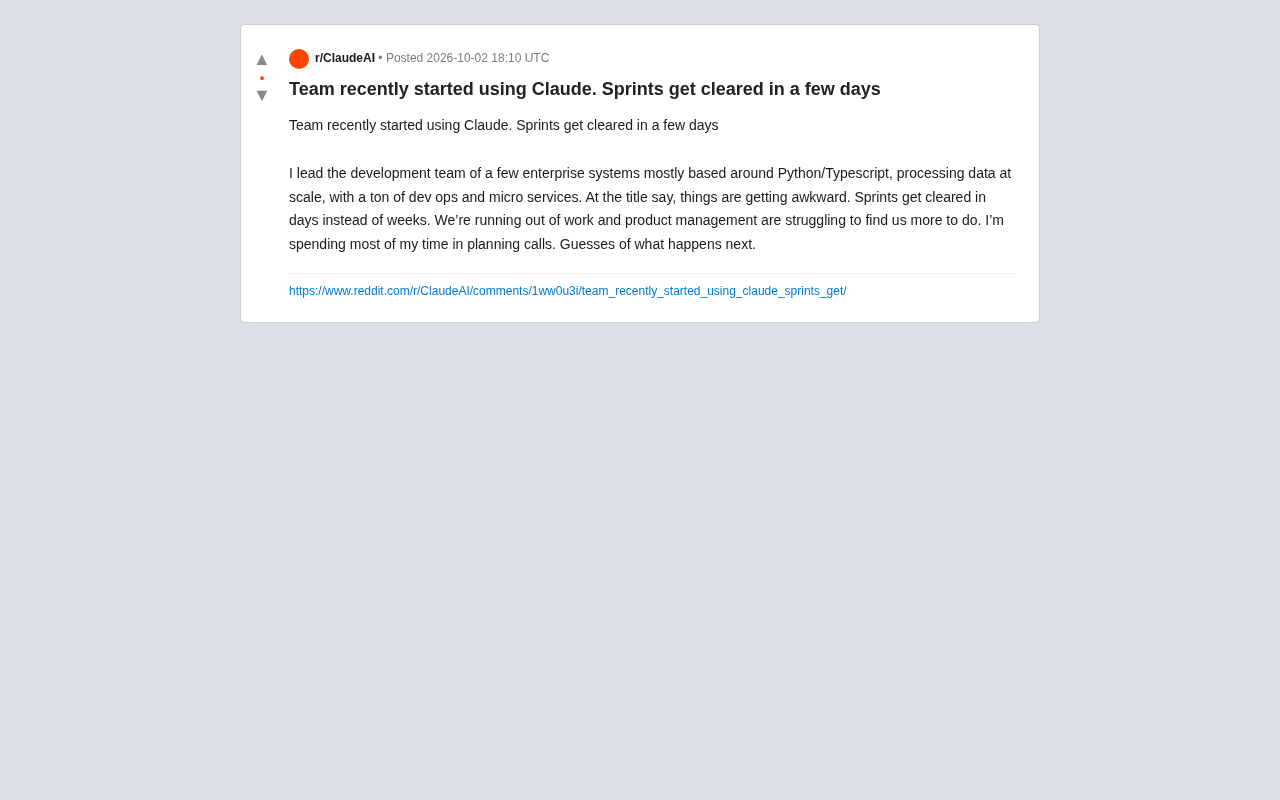
They ended with an open question: what happens next? It's not just a personal puzzle — it reflects a structural shift the entire software development industry is now confronting.
The Real Signal Behind the Efficiency Surge
Sprints clearing in days is a phenomenon worth unpacking. In traditional agile development, Sprint cycles typically run two to four weeks, with teams estimating workload based on historical velocity. When AI coding tools dramatically compress actual development time, the existing estimation model gets completely thrown off.
A few key points deserve attention here. First, the productivity gains are real. Enterprise-grade Python/TypeScript projects, large-scale data processing, microservices, and DevOps — these happen to be areas where AI coding assistants currently perform well: clear specifications, repeating patterns, and abundant boilerplate code. Claude can deliver several times the efficiency when generating this kind of code, writing tests, and handling configuration files.
Second, the bottleneck has shifted from "writing code" to "deciding what to write." When implementation speed is no longer the constraint, product management becomes the new bottleneck. The team lead mentions spending "most of my time in planning meetings" — a sign that the team's center of gravity is moving from execution toward requirements definition and prioritization.
Velocity is the core agile metric measuring how much work a team completes in a single Sprint, typically calculated in Story Points. A team's historical velocity — accumulated across multiple Sprints — forms the foundation for planning and aligning delivery cadence with the product side. When AI tools cut actual coding time by several times, historical velocity data loses its reference value. The same number of story points might now take a quarter of the original time, causing Sprints to end early and backlogs to get consumed rapidly. This "calibration failure" isn't unusual: any major leap in productivity technology (like adopting a new framework or automated testing tools) temporarily disrupts established rhythms. The difference is that AI coding assistants produce changes of greater magnitude and propagate them faster, requiring organizations to proactively rebuild estimation baselines rather than waiting for data to naturally converge.
The Organizational Problem Revealed by Excess Capacity
The phrase "running out of work" actually exposes an organizational problem, not a technical one.
If a team has nothing to do because of efficiency gains, it suggests the product roadmap was never all that deep — and the pipeline of requirements was never all that wide. Before AI tools arrived, these issues were hidden behind a slower development pace; the product team had plenty of time to plan the next batch of requirements. Now that development has sped up, the supply-side shortfall becomes immediately visible.
Looked at from another angle, this is actually an opportunity to reallocate resources. Technical debt, refactoring, performance optimization, monitoring improvements, and documentation work — all the things put off because there was "no time" — now have room to be addressed. A truly mature team won't panic when a Sprint clears early; instead, they'll proactively direct the surplus capacity toward this kind of long-term value work.
What Might Happen Next
For the original poster's question — "what happens next?" — the answer can be traced across several timescales.
Short Term: Role and Process Adjustments
Day-to-day developer work will skew more toward architecture design, code review, and requirements clarification rather than pure coding. More planning meetings are inevitable, since teams need to align on direction more frequently. Teams will likely need to recalibrate their Sprint workload estimation baselines — otherwise every planning session will repeatedly encounter "underestimation."
Medium Term: Changes in Team Structure
When output per unit of time increases significantly, the developer headcount theoretically needed to meet the same business demand goes down. This creates latent pressure on team size — either business expansion absorbs the surplus capacity, or the team faces structural adjustment. For individual developers, the compound skills of defining problems, managing quality, and understanding the business become rarer and more valuable than raw coding speed alone.
Long Term: Reshaping the Value Chain
The value in software development is migrating from "implementation" to "judgment." Whoever can ask the right questions, design sound systems, and carefully validate AI-generated output holds the strategic high ground. The faster AI generates code, the higher the bar becomes for quality assurance, security review, and system design — because errors can be amplified just as quickly.
Microservices architecture is an architectural pattern that decomposes a single application into a set of small, independently deployable services, each focused on a single business capability and communicating via APIs or message queues. This approach is widely adopted in large enterprise systems because it improves scalability and team autonomy — but also introduces complexity around service dependency management, distributed tracing, and configuration consistency. AI coding assistants are especially effective in microservices contexts: generating boilerplate service scaffolding, writing contract tests, handling repetitive Infrastructure-as-Code (IaC) configurations. But this also means errors can propagate across multiple services even faster. As a result, AI-augmented microservices teams actually face higher — not lower — demands around integration testing, service boundary design, and change management.
A Few Recommendations for Team Leads
Faced with this "happy problem," the better move is to go on the offensive rather than passively waiting for product to hand you work:
- Clear technical debt: Bring long-neglected refactoring, test coverage improvements, and dependency upgrades onto the roadmap.
- Invest in infrastructure: Improve CI/CD pipelines, monitoring and alerting, and automated operations — investments that will continue to amplify team capacity.
- Reassess your process: Sprint cadence, estimation methods, and collaboration practices all need to be redesigned to match the new productivity level.
- Strengthen quality gates: AI output requires rigorous review; establish code quality gates and automated security scanning mechanisms.
- Get closer to the business: Help the development team develop a deeper understanding of business goals, actively participate in requirements definition, and stop waiting to be fed work.
What this Reddit user is experiencing may well be what a large number of development teams face over the next few years. AI coding tools don't just change efficiency numbers — they represent a deep restructuring of how software development organizations are shaped, how roles are defined, and how value is measured. Whether teams navigate this well depends on whether they treat it as a threat or as an opportunity to redefine what they bring to the table.
Related articles

Why Do AI Models Think Humans Are "Immoral Sheep"?
AI models tend to see humans as blind sheep in moral reasoning, sparking Hacker News debate. This article analyzes the data sources, psychological basis, and AI ethics implications of this pessimistic judgment.

Databricks Real-Time Energy Trading Analytics: What's Needed Beyond Speed
An analysis of Databricks' real-time energy trading and analytics solution: streaming ingestion, Delta Lake storage, unified feature and model governance, and the traceability, elasticity, and decision-loop capabilities trading desks truly need beyond speed.

Spark Declarative Pipelines: Data Infrastructure Built for Agents
Original article reveals over 70% of production Spark Declarative Pipelines are written by AI agents. Analysis of why declarative pipelines suit agent generation and verification better than imperative, and practical implications for data team framework selection.