TechCrunch Disrupt 2026 Final Day: Save 75% on Early Bird Tickets

TechCrunch Disrupt 2026 offers a 75% discount on its final registration day, with high-density offline connections among 10,000+ tech leaders as the core value.
Registration for TechCrunch Disrupt 2026 enters its final day, with an official 75% discount on passes and an expected gathering of more than 10,000 tech leaders. The article argues that the core value of such conferences lies in high-density offline random connections, especially for AI application-layer founders in financing, enterprise customer outreach, or early hiring windows. Deep discounts usually mean the organizer is pushing attendance and marginal acquisition costs are low, making this a low-cost entry opportunity for budget-constrained early teams. However, public information has not yet disclosed the agenda, speakers, or AI breakout session details, so buyers must decide with incomplete information. The article suggests quickly judging whether to buy a ticket based on goal fit and time cost.
TechCrunch Disrupt 2026 Enters Its Final Registration Day
Registration for TechCrunch Disrupt 2026 is about to close. According to the official RSS announcement, today is the last chance to join this tech gathering. The event will bring together more than 10,000 tech leaders, giving participants the opportunity to absorb industry insights and build high-value connections in a single day.
This registration milestone did not reveal further details about the agenda, speakers, or specific breakout sessions, but the positioning of "10,000+ tech leaders" itself sends a signal: Disrupt remains a线下 (offline) connection venue that startups, investors, and big-company strategy teams cannot afford to ignore.
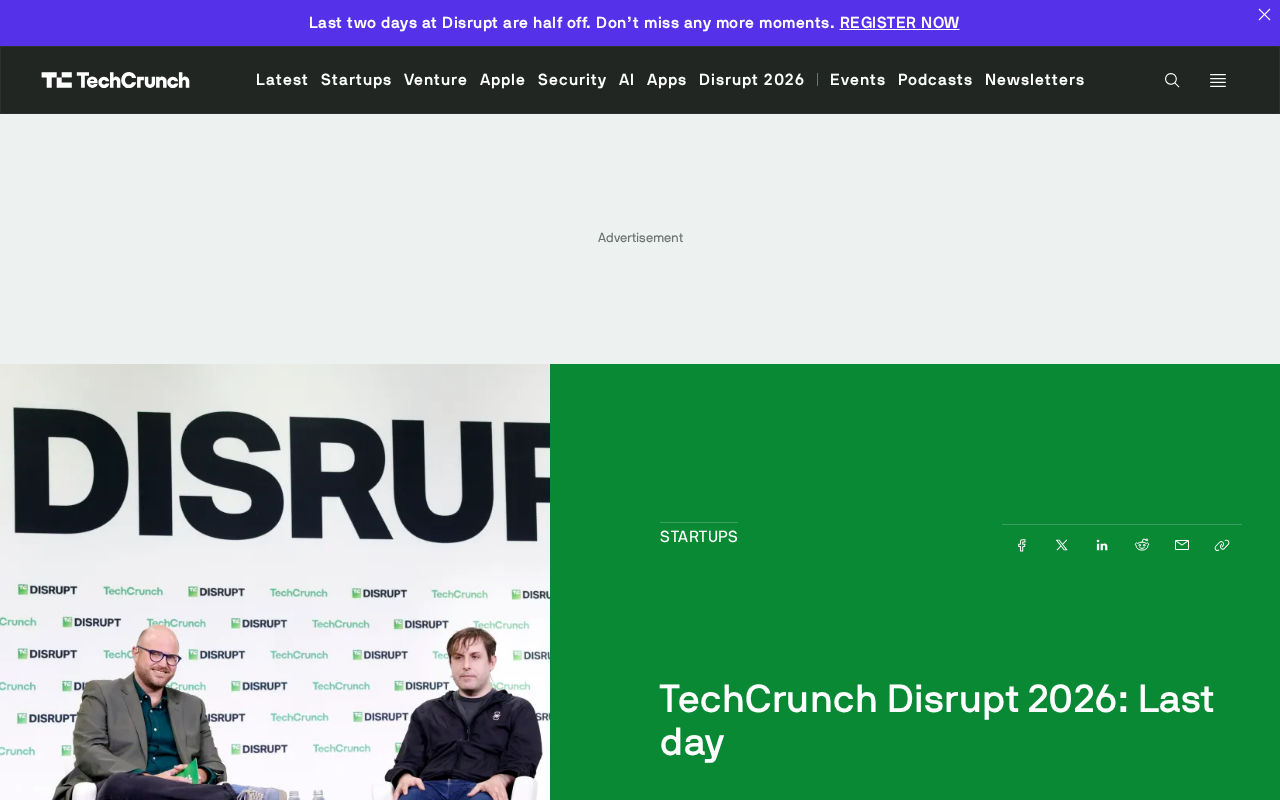
TechCrunch Disrupt is the flagship startup and technology conference hosted annually by tech media outlet TechCrunch since 2011, and it has long been regarded as one of the bellwethers of the global startup ecosystem. Its regular programming includes the Startup Battlefield competition, investor matchmaking sessions, and keynote speeches from big-company executives. Companies such as Dropbox and Minecraft have used this stage to gain early exposure. Disrupt is typically held in San Francisco, and its attendees are mainly early-stage founders, venture capitalists, corporate innovation teams, and tech media. Its core value therefore lies not just in the agenda content, but in bringing capital, talent, and distribution together into the same physical space. Understanding this background helps clarify what the scale figure of "10,000+ tech leaders" actually means: it is connection density, not merely audience size.
What the 75% Discount Means
Official information shows that current ticket purchases can save 75% of the cost. A discount of this magnitude is uncommon among comparable tech conferences.
From a pricing strategy perspective, such deep discounts close to the opening usually occur in two scenarios: first, the organizer wants to push attendance numbers in the final stretch; second, the preparation costs for the on-site experience have already been largely covered by major sponsors, lowering the marginal cost of acquiring attendees. Whichever the case, for early-stage teams with limited budgets that want access to the core circle, this is a low-cost window to enter.
It is important to note that the discount applies only to passes, not to travel or accommodation. Attendees still need to evaluate the total cost on their own.
Tech conference ticket pricing is usually tiered: Early Bird, regular tickets, last-minute rush tickets, and discounted tickets for students or startup teams. Unlike consumer goods, conference ticket pricing has a special marginal cost structure—fixed costs such as venue, stage, and catering are largely locked in before the event opens, and the incremental cost of one more attendee is very low. Therefore, offering a large discount in the final stage does not significantly erode profit; instead, it can expand on-site attendance and increase the exposure value for sponsors. A 75% discount is a rare level of generosity in the industry, often meaning two things are true at once: seats have not yet sold out, and the organizer values headcount scale for external partners more than revenue from individual tickets. For buyers, this also explains why the period right before the event may actually be the lowest-price window.
The Networking Value of 10,000+ Attendees
The core selling point of the Disrupt series has never been just the stage content. An offline gathering of 10,000 people means high-density opportunities for random connections.
For founders building at the AI application layer, the value of such events is especially concentrated in three scenarios: finding seed-round investors, connecting with potential enterprise customers, and recruiting early technical talent. Compared with online Demo Days, informal conversations at an offline venue often lead to faster trust-building.
Of course, scale also brings filtering costs. Finding the truly relevant people among 10,000 attendees requires planning a target list and route in advance.
Demo Day refers to the concentrated pitch event organized by an incubator or accelerator when a program concludes, where startup teams present their products to investors and media in sequence, with a highly standardized format and strictly segmented time. In contrast, an offline conference like Disrupt offers unstructured interaction: in hallways, at booths, and at after-parties, there is no fixed agenda, and both parties can form an initial judgment within minutes and decide whether to go deeper. Sociologists studying startup networks have long pointed out that weak ties—that is, casual acquaintances rather than close contacts—often bring the most critical financing and hiring information, and high-density offline events are efficient generators of weak ties. This is also why online Demo Days cannot fully replace offline venues: trust-building depends on nonverbal signals and immediate feedback, which are significantly weakened in video conferencing.
Action Advice for the Final Day
If you are considering whether to buy a ticket, you can quickly judge from two dimensions:
- Goal fit: Is your product stage in a window where it needs external capital or channel partnerships?
- Time cost: Can a one-day event cover your three most urgent unresolved problems right now?
If both answers are yes, the 75% discount makes the decision threshold much lower. If the answers are no, missing this one will not cause substantial loss.
The final-day registration window is usually calculated in Pacific Time. It is recommended to rely on the countdown shown on the official page to avoid missing the deadline due to time zone differences.
Information Gaps Beyond Registration
As of publication, public information has not yet disclosed the specific agenda, keynote lineup, or AI-related breakout session arrangements for this year's Disrupt. For content-oriented attendees, the absence of this information increases decision uncertainty.
Based on the pattern of past Disrupt events, the full agenda is usually published only close to the opening. If the organizer continues this rhythm, ticket buyers will need to make a judgment with incomplete information. This is also one reason the final-day discount strategy works—using a price incentive to offset information uncertainty.
One-line Summary
TechCrunch Disrupt 2026 offers a 75% discount on its final registration day, with high-density offline connections among 10,000+ tech leaders as the core value.
Paragraph Summary
Registration for TechCrunch Disrupt 2026 enters its final day, with an official 75% discount on passes and an expected gathering of more than 10,000 tech leaders. The article argues that the core value of such conferences is not the stage content, but high-density offline random connections, especially for AI application-layer founders in financing, enterprise customer outreach, or early hiring windows. Deep discounts usually mean the organizer is pushing attendance and marginal acquisition costs are low, making this a low-cost entry opportunity for budget-constrained early teams. However, public information has not yet disclosed the agenda, speakers, or AI breakout session details, so buyers must decide with incomplete information. The article suggests quickly judging whether to buy a ticket based on two dimensions: goal fit and time cost.
Related articles

DeepCell: One-Click AI Generation of Documents, Spreadsheets, and Slides
DeepCell tops Product Hunt with one-click generation of documents, spreadsheets, and slides, using the .deepcell format for linked updates, designed for System 2 tasks like modeling and sales reviews.

Doneas: 15-Minute Daily Accountability Calls That Keep Indie Developers From Procrastinating
Doneas is a daily accountability tool for indie developers: plan tasks on Monday, join a 15-minute call with five builders each day, and log deliveries on a public progress page. This article analyzes its core mechanics, effectiveness, and potential issues around retention and matching.

Fastlane 2.0: Fully Automated AI Ad Campaigns, From Creative to Optimization
Fastlane 2.0 is an AI ad automation tool: enter your website and it learns your brand, generates video and image ads, and runs and optimizes them on Meta, TikTok, Instagram, and YouTube.