TechCrunch Disrupt 2026: Five AI Safety Sessions Every Founder Should Attend

TechCrunch Disrupt 2026 spotlights AI safety with Anthropic, NVIDIA, and more — a must for founders.
TechCrunch Disrupt 2026 has lined up five dedicated AI safety sessions across its AI Stage and Real World AI Stage, featuring practitioners from Anthropic, NVIDIA, AWS, and Waabi. The article argues that AI safety has evolved from a compliance burden into a strategic issue affecting product credibility and business sustainability. The speaker lineup spans model alignment, compute infrastructure, cloud governance, and real-world autonomous driving — mapping out AI safety as a systemic challenge. Founders are encouraged to engage with both model-level risk control and high-stakes deployment practices. Early registration before September 25 saves up to $200.
Why AI Safety Is Now a Founder's Core Curriculum
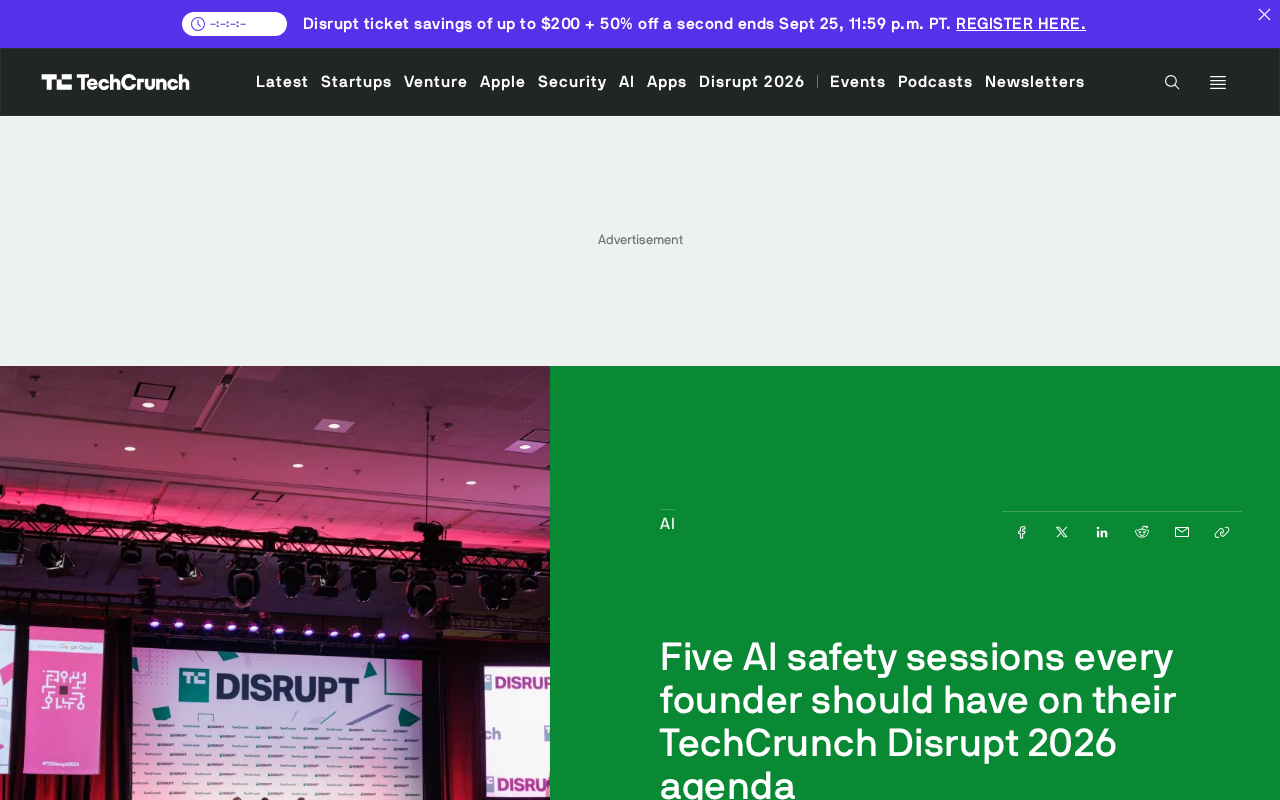
As large model capabilities advance rapidly, AI safety has moved from the fringes of research labs to the center of every tech founder's agenda. At the upcoming TechCrunch Disrupt 2026, organizers have scheduled five sessions dedicated to AI safety across two stages — the AI Stage and the Real World AI Stage — bringing together industry leaders from Anthropic, NVIDIA, AWS, Waabi, and other top institutions.
For founders, AI safety is no longer just a compliance burden. It's a strategic concern that touches product credibility, business sustainability, and regulatory risk. Understanding safety boundaries and mastering responsible deployment practices are becoming foundational skills for building AI products.
Industry Signals Behind the Five Sessions
These five sessions span two stages and cover the full spectrum from foundational model safety to real-world deployment. The speaker lineup is notably representative:
- Anthropic, a model company with AI safety at the core of its mission, typically focuses on alignment and controllability;
- NVIDIA brings safety considerations at the compute and infrastructure layer;
- AWS approaches safety governance from the angle of cloud platforms and enterprise-scale deployment;
- Waabi, as a representative of the autonomous driving space, contributes safety practices from high-stakes, real-world scenarios.
This combination of speakers is no accident. It reflects how AI safety has evolved from a single-model problem into a systemic challenge that cuts across compute, platforms, and applications. Founders looking to build a moat in this space need to understand the different layers of the technology stack simultaneously.
Alignment is one of the core concepts in AI safety — it refers to the body of techniques and methodologies for ensuring that an AI system's goals and behaviors remain consistent with human intent and values. As large models grow more capable, there's a risk of models that "appear to follow instructions on the surface while pursuing hidden objectives." Alignment research exists to address these potential loss-of-control problems. Anthropic has invested heavily in this area; its proposed "Constitutional AI" method improves model controllability through rule-based constraints and self-critique training. For founders, understanding alignment means that when choosing a foundational model, you need to look beyond capability benchmarks and evaluate how predictably the model behaves at edge cases — this directly affects your product's safety credentials and enterprise customers' purchasing decisions.
From Model Alignment to Real-World Deployment
The AI Stage leans toward frontier model capabilities and safety research, while the Real World AI Stage emphasizes safe deployment in actual business scenarios. This dual-track design has strong practical relevance for founders.
On one hand, understanding alignment and risk control at the model layer helps founders assess the reliability of underlying technology. On the other hand, the hands-on experience from companies like Waabi in autonomous driving demonstrates how AI systems can operate robustly and verifiably in real-world environments where safety is literally a matter of life and death. For any team looking to commercialize AI capabilities, neither dimension can be ignored.
Waabi is an autonomous driving company founded by Raquel Urtasun, former Chief Scientist at Uber ATG, known for its "AI-first" technical approach — centered on replacing the heavy manual labeling and rule-writing typical of traditional autonomous driving with large-scale simulation and generative world models. Autonomous driving is one of the most demanding scenarios in AI safety: system errors can cost lives, and regulators place extremely high demands on verifiability and explainability. Waabi's safety validation methodology accumulated through real-world road testing — including how to define quantitative standards for "safe enough" and how to handle long-tail edge cases in open-world environments — offers a valuable reference for any team building high-stakes AI applications in healthcare, finance, or industrial control.
Attendance Tips and Discount Information
According to organizer information, registering before September 25 can save you up to $200 on ticket prices. For founders who are building AI products or planning to enter the space, these five safety sessions offer a rare opportunity to gain first-hand insights directly from practitioners at leading institutions.
One note of caution: this article is based on pre-conference announcement information, and the specific agenda is subject to official releases. We recommend following TechCrunch's official channels for the complete speaker roster and schedule.
Takeaway
AI safety is rising from a technical topic to a startup strategy topic. TechCrunch Disrupt 2026 brings together practitioners from different layers of the stack — Anthropic, NVIDIA, AWS, Waabi — across five dedicated sessions, giving founders a window into the AI safety ecosystem as a whole. For teams that want to get ahead of the responsible AI wave, this is unmistakably content worth adding to your calendar.
Related articles

Chain of Thought Isn't Just for AI: How Humans Can Use CoT to Improve Thinking Quality
Chain of Thought isn't just a prompt trick for large models. Starting from a Hacker News discussion, this article analyzes why CoT works for human thinking too, breaks down actionable ways to transfer it, and highlights the key differences between human CoT and machine CoT.
Cloudflare Teams Up with OpenAI: Closi…
Cloudflare Teams Up with OpenAI: Closing the Loop from Vulnerability Discovery to Defense with AI
Cloudflare uses OpenAI Daybreak to investigate security vulnerabilities and generate reviewable remediation plans, while developers use Codex to boost coding efficiency and quality.

Orca Multi-Agent Orchestration in Practice: A Guide to Parallel Collaboration with Claude and Codex
Orca is Stable AI's free open-source agent workbench supporting 34 agents like Claude Code and Codex in parallel. Learn its Git worktree isolation, multi-model orchestration, and mobile management.