TechCrunch Disrupt 2026 Main Stage Lineup Revealed

TechCrunch Disrupt 2026 main stage spotlights brain-computer interfaces, Hollywood capital, and top VCs, mapping the triangular tension of tech, capital, and market.
TechCrunch Disrupt 2026 has announced its full main stage agenda, spanning brain-computer interfaces, Hollywood's entry into tech investment, and top-tier VC methodologies. Neuralink co-founder Max Hodak will discuss the commercialization path for neural engineering after founding Science Corp. Actor Mark Wahlberg's participation signals Hollywood capital's accelerating push into tech. Benchmark partners may address whether the 'betting on people' philosophy still holds in the AI era. The underlying theme: the tension between technological breakthroughs and capital logic.
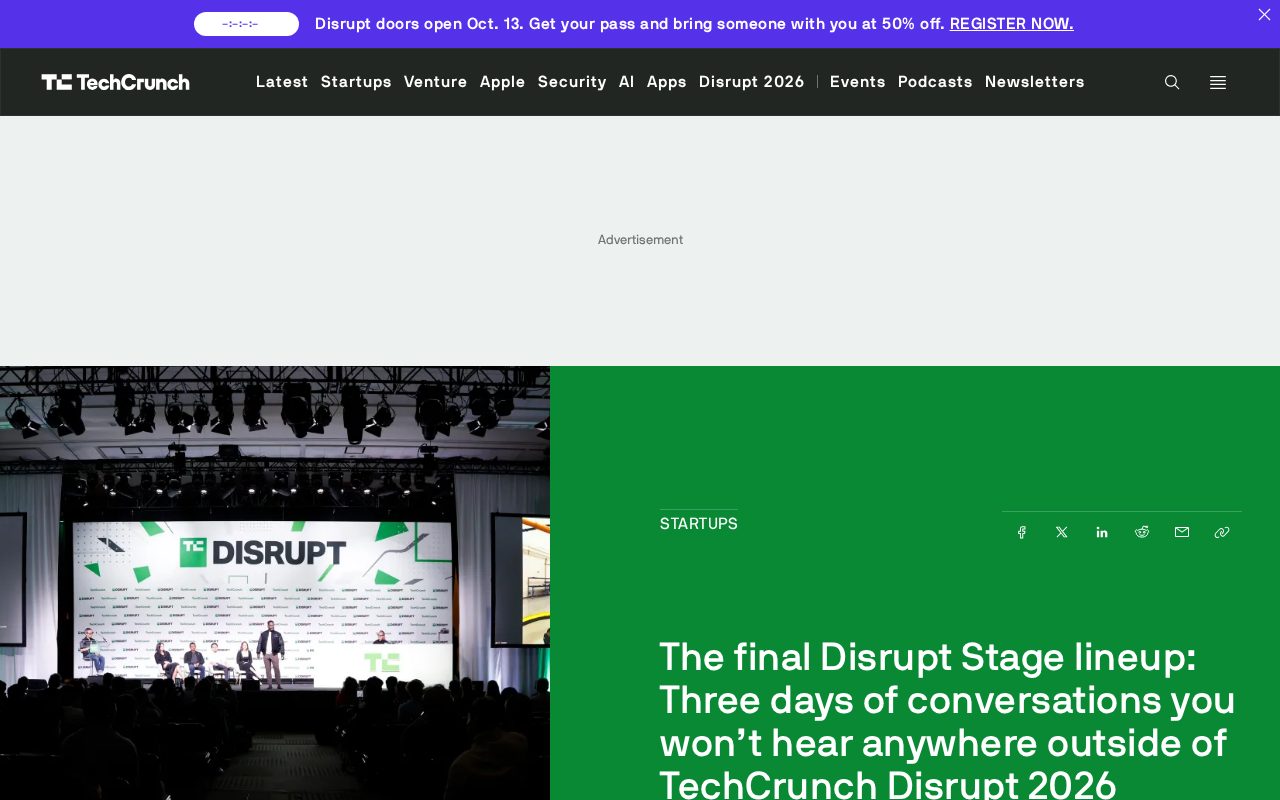
TechCrunch Disrupt 2026's main stage (Disrupt Stage) full agenda has just been announced, and the organizers describe this year's lineup as "three days of conversations you won't hear anywhere else." This isn't just another tech conference — from brain-computer interfaces to Hollywood capital, from top-tier VC methodologies to startup survival stories, this year's topics span a wider range than ever before and are more willing to wade into controversial territory.
Main Stage Speakers: Who's On Stage and Why It Matters
Max Hodak: The "Rebel" of the Brain-Computer Interface Race
Max Hodak's name has always carried a certain distinction in the brain-computer interface field. As a co-founder of Neuralink, he went on to found Science Corp. after leaving, pursuing a technological path entirely different from the Musk ecosystem. According to TechCrunch, Hodak will share his assessment of the commercialization prospects for neural engineering on the Disrupt Stage.
The value of this appearance isn't in the label of "former Neuralink executive" — it's that he represents a fork in the road: should brain-computer interfaces prioritize medical restoration, or head straight toward human enhancement? The industry has yet to reach consensus on this question, and Hodak has always held a strong stance.
Brain-Computer Interface (BCI) refers to the technological framework that establishes a direct communication pathway between the brain and external devices. The core principle involves electrode arrays capturing neuronal firing signals, which are then translated into commands capable of driving external devices through decoding algorithms. Current mainstream approaches fall into two categories: invasive and non-invasive. Invasive methods (such as Neuralink's flexible electrode thread approach) offer high signal quality but carry significant surgical risk, while non-invasive methods (such as EEG headsets) are safer but have limited resolution. Science Corp. is taking a third path — using endovascular or optical approaches to achieve high-channel-count recording, attempting to strike a balance between signal quality and surgical invasiveness. The commercialization challenge in this field isn't the technology itself, but rather lengthy regulatory approval cycles, limited clinical indications, and uncertain acceptance by payers (both public healthcare and commercial insurance) of high-cost neural implants.
Mark Wahlberg: Hollywood Enters Tech Investment
Actor Mark Wahlberg appearing on a tech conference's main stage might seem like a celebrity appearance at first glance, but given the recent surge of Hollywood capital into AI and consumer tech, his participation feels more like a signal. Wahlberg has made actual investments in fitness tech and health consumer products in recent years, and his conversation will likely center on "how entertainment capital evaluates tech projects."
For entrepreneurs, the practical value of such conversations lies in understanding the decision-making logic of non-traditional VCs — the metrics they prioritize, their tolerance for return timelines, and the weight they give to brand synergy often differ significantly from standard Silicon Valley funds.
Benchmark Partners: An Inside View from a Top-Tier Fund
Benchmark's stature in the venture capital world needs no introduction. This fund, known for its "equal partnership" model and its refusal to scale up, has long been one of Silicon Valley's most contrarian institutions. According to official information, multiple Benchmark partners will participate in conversations.
What's worth watching is how they'll respond to an increasingly pointed question: in the AI investment boom, does the traditional VC philosophy of "betting on people" still hold? When compute, data, and model weights become core assets, the framework for early-stage investment judgment is being re-examined.
"Equal Partnership" is the organizational structure Benchmark has maintained since its founding in the 1990s: all general partners hold equal voting rights and profit-sharing ratios, the fund has no hierarchical investment committee, and it doesn't recruit junior investment staff. This model allows Benchmark to maintain an extremely small team size (typically 5-6 GPs), with each fund's size kept to around $400-500 million, thereby avoiding the return pressure and decision-making rigidity that comes with large-scale capital. As the venture capital industry broadly trends toward platformization and multi-stage coverage, Benchmark's "anti-scaling" stance makes it an industry outlier. But the costs of this model are equally obvious: when portfolio companies enter later funding rounds, Benchmark often lacks sufficient capital reserves to follow on, gradually losing boardroom influence at super-unicorns.
The Implicit Narrative of the Three-Day Agenda
Based on the announced lineup, Disrupt 2026's main stage design has a clear underlying thread: the tension between technological breakthroughs and capital logic.
Brain-computer interfaces represent "how far technology can go," Hollywood capital represents "where the money comes from and where it goes," and Benchmark represents "who has the authority to judge." Where these three lines converge, they actually sketch out the most authentic predicament of today's tech entrepreneurship — the misalignment between technological feasibility, capital patience, and market timing often determines a company's fate more than the technology itself.
TechCrunch emphasized in its announcement that these conversations "can't be heard anywhere else." There's marketing spin in that claim, but it also reflects a fact: Disrupt's main stage has always been known for not shying away from conflict, and the clash of viewpoints between guests often carries more information than solo presentations.
The "betting on people" philosophy is one of the core methodologies of early-stage Silicon Valley investing. Its logical foundation is: at a stage when product and market are unverified, the founder's cognitive ability, execution capability, and adaptability are the only assessable variables. This framework was repeatedly validated in the internet era — early investment decisions for Google, Facebook, and Airbnb were almost all built on "betting on the founder" rather than "betting on the sector." But in the AI era, this logic faces challenges: core resources like compute clusters, data acquisition channels, and foundation model weights are increasingly concentrated in the hands of a few large companies, and startup differentiation comes more from resource integration capability than from purely founder traits. This means investors' due diligence checklists are expanding from "how strong is this person" to "how many GPUs can this person get, can they sign exclusive data agreements, and can they afford the hundreds of millions of dollars per round in model training costs."
Registration Information and Attendance Tips
Officials also released ticketing information: register now to save up to $100 and get a second pass at half price. For entrepreneurs, investors, and tech professionals planning to attend, the early registration discount window is worth noting.
In terms of content density, the three-day agenda covers several of the most active nodes in the current tech industry — AI infrastructure, neural technology, consumer hardware, and structural changes in capital markets. If you're focused on the proposition of "how technology becomes business," several of the main stage conversations should not disappoint.
TechCrunch Disrupt 2026's main stage lineup sends a signal: at a time when the AI narrative dominates, the industry is re-searching for the balance point between technology, capital, and talent. And these three days of conversations may offer some real judgment beyond the headlines.
One-line Summary
TechCrunch Disrupt 2026's main stage focuses on brain-computer interfaces, Hollywood capital, and top-tier VC, sketching the triangular tension between technology, capital, and market.
Paragraph Summary
TechCrunch Disrupt 2026 has announced its full main stage agenda, covering three major dimensions: brain-computer interfaces, Hollywood capital's entry, and top-tier VC methodologies. Neuralink co-founder Max Hodak will share his path toward neural engineering commercialization after founding Science Corp., representing the industry's fork between medical restoration and human enhancement. Actor Mark Wahlberg's participation reflects Hollywood capital's accelerating entry into tech investment, and his non-traditional VC decision-making logic offers reference value for entrepreneurs. Benchmark partners' conversation may touch on the debate over whether the "betting on people" philosophy still holds in the AI era. The article notes that the underlying thread of the three-day agenda is the tension between technological breakthroughs and capital logic — the misalignment between technological feasibility, capital patience, and market timing often determines a company's fate more than the technology itself. Officials also released registration discount information.
Related articles

Chain of Thought Isn't Just for AI: How Humans Can Use CoT to Improve Thinking Quality
Chain of Thought isn't just a prompt trick for large models. Starting from a Hacker News discussion, this article analyzes why CoT works for human thinking too, breaks down actionable ways to transfer it, and highlights the key differences between human CoT and machine CoT.
Cloudflare Teams Up with OpenAI: Closi…
Cloudflare Teams Up with OpenAI: Closing the Loop from Vulnerability Discovery to Defense with AI
Cloudflare uses OpenAI Daybreak to investigate security vulnerabilities and generate reviewable remediation plans, while developers use Codex to boost coding efficiency and quality.

Orca Multi-Agent Orchestration in Practice: A Guide to Parallel Collaboration with Claude and Codex
Orca is Stable AI's free open-source agent workbench supporting 34 agents like Claude Code and Codex in parallel. Learn its Git worktree isolation, multi-model orchestration, and mobile management.