TechCrunch Disrupt 2026 Side Events Go Live: KOTRA, WayFounder, and More Join the Lineup

TechCrunch Disrupt 2026 adds KOTRA and more partners, making side events the go-to venue for real founder networking.
TechCrunch Disrupt 2026 will host a range of partner-led side events beyond the main conference, with new additions including KOTRA, Enterprise Ireland, WayFounder, SafetyWing, and Descope — spanning government trade promotion, accelerators, insurtech, and developer tools. Formats include founder dinners, investor meetups, workshops, and roundtables, offering more focused, smaller-scale settings for meaningful exchange. Organizers encourage attendees to plan proactively: founders should target events aligned with their funding stage, investors can use vertical roundtables to source deals efficiently, and service providers can treat side events as both a branding and customer acquisition channel.
Disrupt Week Goes Beyond the Main Venue
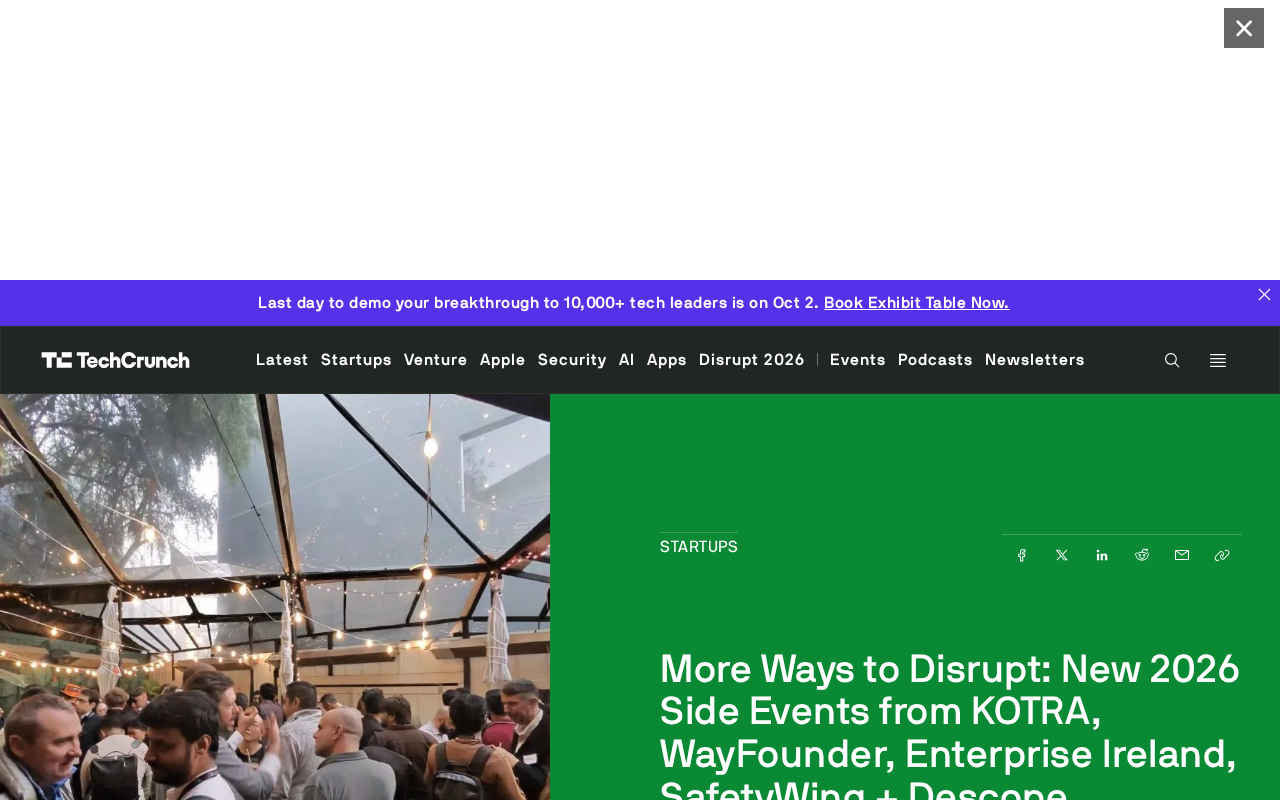
TechCrunch Disrupt has never been confined to the walls of Moscone West. Once the main stage talks wrap up and the booths are packed away, the real networking and relationship-building begins. According to official announcements, a series of partner-hosted side events will take place across San Francisco during Disrupt Week 2026 — spanning founder dinners, investor meetups, happy hours, workshops, and roundtable discussions.
The newly added partners make for an interesting lineup: Korea Trade-Investment Promotion Agency (KOTRA), startup acceleration platform WayFounder, Enterprise Ireland, digital nomad insurance provider SafetyWing, and identity authentication platform Descope. These organizations span government trade promotion, startup incubation, insurtech, and developer tools — reflecting the remarkably broad range of players that the Disrupt ecosystem attracts.
TechCrunch Disrupt is one of Silicon Valley's longest-running startup conferences, held annually in San Francisco since 2011 and one of the most high-profile stages in the global startup ecosystem. Companies like Airbnb, Dropbox, and Yammer all made early splashes through Disrupt's Startup Battlefield competition. The concept of "Disrupt Week" evolved naturally from this dynamic — while the conference itself typically runs two to three days, the investors, founders, and media who converge on San Francisco tend to stay longer, creating an informal "conference week" that generates a wealth of activity beyond the official schedule. KOTRA is a South Korean government agency tasked with promoting trade and foreign investment, helping Korean companies expand into overseas markets. Enterprise Ireland is the Irish government's primary body for supporting domestic companies going international. The fact that both appear on the same Disrupt partner list underscores the sustained interest from Asian and European governments in accessing the U.S. tech ecosystem.
Why Side Events Matter
For the founders, investors, and developers who attend major tech conferences, the most valuable moments are rarely the keynotes on stage — they happen in hallways, at cocktail receptions, and around dinner tables. Side events are prized precisely because they offer smaller, more focused settings that enable deeper conversations.
Take the formats on offer: founder dinners typically bring together entrepreneurs at similar stages, making it easy to swap battle-tested insights; investor meetups open a direct line of communication for teams seeking funding; workshops and roundtables tackle specific topics and deliver actionable knowledge; and happy hours let professional networks grow organically in a relaxed atmosphere.
In short, the main conference floor transmits trends and signals — side events are where those signals get converted into real relationships and collaboration opportunities. For first-time attendees especially, planning ahead for these events can dramatically increase the return on the entire trip.
How Attendees Should Plan
The official advice is straightforward: browse the events on offer, find the communities you belong to, and start building your own schedule. Behind this is a well-established conference methodology — in an information-dense week like Disrupt, passively waiting around usually means missing out. Actively filtering and booking in advance is the move.
The right approach varies depending on your role:
Founders
Prioritize dinners and investor events that align with your sector or funding stage. Invest your limited time in the rooms most likely to spark genuine chemistry.
Investors
Use vertical-themed roundtables and gatherings to efficiently encounter a high volume of early-stage projects and improve your deal-sourcing throughput.
Ecosystem Service Providers
For companies like SafetyWing and Descope, side events serve a dual purpose: brand visibility and direct access to target customers.
Descope is a developer-focused identity and user management platform that offers no-code/low-code authentication flow builders, helping engineering teams quickly integrate login, multi-factor authentication (MFA), and single sign-on (SSO) without building auth infrastructure from scratch. SafetyWing is an insurtech company serving digital nomads and remote workers, offering monthly subscription-based travel health and remote health insurance — a business model built entirely around the emerging class of globally mobile professionals. Both companies' decision to sponsor Disrupt side events makes clear commercial sense: developers and remote-first founders are a core segment of Disrupt's attendee base. For participants, understanding the business logic behind each side event's organizer can help you gauge the likely attendee profile — and make sharper decisions about where to spend your time.
Closing Thoughts
The newly announced partner lineup further illustrates how Disrupt is evolving from a standalone tech conference into a global hub for startup ecosystem networking and commerce. The addition of government trade agencies, accelerators, insurtech, and developer tool companies adds meaningful new dimensions to what the event can offer. If you're planning to attend, now is the time to dig into the event listings and lock in the sessions that matter most to you.
Related articles

Hands-On with the Gemini 4 Argon API: Thinking Levels and Background Mode Explained
A Free Code Camp crash course on the Gemini 4 Argon API: from getting a key and sending your first request to controlling reasoning costs with thinking levels, enabling multi-turn chat with previous_interaction_id, and generating a Breakout game in background mode—plus a Google engineer's take on the model's capabilities.

Reinforcement Learning Takes On Getting Over It: Distributed Training Strategies Behind 63% Progress
A developer uses deep reinforcement learning to tackle Getting Over It. The agent climbs from the bottom to 63% progress but gets stuck at the anvil. The project is open-sourced, using divide-and-conquer training and CPU-only training, seeking community collaboration to break the bottleneck.

Sigma FP2 Released: The World's Smallest Full-Frame Camera Gets Sensor and Screen Upgrades
Sigma launches the FP2 full-frame camera, retaining its smallest-and-lightest design with three key upgrades: improved sensor, articulating LCD screen, and longer battery life—built for portable video creators.