TechCrunch Disrupt 2026: Startup Battlefield 200 Judge Lineup Revealed

Startup Battlefield 200's judge panel is nearly set as 200 elite startups prepare to compete at TechCrunch Disrupt.
TechCrunch Disrupt's annual Startup Battlefield 200 is entering its final stage, with five new venture capitalist judges announced and the full panel nearly complete. Selected from thousands of global applications through multiple rigorous rounds, 200 startups have earned their spots. As a flagship TechCrunch program with alumni like Dropbox and Mint, simply making the cut carries real industry weight. For founders, pitching to seasoned investors is both invaluable practice and a chance to gain exposure. For industry observers, which sectors make it in and what questions judges focus on offer a live read on where investment interest is headed.
Startup Battlefield 200 Enters Its Final Stage
After thousands of applications, multiple review rounds, and hundreds of hours evaluating startups from around the world, TechCrunch Disrupt's highly anticipated Startup Battlefield 200 is entering its most exciting phase. With the latest batch of judges now announced, the full panel is nearly complete. In just a few weeks, 200 carefully selected startups will gather on one stage to compete for the top honor in this premier startup competition.
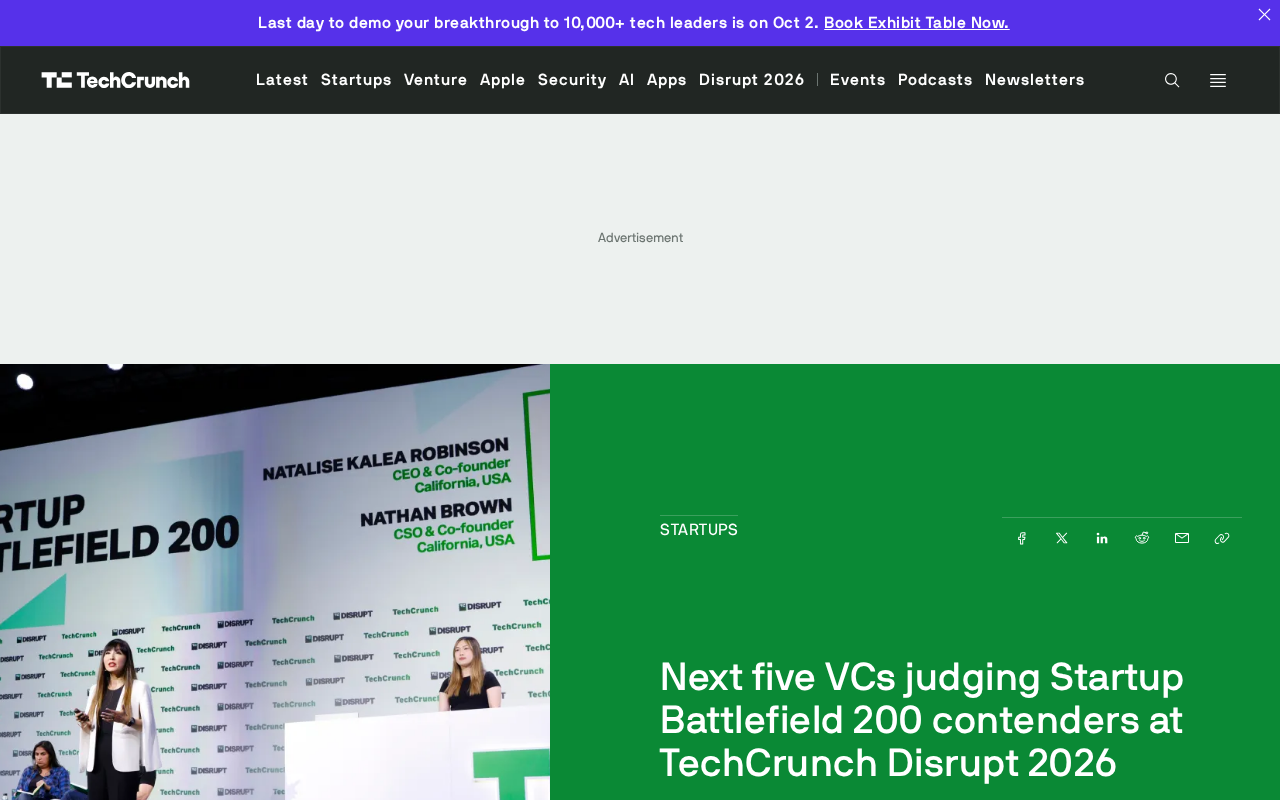
Startup Battlefield is TechCrunch Disrupt's signature program, and over the years it has witnessed the early days of many well-known tech companies. For early-stage founders who make it to this stage, simply being selected is already a signal of industry recognition.
The Weight of the Judge Panel
The announcement of five new venture capitalists (VCs) joining the judging panel means the full lineup is nearly finalized. In the Startup Battlefield format, judges are more than just scorers — they represent the real-world standards that the investment community applies when evaluating startups.
For founders, the opportunity to demo their product and field sharp questions in front of these seasoned investors is an invaluable experience. Each judge's background and investment focus will naturally shape the lens through which they evaluate projects in different sectors — something competing teams would be wise to research in advance.
Venture capitalists play a pivotal role in the tech startup ecosystem. They manage funds backed by institutional investors or high-net-worth individuals and specialize in investing in early- or growth-stage companies with high potential, in exchange for equity. A VC's investment decisions don't just shape the funding trajectories of individual startups — the sectors they focus on often signal where the next technology cycle is heading. In the context of Startup Battlefield judging, seasoned VCs typically zero in on total addressable market (TAM), business model sustainability, team execution, and competitive moats. These are precisely the dimensions founders need to be fully prepared to address in their pitches.
Why Startup Battlefield Is Worth Watching
The selection process alone speaks to the rigor of this competition: thousands of applications filtered through multiple rounds of review, with only 200 companies ultimately making the cut. This high bar ensures the overall quality of competing projects and makes the event a valuable window into global startup trends.
For practitioners, investors, and media following the tech startup ecosystem, Startup Battlefield 200 is more than a competition — it's a live snapshot of emerging technology directions and market opportunities. Which sectors make it in, and which questions judges find most compelling, often reflect the broader investment climate of the moment.
Since its founding in 2007, Startup Battlefield has become one of the most influential showcases for early-stage startups. Among past participants and winners, several have gone on to become industry giants — Dropbox, Mint, and Yammer all made appearances here. For early-stage teams without established brand recognition, making the cut alone can generate significant media exposure and investor attention. The competition is typically structured in preliminary rounds, semifinals, and a final, with teams presenting live demos and fielding Q&A from different judging panels at each stage. The winner receives prize money, but more importantly, concentrated attention from global tech media and the investment community. This format means that even teams that don't take home the top prize often walk away with meaningful connections and market feedback from their time in the competition.
Closing Thoughts
With the judging panel nearly assembled, TechCrunch Disrupt's Startup Battlefield 200 is ready to launch. For founders, this is a rare chance to be seen. For the broader tech industry, the projects and judgments on display will serve as signals worth paying attention to. The complete judge roster and further event details are well worth following as they emerge.
Related articles

Understanding DeepSeek in 3 Minutes: The Rise from a Quant Hedge Fund to an Open-Source AI Leader
DeepSeek's history in 3 minutes: from High-Flyer Quant's compute build-up to V2's MLA inference cost cuts, V3's $5.576M training bill, R1's open-source global shock, and V4 with a $7B Series A.

Local Creative Writing Model Showdown: Fine-tuned Qwen3.8 27B Wins, DeepSeek v4.1 Underwhelms
Bilibili creator tests seven local creative writing models: Hemingway and HumanLike Chat based on Qwen3.8 27B perform best, DeepSeek v4.1 is plain, Dongfang Shuo ranks last with confused characters. Includes three test prompts, scores, and usage advice.

Liang Wenfeng's Three Big Bets: Why Did DeepSeek Open-Source Its 82% Gross Margin?
Why did DeepSeek open-source DeepInfer, its 82% gross margin inference framework, and then launch a hundred-billion funding round? An analysis of Liang Wenfeng's three big bets and the open-source strategy.