TechCrunch Founder Summit Agenda Revealed: Boston Event to Focus on Fundraising, Hiring, and AI

TechCrunch Founder Summit reveals its Boston agenda, focusing on fundraising, hiring, and AI for startup founders.
TechCrunch Founder Summit is coming to Boston, with the official agenda now live. Built around the idea of helping founders avoid hard lessons, the event covers three main tracks: fundraising (from seed rounds to later stages), early-stage hiring and team building, and AI insights. AI is featured as a standalone theme, reflecting how central it has become to the startup world. The event targets early-stage founders and emphasizes the value of in-person networking alongside the structured programming.
The full agenda for TechCrunch Founder Summit has been announced. The startup-focused event will be held in Boston, centering on three core themes: fundraising, team hiring, and practical AI insights. For early-stage founders, events like this are often one of the best ways to gain firsthand industry knowledge.
Summit Vision: Helping Founders Avoid the Hard Lessons
The organizers have a clear mission for this summit — "founders shouldn't have to learn the hardest lessons the hardest way." That phrase captures the event's core value proposition: by sharing experiences from veterans and peers, the summit aims to help entrepreneurs sidestep avoidable pitfalls, making the tough parts of building a company more manageable and the wins more worth celebrating.
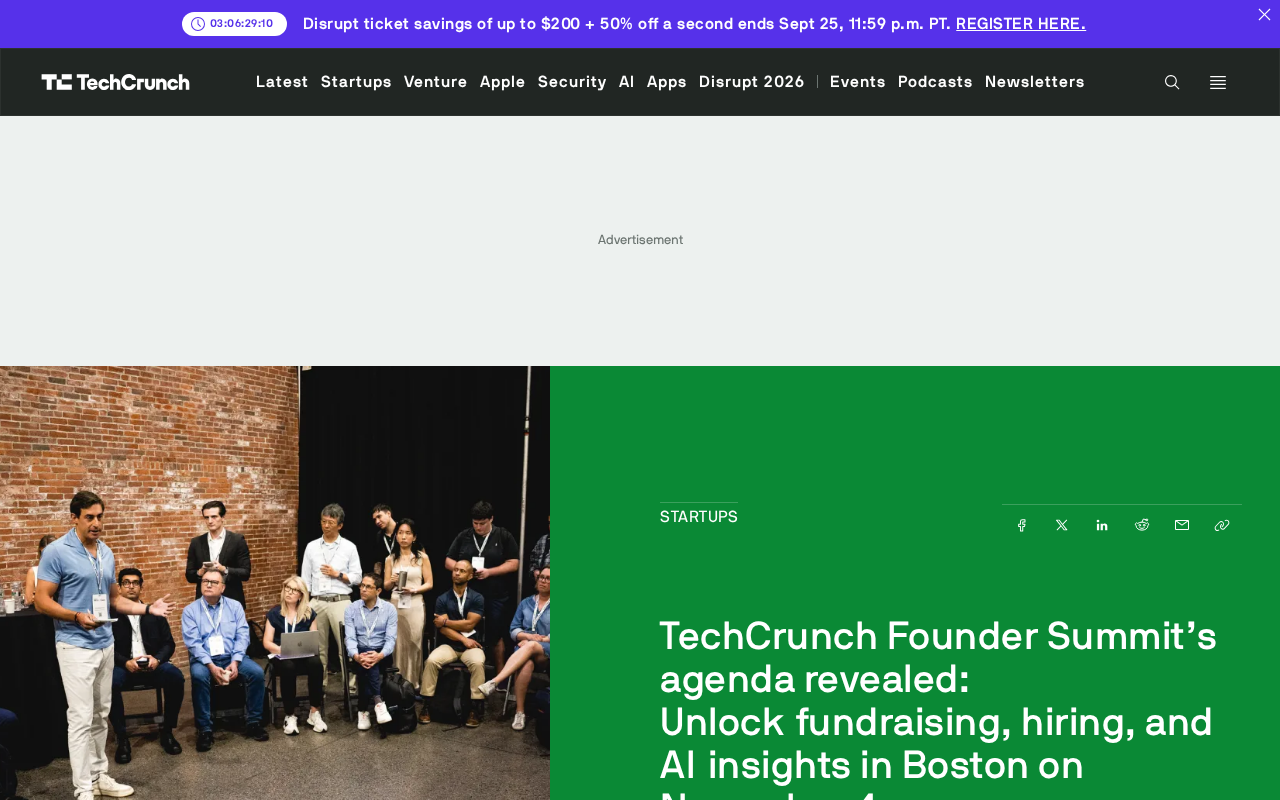
Starting a company is an inherently uncertain journey. Getting the fundraising timing right, building a core team, choosing a technical direction — each of these can make or break a startup. As a media platform with deep roots in the tech startup world, TechCrunch uses events like this to give founders a concentrated setting for gaining both knowledge and connections.
Three Core Themes
Based on the official agenda, this year's summit is organized around three main tracks.
Fundraising
Fundraising is a challenge almost no startup can avoid. From seed rounds to later-stage financing, founders need to continuously sharpen their ability to tell a compelling story, build trust with investors, and navigate the tradeoffs between valuation and equity dilution. The summit will address these practical questions through perspectives from both investors and successful founders.
Startup fundraising typically unfolds in stages: Pre-seed and Seed rounds rely primarily on angel investors or early-stage VCs, with deal sizes ranging from hundreds of thousands to a few million dollars, used to validate product direction. Series A and beyond require founders to show quantifiable growth metrics and a clear business model. "Telling a great story" is especially critical in early fundraising — when data is limited, investors are largely betting on a founder's judgment and execution ability, which means the logic of a pitch deck and the founder's delivery often carry more weight than the financial model itself. Valuation and equity dilution are another major challenge: an inflated valuation can create a "down round trap" in the next raise, while excessive early dilution can erode the founding team's control and incentives. These are exactly the kinds of core issues the fundraising track aims to help founders work through before they run into them firsthand.
Hiring
For early-stage companies, the quality of the first few hires often directly shapes the company's trajectory. Attracting the right talent with limited resources and building a high-performance team culture are among the most persistent pain points founders face. This track speaks directly to one of the most common struggles in early-stage company building.
AI Insights
Artificial intelligence has been carved out as a standalone core theme, reflecting how central AI has become to today's startup ecosystem. Whether it's integrating AI capabilities into a product or identifying new opportunities created by the AI wave, founders need to stay sharp on where the technology is headed. The summit will offer frontline observations on AI applications and industry direction.
In the current startup landscape, AI adoption generally falls into two categories: "AI-native" products, where the core functionality is driven by large language models (LLMs) or other AI models — such as AI writing assistants or code generation tools — and using AI as an efficiency layer embedded into existing products or internal workflows to reduce operating costs or improve user experience. A common trap for early founders is over-reliance on a single AI vendor (such as the OpenAI API), which leads to a shallow moat and makes the product easy to replicate. How to build genuine differentiation on top of AI capabilities — whether through proprietary data assets, vertical domain expertise, or a unique distribution channel — is the central question in AI entrepreneurship today. The summit's dedicated AI Insights track is designed to help founders find a pragmatic path forward amid the technology hype.
Who Should Attend
This event is primarily aimed at founders at various stages of building their companies — especially those actively searching for answers around fundraising, team building, or exploring AI opportunities. The value of an in-person summit goes beyond the agenda itself: face-to-face conversations with investors, peers, and industry experts often produce the most valuable takeaways that no panel discussion can replicate.
For the Boston-area startup ecosystem, a practically focused summit like this is also a reflection of the region's vibrant tech community.
Closing Thoughts
With the goal of "lowering the barriers to building and amplifying the joy of success," TechCrunch Founder Summit packs fundraising, hiring, and AI into a single day of programming. For founders looking to systematically sharpen their startup knowledge and expand their professional network, this kind of event offers a high-density opportunity to do both. Interested founders can follow official channels for registration and attendance details.
Related articles

Workbuddy for Absolute Beginners: How a Desktop AI Agent Fits Into Real Workflows
A beginner's guide to the Workbuddy desktop AI agent: installation, claiming credits, file management, and building automated workflows—compared with CodeX for fit and cost, helping professionals shift from AI question-askers to AI managers.

OpenAI's New Agent Stack: Computer Use, Decisions API, and Ultra-Fast Workflows
OpenAI Dev Day unveiled a new agent stack: Computer Use outperforms humans, Decisions API delivers ultra-low-latency classification via Luna, Agents API opens the same Computer Use capabilities, and GPT-6.1 Sol costs only one-seventh of Astra. Core updates, benchmark data, and developer insights.

Liang Wenfeng Open-Sources DeepInfo Inference Framework, Takes On U.S. Ban
DeepSeek open-sources its DeepInfo inference framework after its models, featuring GPU/CPU cross-pipelining, small-model prediction with large-model verification, and full Huawei Ascend and NVIDIA chip support—facing the U.S. federal ban head-on. This article analyzes its significance for AI deployment and open-source strategy.