TechCrunch Founder Summit Early-Bird Tickets About to Expire — Save Up to $200

TechCrunch Founder Summit early-bird tickets close October 16, saving up to $200.
TechCrunch Founder Summit will be held on November 4 at Boston's SoWa Power Station, expected to gather 1,000 founders and investors. Early-bird discounts (applicable to both Founder Pass and Investor Pass) can save up to $200, but will end after October 16. The article notes that the summit is positioned not as a general tech conference, but as a small-scale in-depth exchange emphasizing solving specific problems, encouraging attendees to bring their toughest questions. Whether it is worth attending can be measured by attendee quality, whether the agenda revolves around specific problems, and geographic convenience. For teams in a fundraising window or looking for co-founders and early customers, attending may bring returns exceeding the ticket price; but ultimately ROI depends on what problems you bring, whom you talk to, and whether you follow up afterward.
Tech founders, pay attention: the early-bird ticket discount for TechCrunch Founder Summit is about to end. The event, scheduled for November 4 at the SoWa Power Station in Boston, will bring together 1,000 founders and investors, and early-bird tickets can save you up to $200 — but that offer disappears after October 16.
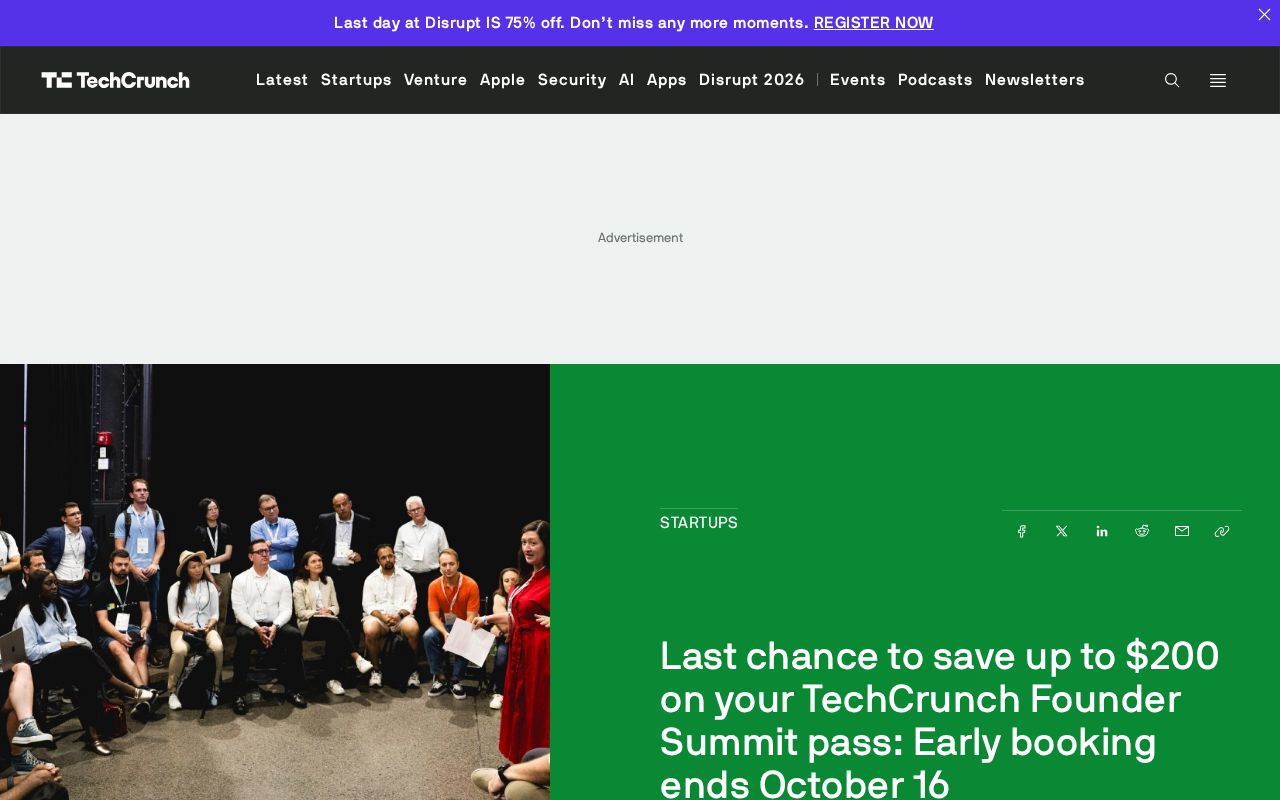
An offline summit built specifically for founders
TechCrunch Founder Summit has a very clear positioning: it is not a broad tech industry conference, but a small-scale, in-depth networking event specifically for founders and investors. A size of 1,000 people is medium-to-small among tech summits, which means attendees have more opportunities for substantive conversations rather than exchanging business cards in a crowd.
The venue is Boston's SoWa Power Station. This industrial heritage site itself carries a symbolic meaning of "from old energy to new energy," which fits the entrepreneurial theme quite well.
SoWa Power Station is located in Boston's South End, in the SoWa Art + Design District. Its predecessor was an industrial power plant built in the late 19th century, which once supplied electricity to Boston's early streetcar system. After renovation, it retained its red-brick exterior walls, steel trusses, and high vaulted ceilings, and is now used as a venue for exhibitions, markets, and large events. Choosing such an industrial heritage site as the location for a tech summit is not uncommon in Boston — in recent years, the city has seen multiple similar cases of transforming historic buildings into containers for innovation events. For attendees, the physical scale of such spaces (usually with ceilings over 10 meters high) is naturally suited to arranging a main stage, exhibition areas, and networking zones, while avoiding the standardized atmosphere of a hotel ballroom and making informal interaction easier to spark.
The urgency of the early-bird offer
According to official information, the early-bird discounts for the Founder Pass and Investor Pass will end after Friday, October 16, at which point attendees will need to pay full price, with the difference reaching as much as $200. For early-stage startup teams, that money could mean a cloud services bill, the budget for a small user test, or the cost of several coffee meetings with investors.
In its promotion, TechCrunch specifically emphasizes one point: "Bring your toughest questions and make the day genuinely valuable for your business." This sentence reveals the summit's core value proposition — not listening to talks, but solving problems.
How founders should view this kind of summit
The tech industry never lacks conferences. Every year, there are hundreds of events around the world labeled "founders," "investment," or "growth," but few truly generate practical value. Judging whether a summit is worth attending usually comes down to three dimensions:
The quality of attendees rather than the quantity. A size of 1,000 people is a curated scale, ensuring sufficient networking density while avoiding the awkwardness of large expos where "you can't meet anyone."
Whether the agenda revolves around specific problems. TechCrunch encourages attendees to bring their hardest questions, which suggests the event may include roundtable discussions, one-on-one diagnostics, or small-scale workshops.
Geographic convenience. Boston is a major tech center on the U.S. East Coast, surrounded by a large number of universities, research institutions, and early-stage funds. For teams with business operations on the U.S. East Coast, the time cost of attending is relatively manageable.
Founder Pass and Investor Pass are common ticketing tiers at TechCrunch summits: the former is for founders currently operating or preparing to launch a company, while the latter is for angel investors, VCs, and family office representatives. The two passes usually share the core agenda, but may differ in exclusive networking sessions, roundtable seating, or one-on-one meeting systems. This tiering is not simple price discrimination, but a matter of matching efficiency — the organizers want to ensure investors do not have to blindly search for projects in the crowd, and founders can lock in potential backers within a relatively controlled pool of names. For early-stage teams, if they have both fundraising and hiring needs, the Founder Pass is often the more suitable choice; if the main goal is to scout projects or build an investment pipeline, the Investor Pass is more relevant. Before purchasing, it is worth confirming: whether both passes provide access to all networking sessions, and whether they include pre-event matchmaking system access.
Is it worth buying a ticket?
If your company is in a fundraising window, or you are looking for co-founders, early customers, and industry mentors, this kind of founder-focused summit may bring returns exceeding the ticket price. But if you are only going with a "just to check it out" mindset, the $200 difference will not change the core value of attending — what truly determines ROI is what problems you bring, whom you talk to, and whether you follow up after the event.
The early-bird ticket deadline is October 16, and the event itself takes place on November 4. There is not much time left to hesitate.
One-line Summary
TechCrunch Founder Summit early-bird tickets close on October 16, saving up to $200.
Paragraph Summary
TechCrunch Founder Summit will be held on November 4 at Boston's SoWa Power Station, expected to bring together 1,000 founders and investors. Early-bird discounts (applicable to both Founder Pass and Investor Pass) can save up to $200, but will end after October 16. The article notes that the summit is positioned not as a general tech conference, but as a small-scale in-depth exchange emphasizing solving specific problems, encouraging attendees to bring their toughest questions. Whether it is worth attending can be measured by three dimensions: attendee quality, whether the agenda revolves around specific problems, and geographic convenience. For teams in a fundraising window or looking for co-founders and early customers, attending may bring returns exceeding the ticket price; but ultimately ROI depends on what problems you bring, whom you talk to, and whether you follow up after the event.
Related articles

Cursor Can Now Control Your Computer: AI Agents Can Drive Desktop Apps for Testing
Cursor adds desktop control: AI agents can drive desktop apps like the iOS Simulator to test their own features. We analyze the impact on dev workflows, possible technical approaches, and reliability concerns.

Vibecoding a Custom Inference Engine: High Hopes, Harsh Reality
A Reddit developer shares the real experience of vibecoding a custom inference engine: running GGUF Q4 models in the browser with WebGL2 and GLSL, only to fall into tokenizer debugging hell. This article analyzes the engineering challenges of browser-side LLM inference and why cloning llama.cpp is the more rational choice.

How High Are Anthropic's Early Investor Paper Returns Ahead of IPO?
Anthropic's early investor paper returns draw attention ahead of IPO. This article analyzes sources of book gains, capital structure, pre-IPO games and risks, and implications for the AI startup ecosystem.