TechCrunch Mobility: The A/B Test Pitting Robots Against Humans

TechCrunch Mobility explores A/B testing robots against humans in mobility, revealing the industry's shift toward ROI evaluation and human-machine collaboration.
TechCrunch Mobility elevates AI's role in transportation to a core topic, recently focusing on A/B testing robots against humans in mobility scenarios. The article notes that such tests reflect the industry's transition from technical validation ("can we do it") to ROI evaluation ("is it good enough, and is it worth it"). Test design faces dual challenges: variable control (road conditions, weather, order density) and choosing evaluation criteria (cost, time, satisfaction), with conclusions limited by scenario. The article argues that the value of testing lies not in concluding that "robots will replace humans" but in providing a basis for hybrid models—robots handle standardized stages, while humans handle exceptions and complex decisions.
TechCrunch Mobility recently turned its attention to an interesting experiment: A/B testing robots against humans in mobility scenarios. Although the original source only provided an opening quote, we can piece together the industry logic and implications behind this experiment based on the column's consistent focus areas.
Robots vs. Humans: A Controlled Experiment on Efficiency and Experience
As a column focused on the future of transportation, TechCrunch Mobility has increasingly discussed the role of AI in mobility in recent years. The column's opening states that it is "your hub for the future of transportation and, now more than ever, the role AI is playing in it," directly highlighting the growing weight of AI in the transportation sector. A/B testing robots against humans is essentially about quantitatively comparing the performance of automated solutions versus manual solutions in real-world scenarios.
Such tests typically involve delivery, passenger transport, route planning, and other stages. The advantages of robotic solutions often lie in consistency, predictability, and scalability potential, while human solutions retain advantages in complex judgment, exception handling, and emotional interaction. By using this comparison as an entry point, the column indicates that the industry has moved past the "can we do it" stage and entered an evaluation phase of "is it good enough, and is it worth it."
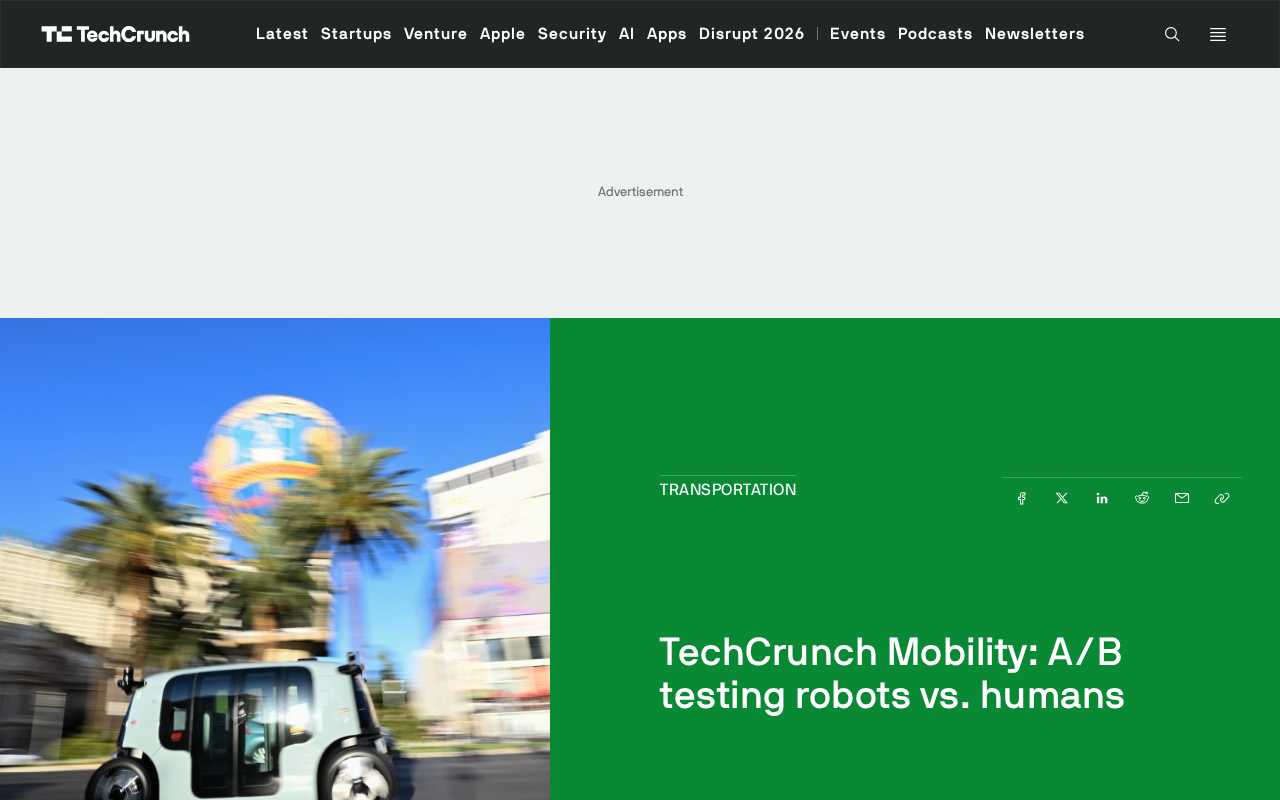
A/B testing originates from product design and statistics. It involves randomly assigning subjects to two or more variant groups and comparing key metrics to determine which approach is more effective. In mobility scenarios, comparing robots and humans as two "variants" requires adherence to the principles of randomization, control, and reproducibility to yield credible conclusions.
ROI (return on investment) is the core metric for measuring the economic viability of automated solutions, calculated as net benefit divided by total investment. For robotic mobility solutions, ROI must account for hardware depreciation, maintenance, energy, insurance, and remote monitoring costs, and compare them against the labor costs, training, and management expenses of human solutions. The industry's shift from technical validation to ROI evaluation means companies are focusing more on the feasibility of commercialization rather than mere technology demonstrations.
Why This Kind of Testing Is Happening Now
Transportation and mobility is one of the most complex scenarios for AI deployment: it involves safety regulations, public roads, user experience, and cost structures. A/B testing provides a relatively controllable evaluation framework that allows companies to compare key metrics of two approaches on a small scale.
From the column's positioning, TechCrunch Mobility continuously tracks autonomous driving, mobility platforms, and logistics automation. Including robot A/B testing in the discussion reflects that the industry's focus on ROI is now outweighing its interest in technological showmanship. Companies need data to answer: in specific scenarios, are robots really more efficient and more economical than humans?
Autonomous driving and mobility automation involve a multi-layered technology stack: the perception layer (LiDAR, cameras, millimeter-wave radar), the decision layer (path planning, behavior prediction), and the control layer (drive-by-wire chassis). The advantages of robotic solutions on structured roads depend on high-definition maps and rule engines, while human drivers rely on experience and contextual judgment. Understanding these technology layers helps analyze the sources of performance differences in robots during A/B testing.
"Last-mile" delivery in logistics automation is a typical scenario for robot testing. It is characterized by high order density and relatively fixed routes but complex end environments. Robots have clear consistency advantages at this stage, but humans remain irreplaceable when facing unstructured factors such as access control, stairs, and pets. This explains why test conclusions often point toward human-machine collaboration rather than complete replacement.
Challenges of Test Design
Comparing robots and humans is not as simple as comparing two software versions. Variable control is the primary challenge: road conditions, weather, and order density all affect results. The second challenge is choosing evaluation criteria—should it be unit cost, completion time, or user satisfaction? Different metrics may point to different conclusions.
Moreover, A/B testing conclusions often have scenario limitations. Robots may have the upper hand in structured environments, but once they enter unstructured scenarios, human adaptability remains hard to replace. The column's title "A/B testing robots vs. humans" precisely implies that this comparison is not about declaring an absolute winner but about clarifying boundaries.
Implications for the Industry
The value of such testing lies not in reaching the simple conclusion that "robots will replace humans," but in providing a basis for hybrid models. In mobility and logistics scenarios, human-machine collaboration may be the more realistic path: robots handle standardized stages, while humans handle exceptions and complex decisions.
By putting the role of AI front and center in its column introduction, TechCrunch Mobility also signals a shift in media perspective—AI is no longer a supporting character in the transportation story but a core variable. For practitioners, paying attention to the methodology and conclusions of such A/B tests is more meaningful than focusing on the outcome of any single test.
(Note: The original source only contains the column's opening quote and a screenshot; specific test details were not disclosed in the source. This article provides interpretation based on the column's positioning and industry context.)
Related articles

Project Leonida: An Open-Source Attempt to Recompile Xbox GTA 6 for PC
Leonida is an open-source project attempting to recompile Xbox GTA 6 to run on PC. We analyze its technical approach, community controversy, and significance for the PC gaming ecosystem.

Sheherazaad's New Album 'Khudgarzi': A Reverb-Drenched New Voice in South Asian Folk
Sheherazaad releases debut album 'Khudgarzi,' produced after Arooj Aftab's EP 'Qasr.' Sung in Urdu, blending Carnatic and Hindustani traditions with reverb-drenched folk-noir.

Switch 2 Black Friday Game Deals: Select Titles at Lower Prices
Nintendo Switch 2 Black Friday sale: $50 off console bundles, $20 off select games. Learn discount details and buying tips to expand your game library.