Sheherazaad's New Album 'Khudgarzi': A Reverb-Drenched New Voice in South Asian Folk

Sheherazaad's debut album 'Khudgarzi' explores genre-chaotic experimental folk with Urdu vocals and South Asian traditional instrumentation.
The article reviews South Asian independent musician Sheherazaad's debut full-length album 'Khudgarzi,' which follows her Arooj Aftab-produced EP 'Qasr.' Sung in Urdu and described as 'reverb-drenched folk-noir,' it juxtaposes Carnatic and Hindustani classical traditions with heavy reverb production. The 'genre-chaotic' label is seen as a conscious aesthetic strategy of diasporic musicians, signaling South Asian experimental folk's growing global visibility.
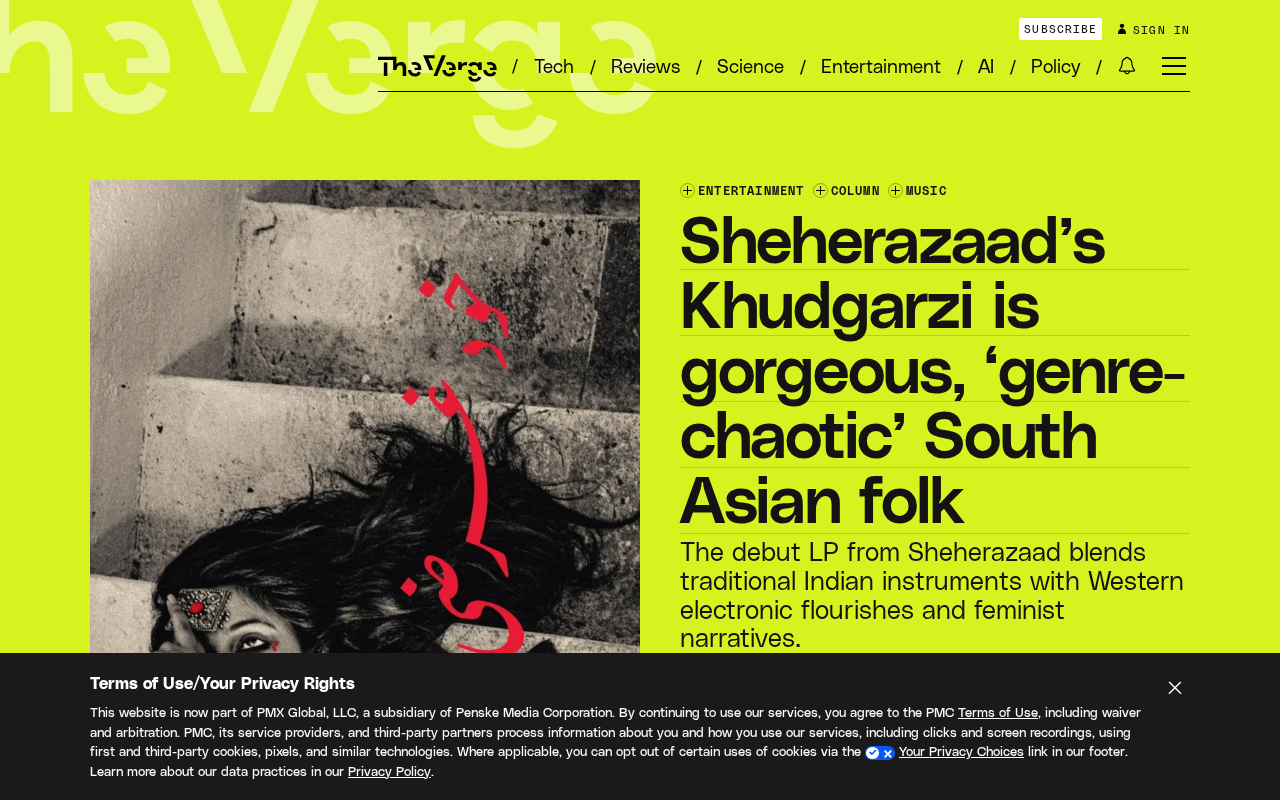
South Asian independent music is gaining increasing global attention, and Sheherazaad's latest work 'Khudgarzi' is undoubtedly an album worth noting in this wave. The musician, who first emerged a few years ago with the EP 'Qasr,' now delivers her debut full-length album, continuing to explore the blurred territory between tradition and modernity.
From 'Qasr' to 'Khudgarzi': A Natural Progression
Sheherazaad's name entered the public eye largely through the EP 'Qasr'—a work produced by Grammy winner Arooj Aftab. Arooj Aftab's stature in the field of experimental folk and South Asian music fusion has been evident in recent years, and her endorsement gave Sheherazaad considerable attention from the very start.
'Khudgarzi' continues along this path but goes further. As a debut full-length album, it is described as "reverb-drenched folk-noir," sung primarily in Urdu. This language choice itself carries a clear cultural stance: not a safe bet catering to the English-language mainstream market, but placing South Asian voices at the center of expression.
Why Arooj Aftab's Role as Producer Matters
Arooj Aftab is a Pakistani-American musician who won the Grammy for Best Global Music Album in 2022 with 'Vulture Prince,' becoming the first Pakistani woman to receive the award. Her work uses Urdu poetry as textual foundation, fusing South Asian classical vocal traditions with minimalism, jazz, and ambient music to form a highly distinctive "experimental folk" vocabulary. In the independent music ecosystem, Grammy recognition not only means artistic validation but translates directly into label resources, media exposure, and touring opportunities. For a newcomer, having Arooj Aftab as producer is equivalent to obtaining a passport into the global world music/indie music network—this is one of the key reasons Sheherazaad attracted attention from the EP stage onward.
Instrumentation: Where Carnatic and Hindustani Meet
The album draws extensively on traditional South Asian music in its instrumentation, spanning both the Carnatic and Hindustani systems. Although both belong to the South Asian classical music tradition, they each have distinct lineages in structure, ornamentation, and improvisational approaches. Placing them side by side on the same album shows that Sheherazaad is not content with a labelized presentation of a single regional style, but seeks to draw from a broader South Asian musical landscape.
Combined with the "folk-noir" positioning, one can infer that the album preserves traditional instrument timbres while using heavy reverb and atmospheric production techniques to create a dark, hazy listening experience. This approach distances itself from pure classical performance and moves closer to contemporary independent music aesthetics.
The Basic Divide Between Carnatic and Hindustani
Carnatic music is primarily prevalent in South India, while Hindustani music prevails in North India, Pakistan, and Bangladesh. Both share origins in ancient Indian music theory but diverged through historical development due to differing degrees of Persian and Islamic cultural influence: Hindustani absorbed more Persian elements and emphasizes improvisational expansion (such as alap and gat), while Carnatic focuses more on the structural integrity of fixed compositions (kriti) and complex rhythmic cycles (tala). In terms of ornamentation, Carnatic commonly uses gamaka to create pitch slides, while Hindustani is known for techniques such as meend. In terms of instruments, Carnatic is represented by the veena and mridangam, while Hindustani commonly features the sitar and tabla. Juxtaposing the two systems means the creator has a broader palette in timbre, rhythm, and improvisational logic, and also suggests a refusal to imagine "South Asian music" as monolithic.
"Genre-Chaotic": A Label Worth Taking Seriously
The original report used "genre-chaotic" to describe this album. On the surface, the term seems like a euphemism for stylistic inconsistency, but in Sheherazaad's creative context, it reads more as a deliberate aesthetic choice.
Contemporary South Asian musicians universally face a tension: on one hand, traditional musical elements are anchors of identity; on the other, diasporic experience and the globalized listening environment make "purity" impossible. "Genre-chaotic" precisely acknowledges this hybrid state rather than forcing it into some clear genre. For listeners, this means the album may not follow any single expectation all the way through, but every turn could be a new entry point.
"Diasporic Experience" and the Identity Tension of South Asian Musicians
"Diaspora" refers to the state of South Asian communities scattered globally due to colonial history, labor migration, and contemporary immigration. For South Asian musicians raised in Western or cross-cultural environments, traditional music is both a link to ancestral culture and something that cannot be "fully inherited" due to geographic and generational ruptures. This situation gives rise to a typical creative strategy: no longer pursuing the "authenticity" of any single regional style, but treating traditional elements as materials that can be dismantled and reassembled, juxtaposed with contemporary vocabularies such as electronic, ambient, and experimental. Arooj Aftab herself is a representative of this lineage—her Grammy recognition for Urdu vocals combined with minimalist ambient production proved that non-English, non-mainstream South Asian voices can also enter the global spotlight. Sheherazaad's "genre-chaos" is a conscious choice unfolding within this lineage.
Why It's Worth Paying Attention To
The arrival of 'Khudgarzi' is a signal that South Asian experimental folk continues to gain visibility. Arooj Aftab's production involvement provided Sheherazaad with a starting point, but a debut full-length album is the true test of a creator's independent voice. Urdu vocals, traditional instrumental foundations, atmospheric production orientation, and a loosening of genre boundaries—together these elements give the album the potential to be discussed beyond independent music circles.
For listeners interested in South Asian music, experimental folk, or cross-cultural creation, 'Khudgarzi' offers a sample for observing how tradition is reorganized in contemporary production contexts.
One-line Summary
Sheherazaad's debut full-length album 'Khudgarzi' explores genre-chaotic experimental folk with Urdu vocals and traditional South Asian instrumentation.
Paragraph Summary
This article reviews South Asian independent musician Sheherazaad's debut full-length album 'Khudgarzi.' The album continues the path of her EP 'Qasr,' produced by Grammy winner Arooj Aftab, and is sung in Urdu, described as "reverb-drenched folk-noir." Instrumentally it juxtaposes the two major South Asian classical traditions of Carnatic and Hindustani, while production uses heavy reverb to create a dark atmosphere. The report uses "genre-chaotic" to describe its stylistic hybridity, which the article argues is not pejorative but a conscious aesthetic strategy of diasporic South Asian musicians, acknowledging the tension between tradition and the globalized listening environment. Overall, the album is a signal of South Asian experimental folk's continued global visibility and offers a sample for observing how tradition is reorganized in contemporary production contexts.
Related articles

From Pulpit to Senate: A Pastor-Senator on What Sin Is
A pastor-senator at Ebenezer Church reflects on how his Senate experience reshaped his understanding of sin and hubris, making his sermons more powerful—even likening Washington to Sodom and Gomorrah.

TechCrunch Mobility: The A/B Test Pitting Robots Against Humans
TechCrunch Mobility spotlights the future of transportation and AI's role, discussing A/B testing robots vs. humans in mobility scenarios, test design challenges, and industry implications.

Project Leonida: An Open-Source Attempt to Recompile Xbox GTA 6 for PC
Leonida is an open-source project attempting to recompile Xbox GTA 6 to run on PC. We analyze its technical approach, community controversy, and significance for the PC gaming ecosystem.