Technohybridism: How AI Recursively Reshapes Social Semantic Norms
AI outputs flow back into social communication and, through adoption and institutionalization, participate in reproducing semantic norms and reshaping the knowledge ecosystem.
The article proposes "recursive semantic normalization," elevating discussions of AI output feedback from technical levels like model collapse to the social-semantic level. It argues that once AI deeply intervenes in social communication, the meaningful unit of analysis is the "hybrid semantic system"—a recursive coupling of human practice, computational generation, and institutional adoption—and builds a four-stage model of generation, selection, adoption, and persistence. It emphasizes that machine outputs have no normative authority; what changes is the field of adoption itself. Adoption is routinized, institutionally diffused, and socially stratified, and the more routinized it becomes, the more machine semantic patterns solidify into "normal" expressions. This yields three social-epistemological consequences: provenance laundering weakening epistemological vigilance, erosion of cognitive diversity, and narrowing of shared hermeneutic resources, along with an empirically oriented "evidence ladder."
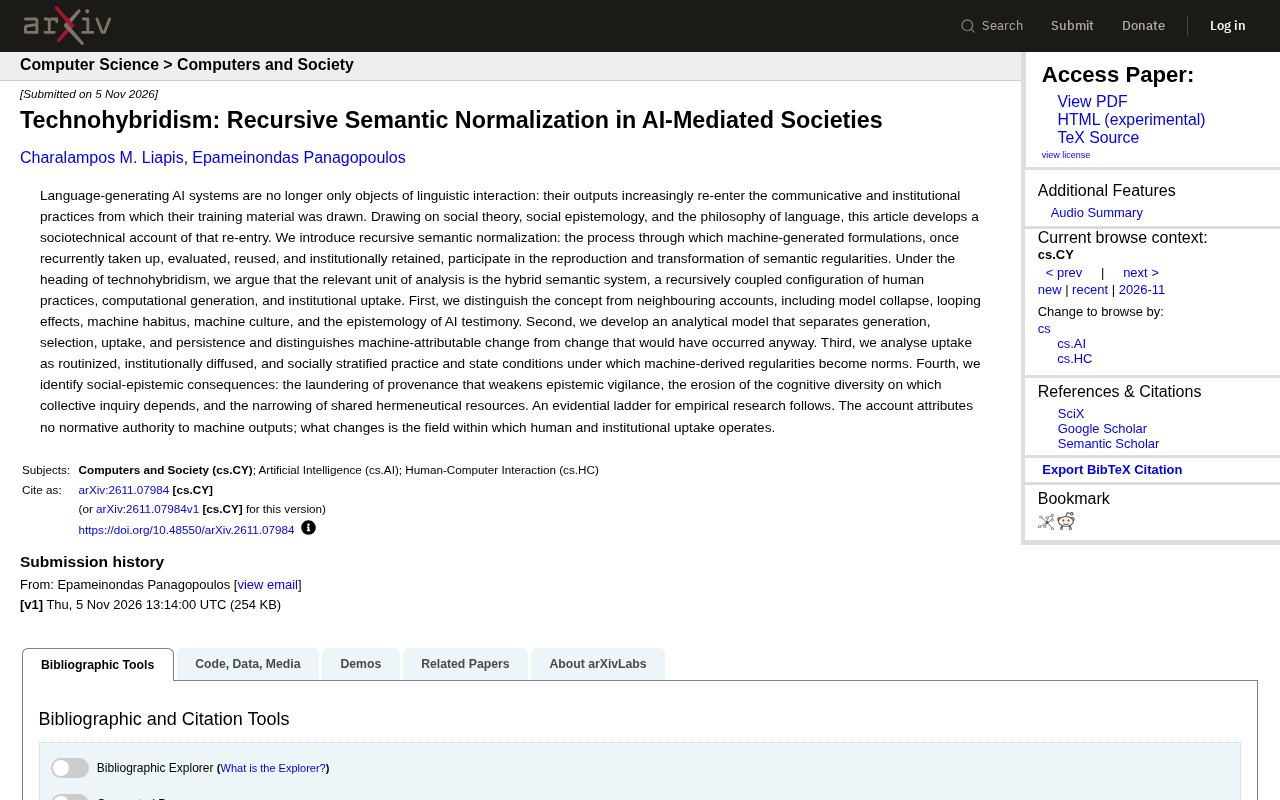
When the outputs of language-generating AI continuously flow back into the source practices of its training materials—that is, into everyday human communication and institutional operations—what happens to language itself? A social theory study from rss proposes the concept of "recursive semantic normalization," attempting to establish a systematic analytical framework for this question.
From Model Collapse to Semantic Normalization: A Broader Problem Domain
Discussions around AI-generated content flowing back into training data have previously concentrated on technical phenomena such as "model collapse": models repeatedly learning from their own outputs leads to distribution drift and diversity attenuation. But this article takes a broader perspective—it focuses on the social-level semantic consequences, rather than the model itself.
The author introduces "recursive semantic normalization" to describe a process in which machine-generated expressions, after being repeatedly adopted, evaluated, reused, and institutionally retained, come to participate in the reproduction and transformation of semantic regularities. In other words, AI outputs are not merely passive textual products but may become participants in shaping the judgment of "what counts as normal to say."
To demarcate itself from existing discussions, the article distinguishes several adjacent concepts: model collapse, looping effects, machine habitus, machine culture, and the epistemology of AI testimony. The significance of this distinction lies in the fact that "recursive semantic normalization" is concerned not with the degradation of a single model or individual cognitive bias, but with semantic change at the level of human-machine coupled systems.
Model collapse refers to the degradation phenomenon that occurs in generative models after their training data is contaminated by their own outputs: the model gradually forgets low-frequency patterns in the original data distribution, outputs tend toward homogeneity, errors accumulate, and ultimately the model loses its ability to model the true data distribution. This concept was first systematically articulated by Shumailov et al. in research around 2023, with its core mechanism being the "recursive curse"—each generation of models learns from the outputs of the previous generation, and errors and biases are amplified layer by layer. It is worth noting that model collapse is primarily a technical judgment about model performance and distributional fidelity; it measures the distance between model outputs and real data. "Recursive semantic normalization," by contrast, is concerned with a different order of problem: even if a model does not collapse, what happens to the normative structure of language itself after its outputs are widely adopted by society. The former asks whether the model is still "accurate"; the latter asks whether society is still "diverse."
Technohybridism: What Is the Unit of Analysis
The article's core claim is that once AI deeply intervenes in social communication, the meaningful unit of analysis is no longer "human practice" or "computational generation" alone, but the "hybrid semantic system"—a configuration in which human practice, computational generation, and institutional adoption are recursively coupled.
Under this framework, the author builds an analytical model that divides the process into four stages: generation, selection, adoption, and persistence. The value of this division is that it allows researchers to distinguish "machine-attributable changes" from "changes that would have happened anyway"—the latter may stem from society's own evolutionary trends rather than AI intervention.
The article particularly emphasizes that this framework does not grant any normative authority to machine outputs. What changes is the very field in which human and institutional adoption operates, not that AI has been endowed with some kind of discursive power. This distinction is crucial for avoiding misreadings based on technological determinism.
Technohybridism is the theoretical stance indicated by the article's title, whose key point is to refuse to treat technology and society as two independent entities and ask "who influenced whom," instead viewing them as hybrid configurations that have always already been intertwined. From this stance, "human practice" and "computational generation" are not two elements that exist prior to interaction but are mutually constituted in interaction: human communication habits shape the model's output distribution, and the model's outputs in turn reshape human expressive habits. Therefore, the unit of analysis must fall on the interface where the two are coupled, rather than on either side alone. This approach is related to actor-network theory and post-phenomenological theories of technological mediation, but it emphasizes specific mechanisms at the semantic level rather than a vague "technological mediation."
Adoption as a Stratified Social Practice
When analyzing the adoption stage, the article treats it as a practice that is routinized, institutionally diffused, and socially stratified. Different groups do not have the same degree of exposure to and reliance on AI-generated content, and institutions also differ in their degree of trust in texts from different sources.
The author further discusses the conditions under which machine-derived regularities transform into norms. The more adoption is routinized and the more it diffuses through institutional channels, the more likely semantic patterns in machine outputs are to be solidified into "normal" ways of expression.
Three Social-Epistemological Consequences
The article identifies several social-epistemological consequences of recursive semantic normalization, and this part is particularly direct in understanding AI's impact on the public knowledge ecosystem.
Laundering of provenance weakens epistemological vigilance—when machine-generated expressions pass through multiple hands into formal or informal communication, their sources become difficult to trace, making it harder for people to maintain due caution about information.
Erosion of cognitive diversity—collective inquiry depends on diverse cognitive perspectives, and the convergence of semantic regularities may weaken this diversity, thereby affecting the quality of collective inquiry.
Narrowing of shared hermeneutic resources—when ways of expression tend toward uniformity, the common conceptual resources available for people to understand the world also narrow. These three consequences are interrelated and jointly point to a structural risk in AI-mediated societies.
Social epistemology studies the social dimension of knowledge: how knowledge is produced, transmitted, and evaluated through others' testimony, institutional certification, and group division of labor and collaboration. It is concerned not with how a single knower forms beliefs, but with how the organization of collective inquiry affects what we know and its reliability. The article borrows this framework to show that the consequences of recursive semantic normalization cannot be understood solely at the individual level—"laundering of provenance" weakens the group's mechanisms for tracking information sources, "erosion of cognitive diversity" affects the distribution of perspectives on which collective inquiry depends, and "narrowing of shared hermeneutic resources" changes the conceptual toolkit society uses to understand the world. All three are structural changes in the knowledge ecosystem, rather than increases or decreases in individual bias.
The Evidence Ladder and Open Questions
Finally, the article proposes an "evidence ladder" oriented toward empirical research, providing a path for subsequent research to advance in stages. This section reflects the author's emphasis on the testability of theory: recursive semantic normalization should not remain at the conceptual level but requires empirical support.
Overall, this study provides a useful analytical vocabulary that elevates discussions about AI output feedback from the technical level of models to the social-semantic level. Its core reminder is that AI's impact on language is ultimately realized not through the output of some model, but through the accumulation of day-to-day adoption practices by humans and institutions.
One-line Summary
AI outputs flow back into social communication and, through adoption and institutionalization, participate in the reproduction of semantic norms, reshaping the knowledge ecosystem.
Paragraph Summary
The article proposes the concept of "recursive semantic normalization," elevating discussions of AI-generated content feedback from technical levels such as model collapse to the social-semantic level. The author argues that once AI deeply intervenes in social communication, the meaningful unit of analysis is the "hybrid semantic system"—a configuration in which human practice, computational generation, and institutional adoption are recursively coupled—and builds a four-stage model of generation, selection, adoption, and persistence to distinguish machine-attributable changes from changes that would have occurred anyway. The article emphasizes that machine outputs have no normative authority; what changes is the field in which adoption operates. Adoption is viewed as a routinized, institutionally diffused, and socially stratified practice, and the more routinized it becomes, the more easily machine semantic patterns solidify into "normal" expressions. This gives rise to three social-epistemological consequences: laundering of provenance weakens epistemological vigilance, erosion of cognitive diversity, and narrowing of shared hermeneutic resources, along with an empirically oriented "evidence ladder."
Related articles
 Tech Frontiers
Coldframe: A Honeypot Disguised as a Supermarket Freezer Controller
Coldframe is a honeypot disguised as Danfoss AK-SM 800A and Dixell XWEB freezer controllers, built as a single Python file that detects CVE-2025-41450 attempts and is identified as real devices on Shodan.
 Tech Frontiers
GRFNet: A Lightweight PyTorch Model Designed for Multichannel Time-Series Classification
GRFNet is a lightweight PyTorch model for multichannel time-series classification, originating from EEG decoding research. With only 3,847 parameters, it is based on the ROCKET architecture, combining random convolution kernels with learnable spatial filters, supports arbitrary input lengths, and will soon be evaluated on the PhysioNet dataset.
 Tech Frontiers
CUDA-Accelerated Rocket League Simulator: A Player-Made Hardcore Experiment
A Reddit post shows a "100% Accurate" Rocket League simulator accelerated with CUDA. We analyze its technical context, CUDA's value in game physics simulation, and the significance and limitations of such community projects.