TEE Encrypted Inference in Practice: Keeping AI Inference Data Inside the Secure Enclave
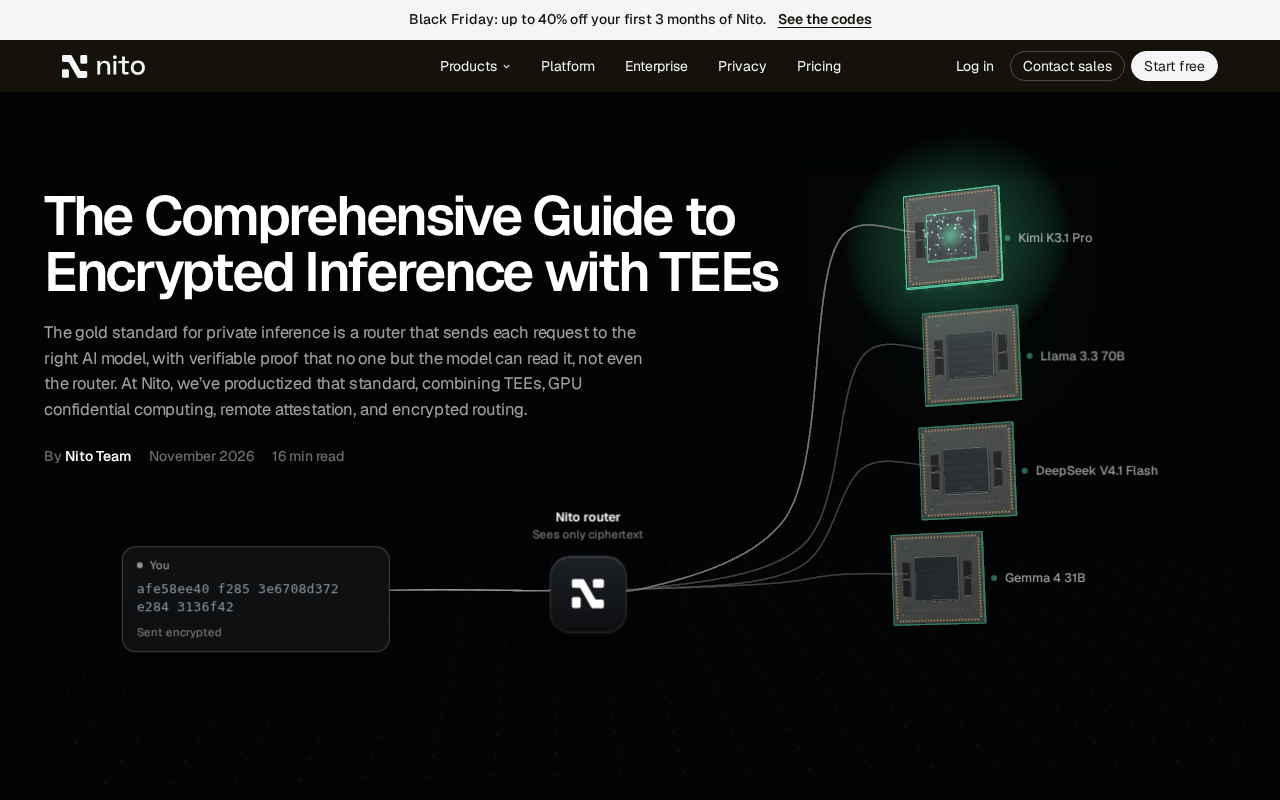
TEEs keep plaintext inside a hardware enclave and rely on remote attestation to establish trust, but are constrained by memory and GPU limitations.
The article addresses the contradiction in cloud LLM inference: computation must go to the cloud, but plaintext must not be exposed. It systematically covers TEE encrypted inference. The core mechanism places computation inside a hardware-isolated enclave, decrypting data on entry and encrypting on output, with plaintext existing only briefly in protected CPU memory. The trust anchor is remote attestation: the client verifies the measurements of the code inside the enclave before delivering the session key, so it need not blindly trust the provider. The article also notes the engineering costs—enclave memory far smaller than the host, incomplete native GPU support, and extra latency from encrypted transfer and attestation—making the approach at the current stage better suited to small and medium models or latency-insensitive scenarios. On the threat model, TEEs cannot resist side channels or boundary software vulnerabilities and should be one layer of defense in depth. Deployment recommendations include field-level encryption classification, hard-coding attestation verification into the client SDK, and stress-testing the memory ceiling and time-to-first-byte with real workloads.
Title
TEE Encrypted Inference in Practice: Keeping AI Inference Data Inside the Secure Enclave
Meta Description
A community technical guide on TEE encrypted inference: how remote attestation builds trust, how keys and data flow, the trade-offs between performance and enclave memory, and the threat model and selection advice you need before deployment.
Article Content
When LLM inference has to handle medical records, financial transactions, or corporate secrets, a fundamental contradiction comes into view: computation must happen in the cloud, but sensitive data cannot be exposed to the cloud provider in plaintext. Trusted Execution Environments (TEEs) are becoming one of the mainstream paths to resolving this contradiction. This article, based on a comprehensive guide recently circulating in the technical community, lays out the core concepts, deployment approaches, and engineering trade-offs of encrypted inference.
Why Encrypted Inference Is Needed
In a conventional cloud AI inference pipeline, data is protected by TLS at the transport layer, but once it reaches the server it must enter memory and the GPU in plaintext for computation to proceed. This means the cloud provider, operations staff, and even potential attackers are in theory all capable of accessing the raw data.
The TEE approach places the computation inside a hardware-isolated "enclave" whose memory contents cannot be inspected by the operating system or the virtualization layer. Data is decrypted on entry to the enclave and encrypted on output once computation completes, so plaintext exists only briefly inside a protected CPU environment. For industries with strict compliance requirements, this offers an auditable technical guarantee rather than merely a contractual promise.
The Basic Workflow of TEE Encrypted Inference
Remote Attestation: Verify First, Then Trust
The key trust anchor in a TEE solution is remote attestation. Before sending data, the client requests that the enclave generate a hardware-backed attestation report containing the measurements of the code running inside the enclave. Only after the client verifies that these measurements match expectations does it hand the encrypted session key to the enclave.
The significance of this step is that users need not blindly trust the provider's claims; instead, they use cryptographic means to confirm that "my data is indeed processed only by this piece of code." A TEE deployment without remote attestation still depends, in essence, on the operator's good faith.
Measurements and hardware backing: The "measurement" in a remote attestation report is typically a cryptographic hash (such as SHA-256) of the code and initial data loaded into the enclave, and it has an avalanche effect—any tiny change to the code produces a completely different hash. Hardware backing means the report is signed by a key built into the CPU (such as the attestation key derived from Intel SGX's fused key, or AMD SEV-SNP's versioned chip key); the private key is fixed inside the chip and cannot be exported. The client verifies the signature through the vendor-provided certificate chain, then compares the measurement against a known "golden measurement" to confirm that the runtime environment has not been tampered with. In practice, the TCB (Trusted Computing Base) version reported by the enclave must also be checked, because known vulnerabilities may require microcode updates, and older measurement values should be explicitly rejected.
Data Flow and Key Management
In actual deployments, the client typically generates a symmetric key, encrypts it with the enclave's public key, and sends it in; all subsequent data is transmitted in ciphertext. The key is never visible outside the enclave, its lifetime is bound to the inference session, and it is destroyed when the session ends. The model weights themselves can also be loaded encrypted, preventing model assets from leaking through storage media outside the enclave.
The complexity of this flow falls mainly on key orchestration: how to rotate keys, how to handle session timeouts, and how to stay consistent across multi-replica deployments are all engineering details that cannot be avoided.
Common patterns for key orchestration: Session-level keys usually adopt an "envelope encryption" structure—the client generates a data encryption key (DEK), wraps it with the enclave's public key (bound to a specific enclave instance), and sends it in; after unsealing, the enclave holds the DEK only in internal memory. Key rotation can be triggered by session timeout or rolled on a fixed time window. In multi-replica deployments, a common practice is not to share session keys across replicas but to have each replica complete remote attestation and establish an independent session; if sharing is required, a key management service (KMS) is introduced as a trusted third party, which verifies each replica's attestation report before issuing keys. After a session times out, the key in enclave memory must be zeroed out, and the client side should discard the corresponding DEK to prevent replay.
Performance and Availability Trade-offs
TEEs are not free. Enclave-available memory is usually far smaller than host memory, so large models must be loaded in chunks or run across multiple cooperating enclaves; encrypted data transfer between CPU and GPU incurs additional overhead; and the attestation process adds to time-to-first-byte.
Views in community discussions also point out that mainstream TEE solutions still lack complete native GPU support, and cramming all inference into a CPU enclave will noticeably reduce throughput for large models. This limitation means that, at the current stage, TEE encrypted inference is better suited to small and medium models or latency-insensitive scenarios than to large-scale online services.
Typical scale of the enclave memory ceiling: Taking Intel SGX as an example, the encrypted memory (EPC) of a single enclave was initially only tens to hundreds of MB; even with subsequent support for dynamic expansion, it remains far smaller than host DRAM. AMD SEV-SNP works at virtual machine granularity, with a memory ceiling close to the whole machine, but encrypted page tables introduce address translation overhead. For large models, tens of GB of weights cannot fit entirely into a small enclave, so chunked streaming loading is required, and each chunk load involves swapping encrypted pages in and out, further amplifying latency. On the GPU side, NVIDIA H100's confidential computing mode can bring GPU memory within the TEE boundary, but it requires coordination between the CPU-side TEE and the GPU driver to complete attestation and encrypted DMA, and the ecosystem is still maturing. These constraints together determine the current throughput ceiling of TEE inference.
The Threat Model Must Be Made Explicit
What a TEE can and cannot defend against is a question that must be clarified when evaluating a solution. It primarily addresses snooping by the host operating system, the virtualization layer, and cloud operators, as well as cold-boot-style attacks. But it generally cannot resist side-channel attacks, software vulnerabilities at the enclave boundary, or deception by the provider regarding code measurements (if the client skips verification).
TEEs should therefore be regarded as one layer in a defense-in-depth strategy, not as an all-purpose shield. For highly sensitive scenarios, a complete closed loop requires confidential containers, least-privilege key policies, and independent audit logs.
Concrete forms of side-channel attacks: The side channels facing TEEs mainly include cache timing attacks (inferring the memory access addresses inside the enclave by observing access patterns of shared cache sets), page fault attacks (using the operating system's control over page tables to observe which pages the enclave accesses), and physical side channels such as power consumption and electromagnetic radiation. These attacks do not break the cryptographic boundary; they extract information from "behavioral traces," which is why remote attestation cannot defend against them. Mitigations include constant-time access to sensitive data inside the enclave, padding or obfuscating access patterns, disabling hyper-threading to narrow shared cache channels, and restricting the set of system calls the enclave may invoke. Engineering practice requires an explicit trade-off between performance and side-channel resistance rather than ignoring it by default.
Recommendations for the Path to Deployment
For teams considering TEE encrypted inference, progress can be made in parallel along three lines: first, clarify data classification and route only genuinely sensitive fields through the encrypted channel, avoiding the performance waste of encrypting everything; second, hard-code the attestation verification logic into the client SDK to prevent business processes from being bypassed; third, during the selection phase, stress-test with real workloads, focusing on two metrics: the enclave memory ceiling and time-to-first-byte.
The value of TEE encrypted inference is not that it makes the cloud absolutely secure, but that it shifts "trust" from trust in people to verification of hardware and code. That shift itself is the precondition for putting sensitive data in the cloud.
One-line Summary
TEEs use hardware enclaves so plaintext exists only inside a protected environment and rely on remote attestation to establish trust, but they are constrained by memory and GPU limitations.
Paragraph Summary
The article addresses the contradiction in cloud LLM inference—"computation must go to the cloud, but plaintext must not be exposed"—and systematically lays out the technical path of TEE encrypted inference. The core mechanism places computation inside a hardware-isolated enclave: data is decrypted on entry and encrypted on output, with plaintext existing only briefly in protected CPU memory. The trust anchor is remote attestation: the client verifies the measurements of the code inside the enclave before delivering the session key, so it need not blindly trust the provider. The article also points out the engineering costs—enclave memory is far smaller than the host, native GPU support is incomplete, and encrypted transfer and attestation add latency—making this approach at the current stage better suited to small and medium models or latency-insensitive scenarios. In terms of threat model, TEEs cannot resist side channels or boundary software vulnerabilities, and should be one layer of defense in depth. Deployment recommendations include field-level encryption classification, hard-coding attestation verification into the client SDK, and stress-testing the memory ceiling and time-to-first-byte with real workloads.
Related articles

Bin's Live Stream Highlights: Hilarious Interactions from "You Came at the Right Time" to "I'll Support You From Now On"
Bin's hilarious live stream highlights: from "You came at the right time" to "I'll support you from now on," featuring Championship skins, wigs, and other game memes that showcase Bilibili's unique streaming culture.

Hunter Rescues Educated Youth: The Mountain-Chasing System Launches a New Warm-Hearted Viral Drama Formula
Bilibili's early-access period short drama *Everyone Thinks I'm a Poor Hunter* opens with a snowy-night rescue of an educated youth. Hunter Chen Shan activates the mountain-chasing system, using realistic hypothermia first-aid details and mutual-probing character dynamics to deliver a warm-hearted period drama without the sleaze.

Riemann Hypothesis Proven by AI? The Truth Has Nothing to Do With Your Reality
34-year-old mathematician Levent Alpöge claims to have proven the Riemann Hypothesis and Generalized Riemann Hypothesis with Claude, releasing 17 million lines of formal verification code. This article sorts out the facts, debunks myths about RSA collapse and new material revolutions, and analyzes the true significance of mathematics-AI collaboration.