Tempest Open-Source Tool: Reduces Token Consumption by 64% for Parallel AI Coding Agents

Tempest cuts token costs by 64% for parallel AI coding agents via shared indexing and isolated workspaces.
Tempest is an open-source tool that addresses the hidden cost of running multiple AI coding agents in parallel — redundant token consumption from each agent independently indexing the same codebase. By implementing a shared code understanding layer (index once, share everywhere) combined with isolated workspaces for each agent, Tempest claims to reduce token usage by up to 64%, offering significant cost savings and faster response times for teams heavily using AI programming workflows.
When AI Coding Agents Work in Silos: The Hidden Cost of Redundant Token Consumption
As AI coding assistants become mainstream, more developers are experimenting with running multiple AI coding agents simultaneously to handle different tasks. However, a hidden cost problem is emerging: when these agents work independently, they each need to repeatedly "understand" the same code repository.
Every time an agent starts up, it spends a significant number of tokens parsing the project structure, reading key files, and building an overall understanding of the codebase. In large language model (LLM) usage, tokens are the fundamental unit of billing and computation — one token corresponds to roughly 3-4 characters in English or 1-2 characters in Chinese. Each time an AI agent interacts with a codebase, it converts the content of code files into token sequences fed into the model's context window. Taking GPT-4o as an example, input tokens cost $2.5-5 per million tokens, and the context window has a fixed capacity limit (such as 128K or 200K tokens). When understanding large codebases, agents need multiple rounds of reading and summarization, with each round consuming real API call costs.
When you run five or ten agents in parallel, these redundant "understanding costs" multiply — essentially paying repeatedly for the same knowledge.
The open-source tool Tempest targets precisely this pain point. Its core proposition is concise and powerful: run AI agents in parallel while reducing token consumption by up to 64%.
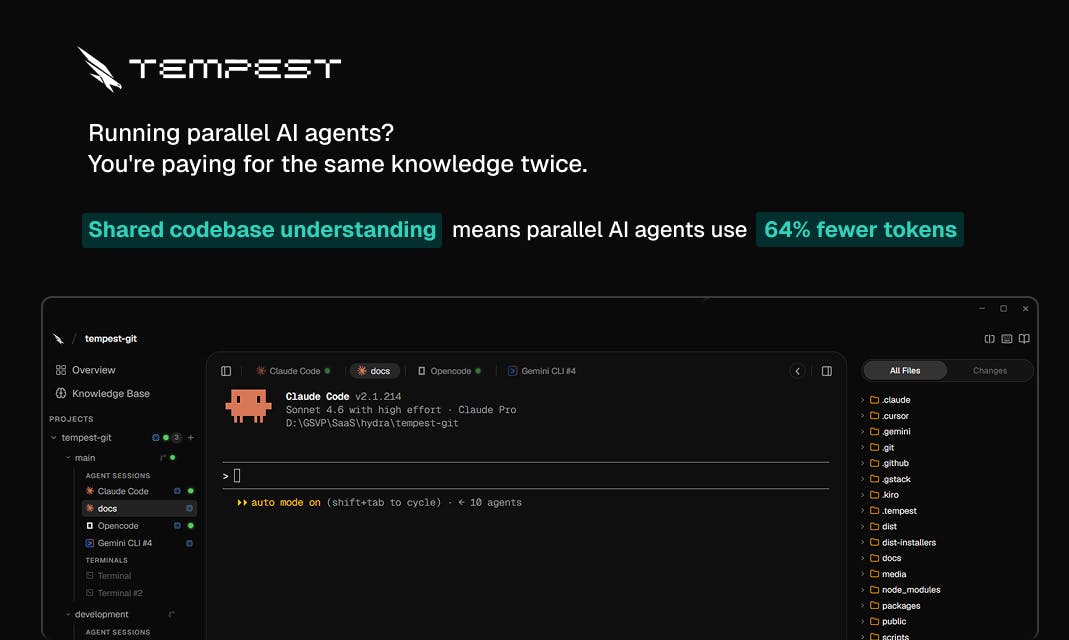
Tempest's Core Mechanism: Index Once, Share Everywhere
Tempest's approach can be summarized in one phrase — "Index once, share everywhere."
Shared Code Understanding Layer
In the traditional model, each agent starts understanding the codebase from scratch. Tempest introduces a shared "code understanding layer": it performs a one-time indexing of the entire repository, builds structured code cognition, and then lets all agents reuse this understanding without each one independently scanning and parsing.
From a technical perspective, modern code indexing typically combines multiple methods: Abstract Syntax Tree (AST) parsing identifies code syntax structures such as function definitions, class inheritance relationships, and module dependencies; symbol table construction records the definition and reference locations of all identifiers in the code; Vector Embedding transforms code snippets into points in high-dimensional vector space, enabling semantically similar code to be quickly retrieved. Similar technologies are already applied in GitHub Copilot's code search, Sourcegraph's code intelligence, and other products. Tempest's innovation lies in designing this index result as a shared resource among multiple agents, avoiding each agent independently executing this computationally intensive process.
Think of it like a team where, instead of having every new member independently read through all the documentation, you establish a shared knowledge base that everyone can directly access. What's saved is precisely the resources consumed by that repetitive work.
Isolated Independent Workspaces
Shared understanding doesn't mean agents interfere with each other. Another key design in Tempest is assigning each agent an independent and isolated workspace.
This concept of isolation originates from the sandbox philosophy in operating systems and containerization technology. In practice, this is typically implemented through a Copy-on-Write (CoW) file system mechanism — all agents share the same read-only code baseline, and when an agent needs to modify a file, the system creates an independent copy for it. This mechanism is widely used in Docker container layered file systems and Git's branching model. For AI coding agents, isolated execution also means each agent can independently run tests and install dependencies without affecting other agents' runtime environments.
This means:
- Each agent can safely make code modifications, run tests, and experiment within its own sandboxed environment
- No file conflicts or state pollution between agents
- The underlying code understanding remains shared, while upper-level operations are isolated from each other
This "shared cognition + isolated execution" architecture solves the token waste problem while ensuring the safety of parallel tasks.
The Real Impact of 64% Token Savings for Development Teams
The official figure states — up to 64% reduction in token consumption for any agent. This number is noteworthy because it directly relates to actual cost bills and operational efficiency.
For teams that heavily use AI coding tools, token costs are a real and continuously growing expense. When you dispatch multiple agents in parallel across CI/CD pipelines, code reviews, bulk refactoring, and other scenarios, the overhead of understanding the codebase often accounts for a significant proportion.
CI/CD (Continuous Integration/Continuous Deployment) is a standard practice in modern software development, referring to the pipeline where code changes are automatically built, tested, and deployed. Under the new AI programming paradigm, multiple agents can be embedded at various stages of this pipeline: one agent handles code review and security scanning, another fixes lint errors automatically, a third generates or updates test cases, and a fourth optimizes performance bottlenecks. Tools like Devin, SWE-Agent, and OpenHands are already exploring these automation scenarios. In these pipelines, each agent needs to understand the entire codebase context to make correct judgments, and this is precisely where redundant token consumption is most concentrated.
Cutting this overhead by over 60% represents considerable savings in large-scale usage scenarios.
Additionally, reducing redundant indexing also brings improved response speed — agents don't need to spend time understanding the code from scratch each time and can enter the actual task execution phase more quickly.
Open-Source Positioning and Target User Profile
Tempest's category tags on Product Hunt include Open Source, Developer Tools, Artificial Intelligence, and GitHub. This combination clearly outlines its target user profile:
- Developers and teams using multiple AI coding agents
- Technical organizations focused on token cost control
- Engineers who prefer open-source, self-hostable solutions
The open-source positioning is particularly noteworthy. For scenarios involving private codebases, open-source tools that can be self-deployed and whose underlying logic can be audited are often more trusted than closed SaaS solutions.
A Measured Perspective: Practical Considerations for an Early-Stage Product
It should be objectively noted that Tempest is still at a very early stage. As of this writing, it has 7 upvotes and 3 comments on Product Hunt, ranking 16th, and has not yet achieved widespread community validation.
Therefore, a rational attitude toward the core claim of "64% token savings" would be:
- This figure was likely measured under specific benchmark scenarios, and actual savings will vary depending on codebase size, number of agents, and task types
- The accuracy and timeliness of the shared code understanding layer (e.g., how the index syncs after code updates) deserves further attention
- Compatibility with mainstream agent frameworks is key to determining its practical value
Conclusion: Reducing Costs and Increasing Efficiency for the Multi-Agent Collaboration Era
The problem Tempest solves reflects the trend of AI programming evolving from "single assistant" to "multi-agent collaboration." Multi-Agent Collaboration is one of the most active research directions in AI engineering during 2024-2025. Frameworks like Microsoft's AutoGen, CrewAI, and LangGraph are all exploring how to coordinate multiple AI agents to collaboratively complete complex tasks. In programming, this trend manifests as a shift from "conversational programming" (like GitHub Copilot Chat) to "task-distribution programming" — developers no longer guide AI through subtasks one by one, but instead decompose overall goals and distribute them to multiple specialized agents for parallel execution. Anthropic's Claude has also explored information-sharing mechanisms between agents through its MCP (Model Context Protocol).
As more tasks are distributed in parallel to multiple AI agents, how to avoid redundant cognitive overhead and how to strike a balance between sharing and isolation will become a common challenge.
Tempest offers a concrete answer with its "index once, share understanding, isolate execution" approach. Whether it can deliver on its 64% savings promise still needs validation through more real-world scenarios. But what's certain is that as multi-agent workflows become widespread, infrastructure tools focused on orchestration efficiency and cost optimization will occupy an increasingly valuable space.
Related articles

Why Does Apple Mail Connect to iCloud Servers When Sending Non-iCloud Emails? A Technical Explanation
When using Apple Mail to send Gmail or other non-iCloud emails, the system still connects to iCloud servers. This article explains the technical reasons including Mail Privacy Protection, APNs, and iCloud Keychain.

L2 Reduction Algorithm Explained: A Python Implementation of Quadratic-Complexity LLL Lattice Reduction
Deep dive into the L2 reduction algorithm, its quadratic complexity advantage over classical LLL, and a Python implementation covering floating-point error control and lazy size reduction.

AGPL or MIT? How Open Source Licenses Affect Project Contributions and Community Activity
In-depth analysis of AGPL vs MIT open source licenses, examining how license choice impacts project contributions, enterprise participation, and community activity, with practical selection guidance.