Temporal Contamination in Language Models: Memory or Reasoning?

Language models may overestimate predictive ability in economic forecasting due to training data containing future information; direct comparison with memoryless models is needed to measure memory effects.
The article discusses temporal contamination in language models used for economic forecasting: models may have seen post-document events during training, so their predictive ability partly stems from memory rather than reasoning. The study highlights flaws in current evaluation, such as the inapplicability of random baselines, since memoryless models achieve 0.64 AUC based on dates alone. The authors propose directly measuring memory by comparing modern models with memoryless models and find that membership inference attacks mainly reflect temporal signals. In nowcast tasks, the lookahead premium for US GDP is below detection threshold and not significant, but the authors stress the need for more rigorous auditing methods that directly compare models with memoryless models on the same items.
Introduction: When Models "Know" the Answer in Advance
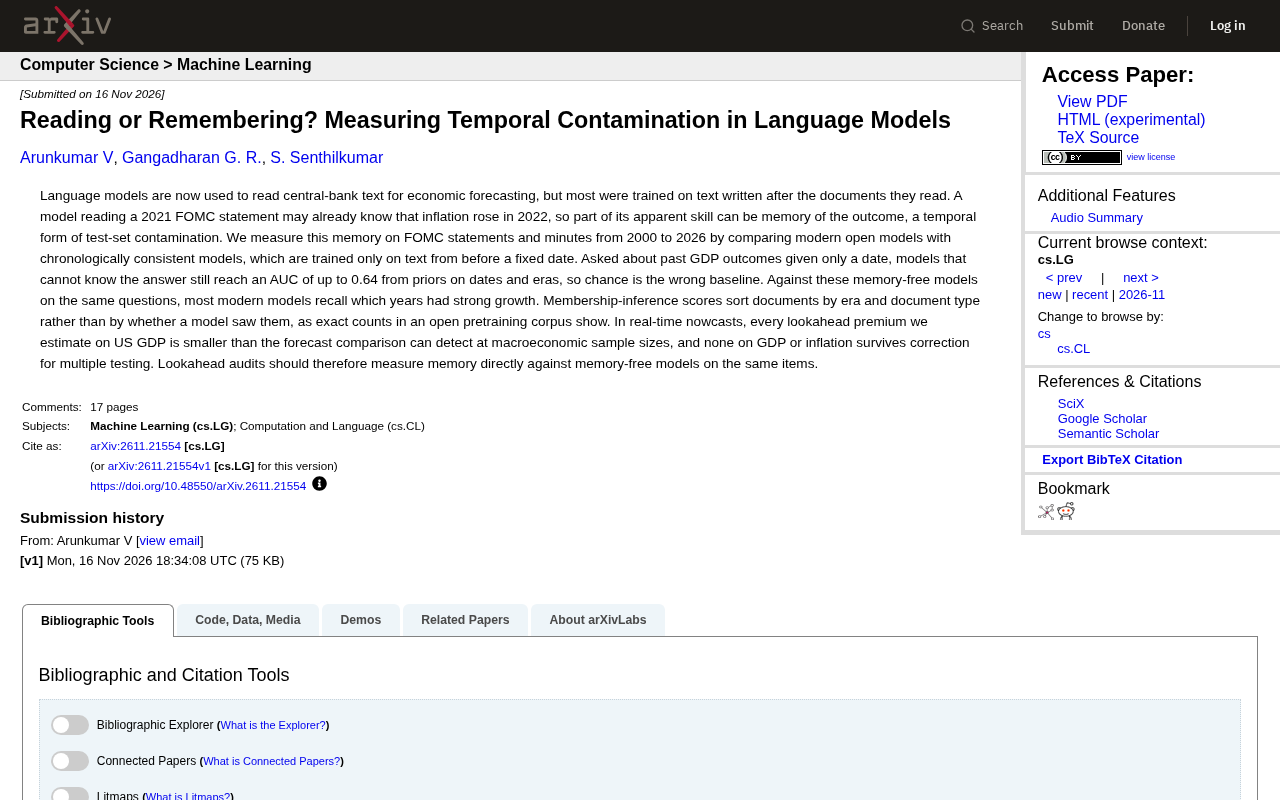
Language models are being used to read central bank texts for economic forecasting, but most models have already "seen" texts written after the documents they are asked to read during training. For example, a model reading the 2021 FOMC statement may already know that inflation would rise in 2022. Therefore, some of the predictive ability the model exhibits may not come from reasoning, but from memory of outcomes—a temporal variant of test set contamination.
A recent study (originally titled "Reading or Remembering? Measuring Temporal Contamination in Language Models") systematically quantifies this temporal contamination and points out fundamental flaws in existing evaluation methods.
Blind Spots in Existing Evaluations: Random Baselines Do Not Apply
When models are asked to "predict past GDP outcomes based solely on the date," those models that theoretically cannot know the answer (training data cutoff before the question date) still achieve AUCs as high as 0.64. This means that models can make informed guesses based on dates and era priors, and random guessing (AUC=0.5) is the wrong baseline.
This finding challenges conventional evaluation logic: if the model cannot know the facts, it should be close to random; but actual performance is significantly better than random, indicating that the model exploits temporal patterns in the data rather than causal reasoning.
AUC (Area Under the ROC Curve) is a common metric for evaluating binary classification model performance, ranging from 0.5 to 1. 0.5 corresponds to random guessing, and 1 corresponds to perfect discrimination. In temporal contamination evaluation, if the model cannot access future information, its predictions should be close to random level (AUC≈0.5). However, the study found that theoretically "memoryless" models can achieve an AUC of 0.64 based solely on dates, indicating that the model exploits temporal patterns in the data (such as autocorrelation of economic cycles) rather than truly understanding causal relationships. Therefore, using a random baseline overestimates the model's predictive ability and masks memory effects.
Measuring Memory: Comparison with "Memoryless" Models
The key innovation of the study is directly measuring memory: comparing modern open models with time-consistent models (trained only on text before a fixed date). On the same questions, most modern models can "recall" which years had strong growth, while memoryless models can only rely on priors. This comparative design avoids the bias of evaluating with a random baseline.
Furthermore, membership inference attack scores mainly rank documents by era and document type, rather than by whether the model has actually seen them—this is verified through exact counts in open pretraining corpora. This indicates that these attacks reflect temporal signals rather than true memory traces.
Membership Inference Attack is a privacy attack technique aimed at determining whether a specific data sample was used to train a machine learning model. Its basic assumption is that the model's prediction confidence or loss value for training samples is usually lower than for unseen samples. However, in time-series text, membership inference scores may mainly reflect the temporal characteristics of documents (such as era, document type), rather than true memory traces. For example, the model may be more familiar with text from a certain era overall, leading to higher scores, but this does not mean the model remembers specific documents. Therefore, the authors verified this through exact counts in open pretraining corpora, emphasizing the need for more direct memory measurement methods.
Impact in Real-Time Forecasting: Weak Lookahead Premium
In actual nowcast tasks, the study estimates that the "lookahead premium" for US GDP is less than what can be detected by forecast comparisons under macroeconomic sample sizes; and for GDP or inflation, after multiple testing correction, no premium is significant.
This means that although temporal contamination exists, its impact in actual forecasting scenarios may be below the detection threshold. However, the authors emphasize that this does not mean contamination can be ignored, but rather that more direct and rigorous auditing methods are needed.
Lookahead Premium refers to the improvement in forecasting performance that a model gains from early exposure to future information in real-time nowcast tasks. In economic forecasting, statistical tests (such as the Diebold-Mariano test) are usually used to compare forecast errors of different models. However, due to limited macroeconomic sample sizes (such as quarterly GDP data), the power of statistical tests is low, making it difficult to detect small premiums. The authors controlled the false positive rate through multiple testing correction (such as Bonferroni correction) and found that in GDP and inflation forecasts, no premium was significant after correction. This indicates that although temporal contamination exists, its actual impact may be below current detection thresholds, but this does not mean contamination can be ignored; rather, more sensitive auditing methods are needed.
Conclusion: Directly Measure Memory, Not Rely on Random Baselines
The authors suggest that lookahead audits should directly compare models with memoryless models on the same items, rather than assuming a random baseline. This methodological shift is crucial for evaluating the true capabilities of language models in time-sensitive tasks such as economic forecasting.
For the AI research community, this study reminds us: when evaluating models, the temporal relationship between training data and test data must be considered, and more precise control designs should be adopted to avoid mistaking memory for reasoning.
One-line Summary
Language models may overestimate predictive ability in economic forecasting due to training data containing future information; direct comparison with memoryless models is needed to measure memory effects.
Paragraph Summary
The article explores the temporal contamination problem faced by language models when reading central bank texts for economic forecasting: models may have already seen events after the documents during training, causing part of their predictive ability to come from memory rather than reasoning. The study points out flaws in existing evaluation methods, such as the inapplicability of random baselines, because memoryless models can achieve an AUC of 0.64 based solely on dates. The authors propose a method to directly measure memory by comparing modern models with memoryless models, and find that membership inference attacks mainly reflect temporal signals rather than true memory. In real-time forecasting tasks, the lookahead premium for US GDP is below the detection threshold and not significant, but the authors emphasize the need for more rigorous auditing methods that directly compare models with memoryless models on the same items.
Related articles

Prompt Engineering for Beginners: From Writing Prompts to Engineering Thinking
Starting from the essence and four functions of prompts, this article systematically explains the six-step process, four success criteria, learning value, and practical limitations of prompt engineering to help you build a complete understanding.

Anthropic Launches Nasdaq IPO: AI Giant's Listing and Risk Disclosures
Anthropic officially launches its Nasdaq IPO under ticker ANT, with market valuation expected to potentially exceed SpaceX's record. The prospectus devotes nearly 100 pages to AI risks, while first-half revenue grew over 14x but net losses widened sharply, reigniting the AI bubble debate.

Rust cURL Clone Uses 4,832 unsafe Blocks—Is the Memory Safety Myth Broken?
A Rust cURL clone uses 4,832 unsafe keywords, challenging Rust's memory safety narrative. We analyze what unsafe really means, compare Fil-C, and examine rewrite motives.