Tencent Cloud Open-Sources Octop: A Self-Hosted AI Assistant with Multi-User and Multi-Agent Support

Tencent Cloud open-sources Octop, a self-hosted AI assistant built for enterprise multi-user and multi-agent deployments.
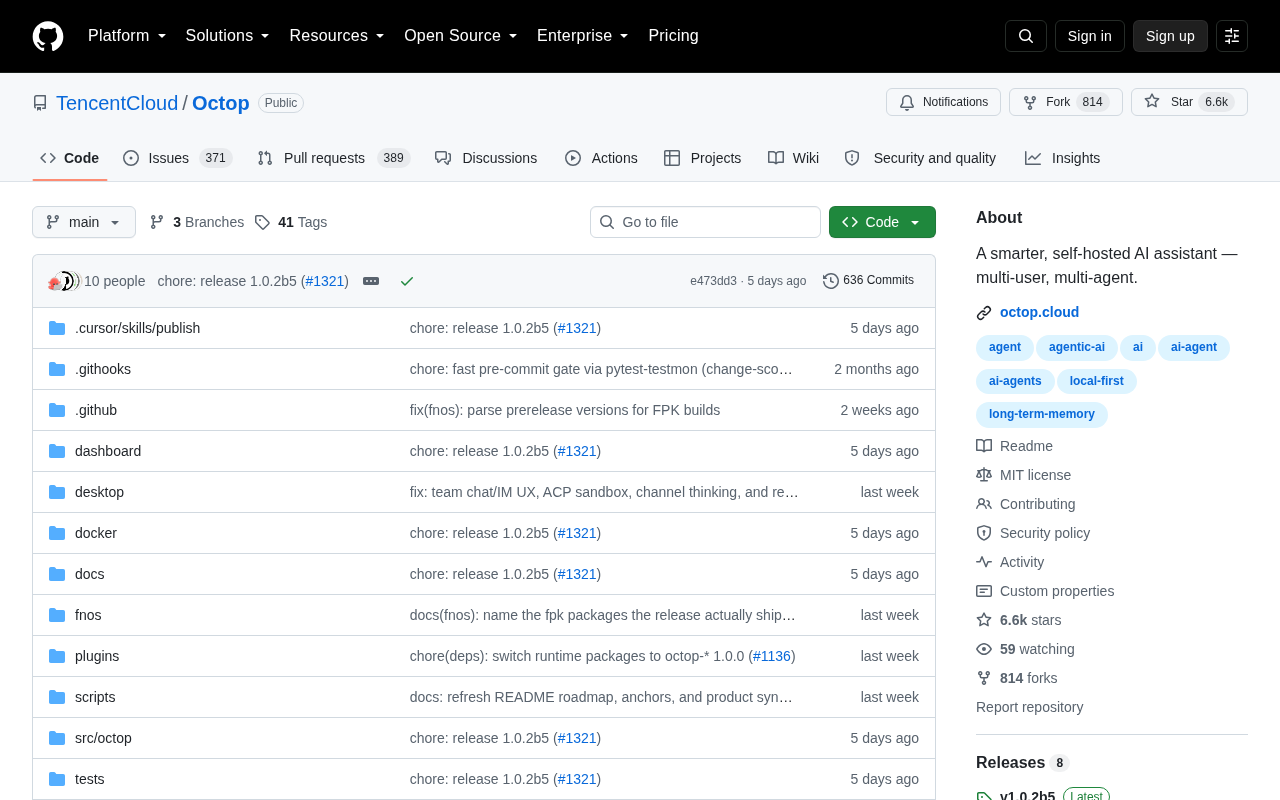
Tencent Cloud has open-sourced Octop on GitHub, a self-hosted AI assistant framework featuring multi-user and multi-agent architecture, designed as a unified internal AI gateway for teams and enterprises. The self-hosted model keeps all data and model calls on the user's own infrastructure, naturally satisfying compliance requirements in data-sensitive industries like finance, healthcare, and government. Its multi-agent design enables specialized agents to collaborate on complex workflows involving retrieval, tool calls, and result aggregation. Built in Python, the project has quickly gained 6,604 Stars and 813 Forks, with 1,476 new Stars in a single week.
Tencent Cloud recently open-sourced an AI assistant project on GitHub called Octop, positioning it as a "smarter self-hosted AI assistant" with two core capabilities: multi-user and multi-agent support. The project quickly gained community traction after launch, accumulating 6,604 Stars and 813 Forks, with 1,476 new Stars added in a single week.
What Is Octop
Octop is an open-source AI assistant framework built with Python, with self-hosting as its primary selling point. This means users can deploy the entire service on their own servers or private infrastructure, without relying on third-party cloud services. For teams that prioritize data sovereignty, privacy compliance, and cost control, this deployment model has obvious appeal — all conversation data, model calls, and business logic remain under your own control.
Unlike most lightweight AI chat tools designed for individual users, Octop was built from the ground up with team and enterprise use cases in mind, placing a strong emphasis on multi-user capabilities. This kind of architecture typically requires handling account systems, permission isolation, and session management — which means it's better suited as a unified internal AI gateway for organizations rather than a personal side project.
Self-hosted has a specific engineering meaning in the AI application space: model inference, API gateways, and user data all run on infrastructure controlled by the deploying party. The fundamental difference from SaaS is that data never passes through a third-party vendor's servers. This is especially important from a compliance standpoint — regulations like China's Personal Information Protection Law (PIPL) and the GDPR impose strict restrictions on cross-border data transfers and third-party processing, and self-hosted deployments naturally sidestep these risks. On the cost side, self-hosting requires higher upfront infrastructure investment, but in high-concurrency scenarios the marginal cost is typically far lower than token-based cloud API pricing. For enterprises with large call volumes, the long-term TCO (Total Cost of Ownership) is often more competitive.
Why Multi-Agent Architecture Matters
Another key feature of Octop is its multi-agent support. As large model applications evolve from single-turn Q&A toward complex task orchestration, a single agent can no longer cover all needs. Multi-agent architecture allows agents with different roles to collaborate: one handles retrieval, another calls tools, and another consolidates results — working together to complete more complex task pipelines.
This design philosophy aligns with the mainstream direction of AI engineering today. Multi-agent systems break a large task into multiple subtasks, each handled by a specialized agent, improving overall reliability and scalability. For developers looking to build automated workflows inside their organizations, a framework with built-in multi-agent capabilities significantly lowers the barrier compared to building orchestration logic from scratch.
In engineering terms, Multi-Agent Systems (MAS) typically rely on an Orchestrator layer to schedule agent execution order and manage information flow. There are two common collaboration patterns: master-slave, where a primary agent decomposes tasks and dispatches instructions to sub-agents; and peer-to-peer, where multiple agents exchange state through a shared message queue or blackboard system and make autonomous decisions about next steps. Typical open-source frameworks supporting this architecture include LangGraph, AutoGen, and CrewAI, all of which have accumulated extensive real-world use cases. Octop's built-in multi-agent capability means developers don't need to integrate these frameworks from scratch — they can define agent roles and tool-calling permissions directly on top of Octop's abstraction layer, keeping their focus on business logic rather than the underlying orchestration plumbing.
Tech Stack and Community Momentum
From what's publicly available, Octop uses Python as its primary development language — consistent with the AI ecosystem's mainstream choice. This makes it easy to integrate with various large model SDKs, vector databases, and toolchains, and lowers the barrier for secondary development and code contributions.
The project's growth trajectory is worth noting: 6,604 Stars, 813 Forks, and 1,476 new Stars in a single week indicate strong developer community recognition in a short period. Projects led and open-sourced by major tech companies like Tencent Cloud typically offer stronger guarantees in terms of engineering quality, documentation, and long-term maintenance — which also makes them more appealing to enterprise users exploring new tools.
Who Is Octop For
Based on its positioning, Octop is best suited for the following use cases:
- Internal enterprise AI platforms: Organizations that need multi-user permission management and centralized deployment.
- Data-sensitive industries: Sectors like finance, healthcare, and government where data must remain on internal networks — self-hosting is a hard requirement.
- Complex task automation: Workflows that require multiple agents collaborating on retrieval, analysis, and execution.
- Secondary development teams: Developers who want to build customized AI products on top of a mature open-source framework.
Conclusion
Octop represents a typical direction for self-hosted AI assistants today: enabling team-level, complex requirements through multi-user and multi-agent architecture while keeping data fully under control. For teams evaluating private AI deployment options, this is an open-source candidate worth adding to your shortlist. That said, since detailed project information is still limited, specifics around model compatibility, deployment complexity, and feature completeness will need to be validated through the official documentation and hands-on testing.
Related articles

Chain of Thought Isn't Just for AI: How Humans Can Use CoT to Improve Thinking Quality
Chain of Thought isn't just a prompt trick for large models. Starting from a Hacker News discussion, this article analyzes why CoT works for human thinking too, breaks down actionable ways to transfer it, and highlights the key differences between human CoT and machine CoT.
Cloudflare Teams Up with OpenAI: Closi…
Cloudflare Teams Up with OpenAI: Closing the Loop from Vulnerability Discovery to Defense with AI
Cloudflare uses OpenAI Daybreak to investigate security vulnerabilities and generate reviewable remediation plans, while developers use Codex to boost coding efficiency and quality.

Orca Multi-Agent Orchestration in Practice: A Guide to Parallel Collaboration with Claude and Codex
Orca is Stable AI's free open-source agent workbench supporting 34 agents like Claude Code and Codex in parallel. Learn its Git worktree isolation, multi-model orchestration, and mobile management.