Tencent Games' AI Design Stack Decoded: How Agents + Hunyuan3D Are Reshaping the Design Workflow

Tencent uses RAG-powered knowledge agents and Hunyuan3D to automate the full pipeline from studio docs to multi-platform 3D assets.
Tencent Games AI director Eric presented a complete solution for applying generative AI to design workflows, targeting two key bottlenecks: studio standards buried in documents and veteran employees' heads, and the repetitive labor of manually optimizing 3D assets for multiple platforms. The solution comprises two applications: a Studio Knowledge Agent that uses RAG to retrieve answers from internal docs and proactively generates executable presets, and a 3D Assistant powered by the Hunyuan3D engine that converts concept art into multi-view images, generates high-fidelity PBR models, and uses automatic retopology nodes to output final assets meeting polygon budgets for both PC and mobile. The system uses a multi-agent orchestration architecture for reliability and emphasizes human review at every stage — agents follow the rules, humans provide judgment and break them when needed.
Where the Real Bottleneck in Design Workflows Lies
At a Tencent Games technical talk, Eric, the company's Global AI Commercialization Director, presented a complete solution for applying generative AI and 3D generation to design workflows. He opened by identifying a pain point common across design teams: designers spend a disproportionate amount of time on repetitive, constraint-driven work.
When a new artist joins a team, they must first learn a whole set of rules before they can produce anything — how to name assets, what the polygon budget is, whether PBR materials are required. Those answers are often scattered across various documents, or live only in the heads of senior employees. New hires have no choice but to learn through trial and error, which is itself a serious efficiency bottleneck.
The bottleneck doesn't disappear once the design is done. Artists still need to produce different versions for different platforms: desktop, mobile, and console each have their own polygon counts and performance requirements, and manually optimizing meshes for each platform is tedious and time-consuming. Eric sees this as exactly where AI agents can step in — understanding studio standards, generating 3D assets, and helping new team members get up to speed quickly.

Two Applications: A Knowledge Agent and a 3D Assistant
The internal experiments shown in the talk consisted of two separate applications. The first, called the "Studio Knowledge Agent," understands the studio's existing knowledge, answers questions, and generates executable presets. The second, the "3D SI Assistant," handles the pipeline from concept art to multi-view images to finished 3D assets.
The demo followed a new hire named Mike. When Mike asked, "What is the standard operating procedure for creating 3D assets in this project?" the knowledge agent retrieved answers from the knowledge base and delivered them in a structured, actionable format. When he followed up about asset standards for mobile versus PC, the agent again drew on the documentation to provide differentiated answers — the key here being that responses come from the studio's own documents, not generated from thin air.
More interesting was the proactive design: the agent recognized that Mike would likely need to create a 3D asset next, so it preemptively generated a preset for the 3D asset creation workflow. That preset could then be picked up by anyone and fed directly into the next application.
PBR (Physically Based Rendering) is the material and lighting standard widely adopted in modern game and film production. Unlike earlier approaches where artists manually tuned specular and diffuse parameters based on experience, PBR simulates the physical laws governing how light interacts with matter in the real world, describing material properties through standardized parameters such as Metallic, Roughness, and Base Color. The advantage of PBR is that a single material set produces physically accurate visuals across different lighting environments, reducing the need for artists to re-adjust materials when switching scenes. In the demo, Hunyuan3D automatically applying PBR materials to generated models means the output isn't just geometry — it's a complete asset ready to use in any PBR-compatible engine.
From Concept Art to Multi-Platform 3D Assets
Once inside the 3D SI Assistant, the previously generated preset was activated automatically, with material type, polygon type, and count requirements all pre-filled. Mike kicked things off with a simple prompt: "Give me four concept images of a female scarf warrior." The system generated images immediately.
This step illustrates a core value of AI assistance: generating images first is far faster and cheaper than building four 3D models from scratch. When Mike wasn't happy with the first batch, he could regenerate as many times as needed until he found one he liked.
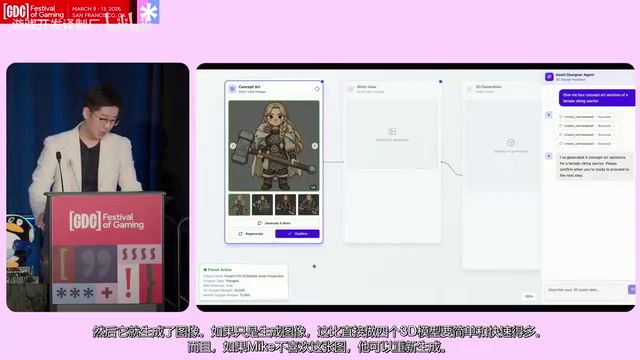
After selecting a concept image, the workflow moved into multi-view generation. The system produced images of the same subject from multiple angles, letting the designer confirm it matched expectations. Once approved, Tencent's Hunyuan3D engine (the HY3D assistant) generated a high-poly initial model with triangulated geometry and PBR materials applied according to the preset. The demo model was richly detailed — hair, skin texture, and armor reflections all convincingly reproduced the concept art.
Retopology: Solving the Multi-Platform Adaptation Problem
A high-fidelity model looks great, but it comes with a new problem: the polygon count far exceeds the studio's budget, and the topology is messy enough that it can't be used directly. This is where the optimization nodes built into the preset come into play.
The workflow includes two optimization nodes — one targeting PC and one targeting mobile — that retopologize the model for each platform. In one pass, Mike ends up with two models that each meet their respective deployment requirements: lower poly count for mobile, higher for PC, with clean topology and logical edge flow on both.
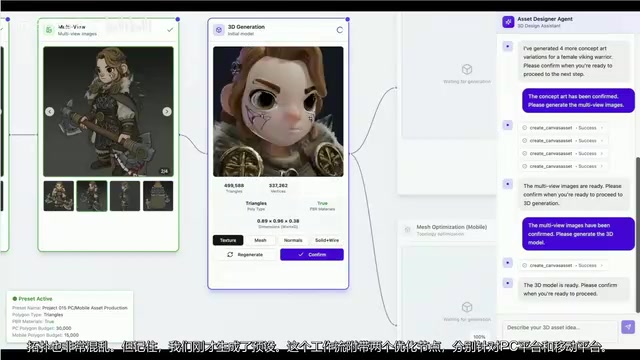
Designers no longer need to manually optimize meshes for different platforms — that process is handled automatically using knowledge drawn directly from studio documentation. On export, assets are automatically named according to naming conventions and placed in the correct folder structure. Eric was candid about the limitations: UV layout and material fidelity still have gaps the tool can't guarantee. "It can get you 90% of the way there, but human expertise is still needed for the remaining 10%."
Retopology is the process in 3D modeling of rebuilding a high-poly, topologically chaotic mesh into a clean, usable one. Initial models produced by AI generation or sculpting software typically consist of millions of triangles distributed randomly with no discernible pattern. While visually detailed, these models can't be used directly in game engines — they don't support skeletal animation rigging, they destroy rendering performance, and they're difficult to edit further. The goal of retopology is to reconstruct the model's surface using fewer quads, with edge flow following muscle lines or structural contours, while compressing the polygon count to within the target platform's budget. Traditionally this is done by hand and is one of the most time-consuming and technically demanding steps in the entire 3D pipeline — which is precisely what the automatic retopology node in the demo is designed to solve.
Three Core Technologies Behind the Solution
RAG (Retrieval-Augmented Generation) is the foundation of the entire system. Eric stressed that without RAG, agents will make things up. By retrieving from a knowledge base with RAG, responses can be both accurate and relevant. All agents in the demo are built on Tencent's ADPAd platform, which supports over 30 data types and features an improved retrieval architecture for greater accuracy and nuance.
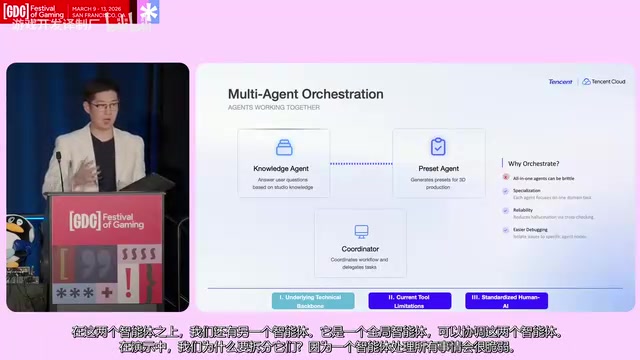
Multi-agent orchestration is the other key piece. The first application contains two sub-agents — one for understanding studio standards, one for creating presets for the 3D assistant — with a global orchestrating agent above them both. The reason for the split: having a single agent handle everything is brittle. Breaking it up makes each agent simpler, and simpler means more reliable and easier to debug. For studios, this means starting small — one agent, one task — and building up gradually.
HY3D (Hunyuan3D) bridges the path from concept to image and from image to 3D model. It currently supports generating a model from 8 multi-view images, making the result more accurate from every angle. Beyond the retopology shown in the demo, HY3D also provides UV unwrapping — Eric specifically called out UV unwrapping as one of the most time-consuming tasks for designers, making this capability particularly valuable.
RAG (Retrieval-Augmented Generation) is a technical architecture that combines large language models with external knowledge bases. Traditional LLMs draw knowledge from training data and suffer from "hallucination" — when asked about domain-specific details, a model may generate content that sounds plausible but is factually wrong, with high apparent confidence. RAG's solution is to retrieve the most relevant passages from an external document library before the model generates a response, feeding those passages as context so the model has grounded material to work from. For a game studio, this means an agent's answers come from the team's own specification documents rather than the model's generalized guesses. Retrieval quality directly determines response quality, which means the degree to which documents are structured and the ongoing cost of maintaining the knowledge base are hidden workloads that can't be overlooked in real-world deployment.
What AI Can and Can't Do
The most valuable part of the talk was Eric's clear-eyed assessment of AI's limits. He stated plainly: AI cannot make decisions. It doesn't know what's right or what's better. If you give an agent a subjective goal like "make something great," it can't do anything with that. But if you give it clear guidance and constraints, it can produce excellent results for your team.
He repeatedly emphasized "human-in-the-loop" — building review checkpoints at every step of the workflow. "Agents are good at following rules, but humans are good at breaking them, so play to each one's strengths." This was the core insight the team drew from their experiments.
Four Practical Tips for Teams Ready to Get Started
For teams looking to implement something similar, Eric offered grounded advice:
Start small and stay specific. Don't try to boil the ocean. Pick the single most painful workflow — it might be onboarding new artists, generating asset proposals, or compliance checking.
Write down your knowledge first. Explicitly document standards like naming conventions and polygon budgets. Time invested in building the knowledge base pays dividends.
Keep humans in the driver's seat. Especially in design workflows, human taste and creative vision are irreplaceable. When agents make mistakes, you need artists to refine the output.
Measure before and after. Did onboarding time shrink? Did errors decrease? Use data tracking time saved to validate your return on investment.
Eric closed by saying that agentic AI is now powerful enough for use cases spanning web, coding, design, and creative work — helping teams expand the space they can explore. But it still cannot replace human vision and decision-making. That was the message he most wanted to leave the audience with.
Related articles

Chain of Thought Isn't Just for AI: How Humans Can Use CoT to Improve Thinking Quality
Chain of Thought isn't just a prompt trick for large models. Starting from a Hacker News discussion, this article analyzes why CoT works for human thinking too, breaks down actionable ways to transfer it, and highlights the key differences between human CoT and machine CoT.
Cloudflare Teams Up with OpenAI: Closi…
Cloudflare Teams Up with OpenAI: Closing the Loop from Vulnerability Discovery to Defense with AI
Cloudflare uses OpenAI Daybreak to investigate security vulnerabilities and generate reviewable remediation plans, while developers use Codex to boost coding efficiency and quality.

Orca Multi-Agent Orchestration in Practice: A Guide to Parallel Collaboration with Claude and Codex
Orca is Stable AI's free open-source agent workbench supporting 34 agents like Claude Code and Codex in parallel. Learn its Git worktree isolation, multi-model orchestration, and mobile management.