Tencent Hunyuan HY3 Official Version Open-Sourced: The Strongest Under 300B, at 1 Yuan per Million Tokens

Tencent open-sources Hunyuan HY3 at 1 yuan/million tokens; Meituan releases trillion-parameter LongCat 2.0 on domestic chips.
Tencent officially released and open-sourced the Hunyuan HY3 model under Apache 2.0, priced at just 1 yuan per million input tokens with strong gains in agents, reasoning, coding, and long context. On the same day, Meituan open-sourced its 1.6T-parameter MoE model LongCat 2.0—the first trillion-parameter model to run inference on 50,000 domestic compute chips—while Alibaba Qwen upgraded its FoneASR real-time speech recognition.
Tencent Hunyuan HY3 Official Version Released and Open-Sourced
Following the release of the HY3 preview version in April, the Tencent Hunyuan team has officially launched and open-sourced the HY3 official version. This official release is not merely an incremental version update, but a mature product introduced after systematic post-training optimization built upon the preview version.
So-called post-training refers to the process—after completing massive-scale data pre-training—of using techniques such as supervised fine-tuning (SFT), reinforcement learning from human feedback (RLHF), and direct preference optimization (DPO) to achieve targeted improvements in specific capability dimensions without altering the underlying architecture. The evolutionary trajectory of post-training techniques can be traced back to OpenAI's landmark InstructGPT paper published in 2022. Before that, while large language models possessed powerful text generation capabilities, they often produced harmful, false, or misaligned content relative to user intent—a phenomenon known as the "Alignment Problem." InstructGPT was the first to systematically introduce RLHF into large-model post-training, demonstrating that human feedback could significantly improve a model's helpfulness and safety, thereby pioneering the technical paradigm of modern conversational large models.
It's worth noting that these three stages each have distinct emphases and follow an inherent progression of technical logic: SFT (Supervised Fine-Tuning) uses high-quality human-annotated question-answer pairs to teach the model to "do as demonstrated," typically requiring thousands to tens of thousands of carefully curated demonstration samples—where data quality matters far more than quantity; RLHF trains a reward model to simulate human judges, then uses reinforcement learning to optimize the policy—its core challenge lies in the reward model itself potentially being "gamed" (Reward Hacking), where the model learns to deceive the reward model rather than genuinely improve output quality, a phenomenon known in the reinforcement learning literature as a manifestation of "Goodhart's Law"; DPO is a simplified alternative to RLHF—proposed by a Stanford team in 2023, its core insight is to directly convert the reinforcement learning objective into supervised learning over preference data, fundamentally bypassing the instability of reward model training. It optimizes directly on preference data pairs (a pairing of a better response and a worse response), eliminating the step of independently training a reward model, making it more stable and efficient, and it quickly became a widely adopted alignment solution across the industry. After DPO, variants like SimPO and ORPO further reduced dependence on reference models, continuously lowering the engineering cost of alignment training. This combination of techniques is the core methodology by which today's mainstream large-model vendors improve the "alignment" quality and practicality of their models. Through this systematic post-training process, the HY3 official version achieved significant improvements across multiple core domains.
Based on the officially published benchmark data, Hunyuan HY3's improvements in key domains—including agents, reasoning, coding, and long-context processing—are particularly notable. An "agent" in the large-model context is not the autonomous AI of science fiction, but an engineering paradigm that grants the model "tool invocation + multi-step planning" capabilities. Its core architecture typically comprises four components: perception (receiving task descriptions and environmental states), planning (decomposing complex tasks into executable sub-steps), action (invoking external tools such as search engines, code interpreters, and database queries), and memory (maintaining short-term conversational context and long-term knowledge storage). The ReAct framework released by Princeton in 2023 pioneered the interweaving of "reasoning" and "action," becoming foundational work in the agent field, followed by official API designs like OpenAI Function Calling and Anthropic Tool Use that standardized agent capabilities.
Notably, the evaluation systems for agent capabilities are themselves rapidly evolving: early on, single-step tool invocation success rate was the core metric, whereas today the industry focuses more on the stability of multi-hop reasoning chains (i.e., a model's ability to avoid "hallucination drift" across five or more consecutive planning steps), the parameter accuracy of tool invocations (especially the format compliance rate of structured JSON output), and the self-correction ability upon task failure. The rise of specialized evaluation benchmarks like WebArena and AgentBench is a direct response to this need. These directions represent the most fiercely contested capability dimensions in the current large-model competition and best reflect practical value. For developers, the enhanced coding and agent capabilities mean significantly increased potential for real-world production deployment.
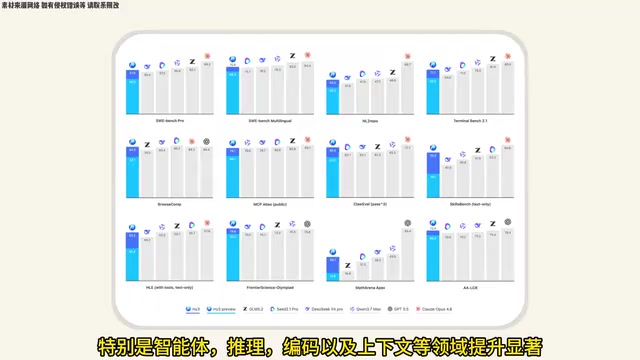
The official statement makes clear that HY3 outperforms DeepseekAd V4 Flash of comparable parameter scale in most scenarios and scored higher on average than GLM-series models in internal blind tests. Tencent positions it as "the strongest model under 300B parameters," a confident assertion of its own product capabilities that also reflects the intense competition among domestic large models in the mid-scale parameter range.
Highly Competitive Pricing and Openness Strategy
The most noteworthy aspect of the Hunyuan HY3 official version is its aggressive cost strategy. API pricing is 1 yuan per million input tokens and 4 yuan per million output tokens—highly competitive among comparable models. There is a technical economics logic behind this pricing: output prices are typically higher than input prices because the output stage requires autoregressive decoding (each generated token requires a full forward inference pass), while the input stage can leverage the KV Cache (Key-Value Cache) mechanism to reuse already-processed context, resulting in relatively lower computational load. The low invocation cost dramatically lowers the trial-and-error barrier for developers, helping to drive large-scale adoption of the model across various application scenarios.
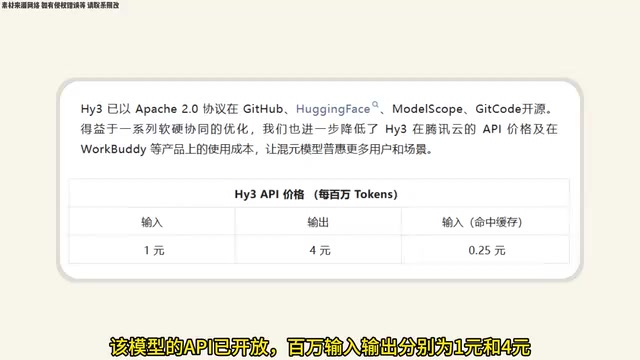
Currently, HY3 is available for free experience on platforms such as WorkBuddyAd and Tencent Yuanbao, and has been officially open-sourced under the Apache 2.0 license. Apache 2.0 is one of the most enterprise-favored licenses in the AI open-source field, and is entirely different from "copyleft" licenses like GPL—it allows anyone to freely use, modify, and distribute the source code, and even use modified versions in closed-source commercial products, without needing to return derivative code to the open-source community. The only requirement is to preserve the original copyright notice and state in the documentation that the project was used.
From the competitive landscape of AI open-source licenses, Apache 2.0 and the MIT license rank as the two most enterprise-friendly options, the difference being that Apache 2.0 additionally provides patent grant terms—meaning the original author explicitly grants users the right to use the code within the scope of their patent rights, which is especially critical for the legal compliance of large enterprises. By contrast, Meta's early Llama 1 used a custom license with additional commercial restrictions, drawing community criticism; Llama 2 and Llama 3 gradually loosened restrictions but retained a clause requiring re-licensing for entities with over 700 million monthly active users, while starting from Llama 3.1 they switched to a nearly fully open license. This series of changes clearly illustrates the trajectory of major players' dynamic balancing act between "openness" and "ecosystem control." Tencent's adoption of the Apache 2.0 license means that startups, independent developers, and even large enterprises can build commercial products based on HY3, positively driving the prosperity of the domestic open-source ecosystem.
Meituan Open-Sources Trillion-Parameter Model LongCat 2.0
In step with Tencent, Meituan also officially open-sourced its trillion-parameter model LongCat 2.0. The model has a total of 1.6T parameters, employs an MoE (Mixture of Experts) architecture, and activates approximately 48B parameters on average.
The MoE architecture is one of the mainstream design paradigms for today's ultra-large-scale language models. Its modern form can be traced back to Google's 2017 paper "Outrageously Large Neural Networks," but what truly ignited the MoE era was Google's Switch Transformer in 2022, which demonstrated that trillion-parameter-scale sparse models could be trained efficiently. Its core idea is to partition the model into multiple "expert" sub-networks, with a lightweight "router" dynamically selecting a few experts to participate in the computation during each inference, rather than activating all parameters.
In current mainstream MoE implementations, routing mechanisms fall into two main categories: Top-K routing (each token selects K experts, typically K=2) and Expert Choice routing (each expert actively selects which tokens to process)—the former is the standard choice for models like DeepSeek and Mixtral, while the latter has advantages in load balancing but is more complex to implement. The router itself is typically an extremely lightweight linear layer plus Softmax with minimal parameters, yet the quality of its decisions has a profound impact on overall model performance: Router Collapse is a common ailment in early training, manifesting as all tokens being assigned to one or a few experts, causing most experts to "starve" and fail to receive effective training. To address this, training usually introduces two measures—Auxiliary Load Balancing Loss and Expert Capacity Factor—the former uses gradients to guide the router toward even distribution, while the latter sets a token processing cap for each expert, with tokens exceeding the cap being dropped or handled via overflow.
This sparse activation mechanism allows the model to possess an extremely large total parameter count (raising the model's capacity ceiling) while only invoking a small portion of parameters during actual inference (controlling computational cost). Taking LongCat 2.0 as an example, of its 1.6T total parameters, each inference activates only about 48B parameters on average (an activation ratio of about 3%), with a computational load comparable to that of an ordinary 48-billion-parameter dense model, yet it enjoys the stronger knowledge expression capability afforded by the trillion-parameter scale. This, together with DeepSeek-V3's 671B/37B configuration, represents the mainstream orientation in current MoE design that pursues the optimal balance between capacity and inference cost.
However, MoE is not without costs: beyond the routing imbalance problem, in distributed inference, different experts may be distributed across different devices, requiring tokens to be dynamically routed and transmitted between devices, which demands substantial All-to-All communication within the cluster (i.e., each GPU must send and receive data to and from all other GPUs). The bandwidth demand of All-to-All communication grows linearly with the number of experts and cluster scale, imposing extremely high requirements on network interconnect bandwidth—this is one of the core reasons why high-speed NVLink interconnect offers value far exceeding ordinary InfiniBand in MoE deployment scenarios. For this very reason, mainstream models with similar designs such as GPT-4, Mistral, and DeepSeek all face very high engineering barriers in large-scale deployment.
The most milestone-worthy aspect of LongCat 2.0 is that it is the industry's first trillion-parameter model to complete inference on a cluster of 50,000 domestic compute chips. Since October 2022, when the U.S. Bureau of Industry and Security (BIS) issued export control rules placing NVIDIA's A100 and H100 series GPUs on the list restricting exports to China—and continuously escalated the intensity of these controls—autonomous and controllable domestic AI compute has become a strategic industry priority, with domestic chips such as Huawei Ascend 910B and Cambricon MLU370 seeing unprecedented demand.
However, stably training and running inference for ultra-large-scale models on these chip clusters faces enormous engineering challenges. NVIDIA's CUDA platform has undergone over 20 years of iteration, accumulating over 4,000 deeply optimized operator libraries, the highly optimized cuDNN operator library, the efficient NCCL collective communication framework, the TensorRT inference acceleration engine, and a development experience deeply integrated with PyTorch—the maturity of this software stack is where NVIDIA's true "moat" lies, far harder to replicate than the chip hardware itself. Domestic chip vendors are rapidly catching up via "CUDA compatibility layer" paths (such as Ascend's CANN framework and Iluvatar's CUDA-over-ILUVATAR solution), but there remain significant gaps in operator coverage, compiler maturity, and the stability of self-developed communication frameworks—especially in the All-to-All communication optimization that MoE models rely on, where the maturity of domestic solutions faces an important test. The success of Meituan's LongCat 2.0 is not only a powerful demonstration of engineering capability, but also holds important exemplary value for the autonomy and controllability of domestic AI infrastructure.
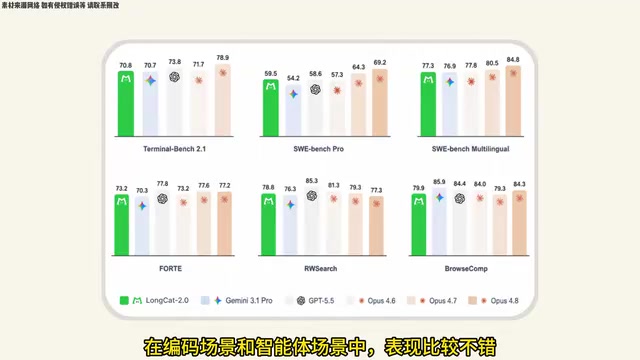
Meituan also simultaneously open-sourced the inference code based on domestic chips, enabling other teams to directly reference and reuse this engineering solution that has been validated in large-scale production—effectively providing the entire industry with a "pitfall-avoidance guide" that can significantly reduce the cost and risk of migration and adaptation on domestic hardware, holding profound significance for the collaborative development of the entire domestic AI ecosystem. In coding and agent scenarios, LongCat 2.0 also demonstrates excellent performance.
Alibaba Qwen FoneASR Real-Time Speech Recognition Gets a Major Upgrade
The Alibaba Qwen team announced that the real-time speech recognition model FoneASR Realtime has received an important upgrade. The new version supports 16 dialects and 30 languages, greatly expanding its coverage.

In terms of performance, the model achieves 88% character accuracy across tests on 16 dialects, with first-token latency controlled at the hundred-millisecond level, and streaming recognition accuracy now approaching offline recognition levels. Understanding this achievement requires knowing the evolutionary lineage of streaming ASR technology: early HMM-GMM statistical models naturally supported frame-by-frame output; around 2014, Baidu's Deep Speech series introduced the CTC loss function, making end-to-end deep learning ASR mainstream—CTC introduced a blank symbol allowing the model to perform sequence learning under unknown alignment, supporting greedy frame-by-frame decoding with excellent streaming characteristics, though it could not leverage right-side context information; around 2019, the Attention encoder-decoder architecture comprehensively surpassed CTC in accuracy but introduced considerable latency due to its autoregressive decoding mechanism; to address this, the industry proposed solutions such as Chunk-based Attention (segmenting audio into fixed time windows for chunk-wise processing) to balance latency and accuracy; the most cutting-edge current trend is to introduce LLMs into the ASR post-processing pipeline, leveraging the powerful contextual understanding of language models to correct intermediate recognition results.
Dialect recognition is a long-standing unsolved technical challenge in the ASR field, rooted in the dual dilemma of data scarcity and internal linguistic variation: Mandarin has massive annotated corpora to draw upon, but the volume of high-quality annotated data for dialects such as Cantonese, Hokkien, and Wu is often two to three orders of magnitude smaller; more troublingly, significant regional variants often exist within the same "dialect" (for example, the Guangzhou and Hong Kong accents of Cantonese differ in both tone and vocabulary), which requires the model to possess fine-grained intra-dialect generalization ability. In recent years, multilingual pre-trained models (such as OpenAI's Whisper, pre-trained on 680,000 hours of multilingual data) have brought new approaches to dialect recognition—through joint training on large-scale, diverse data, models can learn shared acoustic feature representations across dialects, then achieve precise adaptation combined with dialect-specific fine-tuning data. FoneASR's achievement of 88% character accuracy across 16 dialects is precisely a real-world validation of this technical approach in Chinese dialect scenarios.
Offline ASR only begins processing after the user has finished an entire passage, allowing it to fully leverage complete surrounding context for higher accuracy; whereas streaming ASR must output text in real time while the user is speaking, making it extremely sensitive to latency—the core tension of streaming ASR is that accurate recognition requires sufficient context, while real-time output demands the model not wait for too much future information. "First-token latency" (Time to First Token, TTFT) is the core metric for measuring the responsiveness of streaming ASR, referring to the time from when the user begins speaking to when the first recognized character appears on screen. Hundred-millisecond latency is virtually "instantaneous" in human perception (cognitive psychology research shows that humans generally do not perceive audiovisual feedback delays within about 200ms, while delays exceeding 300ms produce a noticeable sense of "lag"), which is crucial for scenarios such as real-time subtitles, simultaneous interpretation, and voice assistants. Bringing streaming recognition accuracy close to offline levels is precisely a technical challenge the industry has long sought to overcome, and FoneASR's breakthrough is the result of the synergy between innovation in Chunk-based streaming inference architecture and highly optimized engineering practice. The model's API is now live on Alibaba Cloud's Bailian platform, and developers can invoke it directly.
First Global AI Governance Dialogue Held in Geneva
Beyond the technology race, AI governance issues continue to heat up. According to Cailian Press, the first Global Artificial Intelligence Governance Dialogue was held in Geneva, Switzerland, with approximately 1,500 delegates from around the world in attendance.
This dialogue was convened during a critical window for building the global AI governance system, and its backdrop is noteworthy. The 2023 AI Safety Summit at Bletchley Park in the UK set a precedent for formal dialogue among major-country governments on frontier AI risks, with both China and the U.S. participating in signing the "Bletchley Declaration"; the 2024 Seoul AI Summit further advanced the building of international consensus on "frontier AI safety"; meanwhile, the EU's Artificial Intelligence Act (EU AI Act) officially took effect in 2024, becoming the world's first systematic AI regulatory legislation, imposing mandatory compliance requirements on high-risk AI systems—the act adopts a risk-tiered regulatory framework, classifying AI systems into four levels: unacceptable risk (outright prohibition), high risk (strict compliance obligations), limited risk (transparency requirements), and minimal risk (basic freedom), exerting a profound impact on the export of AI products globally to the European market.
This two-day dialogue focused on four core themes: the opportunities and impacts of artificial intelligence, capacity building and the AI divide, safe and trustworthy artificial intelligence, and human rights and human oversight. The introduction of the "AI Divide" theme reflects the international community's deep concern over the uneven distribution of AI dividends—developing countries lag far behind developed countries in compute infrastructure, AI talent reserves, and data resources, posing the risk that technology may accelerate the widening of the North-South development gap. Notably, this concern is not unfounded: according to Stanford University's AI Index report, global private AI investment is highly concentrated in the U.S., China, and the UK, with the remaining countries combined accounting for less than 20%, while the geographic distribution of compute infrastructure is even more extreme. Geneva, home to numerous international organizations, was chosen as the venue for the first Global AI Governance Dialogue with distinct symbolic significance—incorporating AI governance into a global multilateral governance framework alongside the WTO, WHO, and ILO, aiming to endow this issue with a universal legitimacy that transcends bilateral competition. These themes reflect the shared concerns of global society regarding AI development—how to embrace the technological dividends while guarding against risks, bridging the digital divide, and safeguarding human values.
Summary
From Tencent Hunyuan HY3's high-cost-performance open-sourcing after systematic post-training optimization, to Meituan LongCat 2.0's trillion-parameter breakthrough on domestic compute via the MoE architecture, to Alibaba Qwen's dual breakthrough in streaming speech recognition latency and accuracy, this series of developments collectively embodies the coordinated advancement of domestic large models across three dimensions: capability, cost, and autonomy. On another front, the global governance dialogue in Geneva reminds us that behind rapid technological development, building a safe and trustworthy AI system is equally not to be overlooked. Domestic open-source forces are reshaping the global AI landscape at an unprecedented pace.
Key Takeaways
Related articles

Kimi K3.1 Hands-On Test: Open-Source Model Nears Opus, Video Generation Steals the Show
Kimi K3.1 completed motion graphics, 3D rendering, mini-games, and video generation in a live test. Analysis of its 2.8T MoE architecture, gap vs Opus/GPT, and hidden video generation.

Sam Altman: Why Life's Biggest Advice Should Still Come from Humans
OpenAI CEO Sam Altman on the limits of AI advice: AI can talk you out of an impulsive email, but life's biggest advice should still come from humans.

"Black October": Did AI Uncover 3% of All Critical Vulnerabilities Ever?
A Reddit post claims 3% of all critical software vulnerabilities ever were found in the past month, dubbed 'Black October.' We break down the statistical issues, how AI-assisted code auditing accelerates discovery, and how developers should respond.