Tencent Open-Sources Hy3D WorldClaw: Text-to-Explorable 3D Open World Generation

Tencent open-sources WorldClaw: text-to-explorable 3D world generation with editable, game-ready mesh assets.
Tencent's Hunyuan team has open-sourced Hy3D WorldClaw, a tool that generates large-scale explorable 3D open worlds directly from text prompts using an agentic workflow. Unlike video generation or Gaussian Splatting approaches, WorldClaw outputs editable, game-ready 3D mesh assets with proper geometry and UV mapping, making them directly usable in production pipelines for game development and virtual content creation.
A Different Kind of AI World Generator
Tencent's Hunyuan team recently released a groundbreaking open-source tool — Hunyuan3D WorldClaw. Unlike most world generation models on the market, WorldClaw doesn't generate video, nor does it rely on Gaussian Splatting technology. Instead, it uses an agentic workflow to directly generate large-scale, freely explorable 3D open worlds from text prompts.
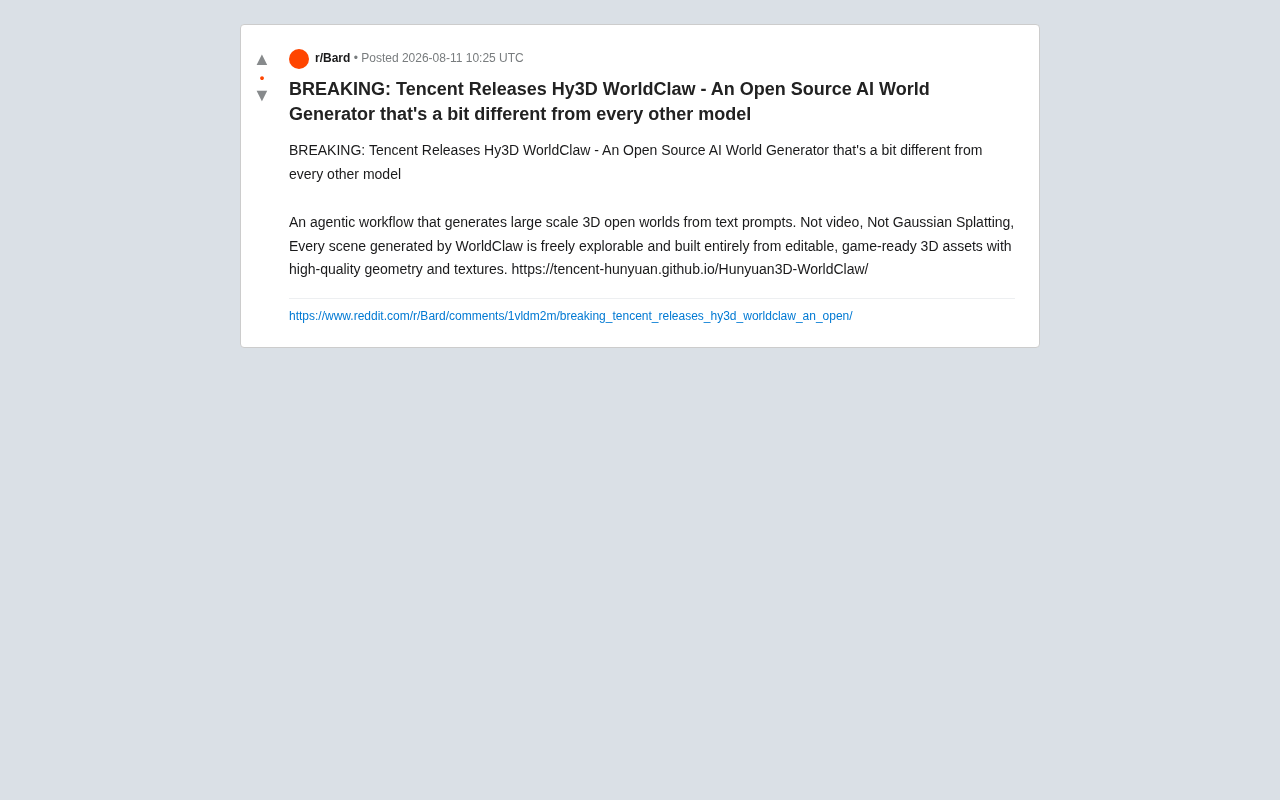
This distinction may seem like a technical detail, but its significance is profound. Most current AI world generation approaches either output fixed-viewpoint video sequences or produce point clouds and implicit representations that are difficult to edit. Every scene WorldClaw generates is composed of editable, game-ready 3D assets with high-quality geometry and textured surfaces. This means developers receive not a one-off demo reel that can't be reused, but genuine 3D content ready for production pipelines.
WorldClaw's Technical Approach: Why a Third Path
Why Not Video Generation or Gaussian Splatting?
Over the past two years, mainstream approaches to AI-generated 3D worlds have fallen roughly into two categories. The first is based on video generation models, simulating continuous scene changes through temporal frames — visually stunning but fundamentally "2D projections" that can't truly be entered or interacted with. The second is based on Neural Radiance Fields (NeRF) or Gaussian Splatting, capable of reconstructing scenes viewable from any angle, but typically outputting implicit representations or massive Gaussian point sets that can't be directly integrated into traditional game engine workflows.
About Gaussian Splatting: Gaussian Splatting is a 3D scene representation method proposed by the INRIA team in 2023 (3D Gaussian Splatting for Real-Time Radiance Field Rendering). Its core idea is to represent scenes using millions of 3D Gaussian functions, each carrying color, opacity, and covariance matrix information. Compared to traditional mesh models, Gaussian Splatting offers extremely fast rendering (achieving real-time frame rates) and high visual quality, but its output is essentially a collection of discrete Gaussian points lacking explicit surface topology — making it impossible to directly import into game engines like Unity or Unreal for editing and physics interactions.
About Neural Radiance Fields (NeRF): NeRF was proposed by the UC Berkeley team in 2020. It trains a multi-layer perceptron (MLP) to implicitly encode a scene's volumetric density and color information, enabling novel view synthesis from sparse images. NeRF pioneered neural scene representation, but its training is time-consuming, inference is slow, and its implicit output cannot be directly converted into editable geometric meshes. While subsequent accelerated variants like Instant-NGP and Nerfacto exist, the fundamental limitation of "implicit representations being hard to edit" remains.
WorldClaw chose a third path: directly generating structured, game-ready 3D mesh assets. This approach is more challenging because it requires the model to not only understand spatial scene layout but also output geometry with industry-standard topology and UV mapping. However, once this pipeline works, the practical value of its output far exceeds the other two approaches.
What Does "Game-Ready" Mean for 3D Assets? In the game development industry, "Game-Ready" assets have strict technical requirements: meshes need reasonable polygon counts (typically thousands for mobile, tens of thousands for PC), clean topology (no overlapping faces or non-manifold edges), proper UV unwrapping (for texture mapping without stretching or overlap), and PBR material textures including diffuse, normal, roughness, and metalness channels. Additionally, proper LOD (Level of Detail) settings are needed to accommodate different rendering distances. In traditional production workflows, taking an asset from high-poly sculpting through low-poly retopology to texture baking often takes technical artists hours to days. If WorldClaw can automatically output assets meeting these standards, it would dramatically lower the human labor barrier for 3D content production.
The Deeper Meaning of UV Mapping and Geometric Topology: UV mapping is the process of "unwrapping" a 3D model's surface onto a 2D plane, enabling 2D texture images to correctly wrap around 3D geometry. UV quality directly affects final rendering — poor unwrapping leads to texture stretching, visible seams, and other artifacts. Geometric topology refers to how vertices, edges, and faces connect and distribute across the mesh. Good topology should follow the natural curvature flow of an object's surface, densifying faces where detail is needed and keeping flat areas simple. These two technical metrics are the key dividing line between "rough AI-generated meshes" and "industrial-grade usable assets."
How the Agentic Workflow Collaborates to Generate 3D Scenes
At WorldClaw's core is an "agentic workflow" — multiple AI agents collaborating to complete the entire process from text understanding to scene construction. Agentic Workflow is a system architecture paradigm that has emerged alongside improvements in large language model capabilities. Unlike traditional single-model end-to-end inference, agentic architecture decomposes complex tasks into subtasks, each handled by a specialized AI agent. These agents coordinate through structured message passing, similar to microservice architecture in software engineering.
In WorldClaw's context, this likely means one agent handles parsing text semantics and planning spatial layout, another generates individual object meshes within the scene, and yet another assigns materials and UV maps to meshes. Compared to single-model end-to-end generation, agentic architecture can decompose complex tasks into multiple sub-steps: semantic parsing, layout planning, asset generation, material rendering, and more — each step calling upon specifically optimized modules. This divide-and-conquer strategy allows each component to be independently optimized and debugged. It not only improves controllability of generation quality but also provides natural interfaces for subsequent local editing and iteration — developers can intervene and modify at any intermediate step without regenerating the entire scene.
Practical Implications for Game Development and 3D Content Production
For game developers, indie creators, and metaverse content teams, WorldClaw's arrival could reshape the cost structure of 3D scene construction. Traditionally, building an explorable open world requires artists, level designers, technical artists, and other specialists working for weeks or even months. For a mid-sized open-world game, environmental asset production alone (buildings, vegetation, terrain, props) can account for over 40% of total art person-hours. By generating editable 3D assets directly from text prompts, the initial prototyping cycle can be dramatically compressed, freeing designers to focus more energy on gameplay validation and art style refinement.
More critically, the "editable" attribute means generated results aren't black-box final products but materials that developers can continue adjusting, optimizing, and recombining. This creates a collaborative rather than replacement relationship between AI generation and human creation — AI handles rapid production of foundational frameworks while humans handle refinement and creative direction. This "human-AI collaboration" model is becoming the dominant philosophy in AIGC tool design: the best AI tools don't replace creators but eliminate repetitive labor, letting humans focus on high-level creative decisions.
Strategic Considerations Behind Tencent's Open-Source Approach
Tencent's release of WorldClaw as open source continues the Hunyuan series' (Hunyuan3D) consistent open approach. In the AIGC field, open source has become a core strategy for leading companies competing for position in the technology ecosystem. Meta's LLaMA series and Stability AI's Stable Diffusion both rapidly built massive developer communities through open sourcing. The business logic of open source is: attract developers to build applications on top by providing free base models, forming a technology ecosystem centered on that model; simultaneously, feedback and secondary development from numerous external users rapidly expose issues and improve model quality, creating a positive flywheel effect.
In the fiercely competitive 3D generation space, open sourcing can rapidly attract developer ecosystems and accumulate usage feedback while helping establish authority over technical standards. For Tencent, being first to open source in a 3D generation space that hasn't yet consolidated into a monopoly helps position the Hunyuan3D series as the industry's de facto standard, subsequently generating long-term revenue through cloud services and commercial licensing. For the industry as a whole, an open, editable, game-ready 3D world generation tool will undoubtedly accelerate AIGC adoption in gaming and virtual content.
Of course, as a newly released project, WorldClaw's actual performance — including maximum scene scale, geometric precision, texture quality, and stability under complex prompts — still needs validation through extensive developer testing. The project page (tencent-hunyuan.github.io/Hunyuan3D-WorldClaw) is publicly available, and interested developers can get hands-on experience immediately.
Conclusion
Hy3D WorldClaw represents a new philosophy in AI world generation: rather than pursuing dazzling video demos, it directly addresses the core pain point of production deployment — outputting truly usable, editable 3D assets. By forging a third path beyond video generation models and Gaussian Splatting, Tencent's differentiated choice may be the critical step in moving AI-generated 3D content from "demo" to "production tool." For the entire 3D content creation industry, when generation tools can finally seamlessly integrate into existing production pipelines, AI-assisted creation will have truly crossed the threshold from "technical showcase" to "industrial application."
Related articles

ChatGPT Space Launches: Team Collaboration and New Pages Features Explained
ChatGPT Space is OpenAI's new team collaboration feature with Pages, real-time collaboration, and Slack/Google Drive sync. We break down its privacy design, multi-platform integration, and the full workflow from conversation to document.

Migrating Apache Spark UDFs to GPU Acceleration with AI Agents
NVIDIA developer blog explains how AI Agents rewrite Apache Spark UDFs for GPU acceleration, covering migration criteria, agent rewriting and verification workflows, plus pitfalls like result consistency and CPU-GPU transfer overhead.

Zed Editor v0.40.4-rc2 Released: Usage Credits Now Available Without Upgrading
Zed editor releases v0.40.4-rc2, allowing users to use usage credits for AI features without upgrading to a paid plan, lowering the trial barrier.