Tencent's Hunyuan Hy4 Flash Launches: Five Mao per Million Tokens as Price War Escalates
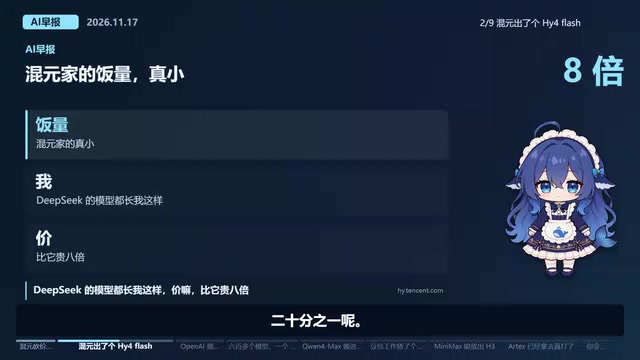
Tencent's Hunyuan Hy4 Flash shakes up the domestic LLM market at five mao per million tokens, distributed across five entry points.
Tencent releases Hunyuan Hy4 Flash — five mao per million input tokens, two yuan output, two fen cache hits, with the same workload costing one-twentieth of the previous generation and reportedly eight times cheaper than DeepSeek. It's available across Tencent Cloud, Yuanbao, WeCom, QQ, and the IME input method. Other news covers OpenAI's free researcher credits, Hugging Face's unified open-weights scheduling, Keywin4 Max in the Versal gateway, Doubao's workbench, and MiniMax's open-weights image model. Security-wise, the FBI disclosed the open-source hacking tool Artex being used in real attacks. The author argues model switching depends on call structure, with latency and availability mattering more than price in production.
The Hunyuan family has a new member. According to a morning briefing video by Bilibili creator "Da Fei Yu AI" (Big Fat Fish AI), Tencent has officially released the Hunyuan Hy4 Flash model, with input pricing pushed down to five mao per million tokens, output at two yuan, and cache hits at just two fen. In today's domestic large model market, this pricing is essentially flipping the table.
How Aggressive Is the Pricing: One-Twentieth of the Previous Generation
According to the video, completing the same workload with Hy4 Flash costs only one-twentieth of the previous generation model. This reduction isn't a short-term promotion propped up by subsidies — it's the result of optimizations to model architecture and inference efficiency.
A sideways comparison makes it clearer: the video states that DeepSeekAd's model is eight times more expensive in equivalent scenarios. In other words, Hunyuan has made "five mao per million tokens" the new price anchor — other vendors either follow or lose their voice in the cost-effectiveness narrative.
For developers calling APIs at high frequency, this means the cost pressure on batch tasks that previously required careful budgeting — long document summarization, batch translation, customer service bots — is greatly relieved. The two-fen cache hit pricing is clearly designed to encourage context reuse, making it well suited for multi-turn conversations and fixed knowledge base Q&A scenarios.
Token pricing and cache hits are two key concepts for understanding large model API costs. A token is the basic unit of text a model processes; roughly, one English word corresponds to about 1.3 tokens, and one Chinese character to about 1-2 tokens. At five mao per million input tokens, processing a 100,000-character Chinese novel costs only about one mao. Cache hit refers to when the context prefix of a request is exactly the same as a previous request, allowing the server to directly reuse the already-computed KV cache without re-inference, which is why the unit price can drop to two fen. This mechanism delivers the greatest benefit in scenarios with high prefix repetition — multi-turn conversations, fixed system prompts, knowledge base Q&A — while batch tasks where each request differs cannot easily enjoy cache discounts. Cost evaluation must distinguish between these two types of workloads.
Five Entry Points at Once: More Than Just an API
Another highlight of Hy4 Flash is its distribution channels: it's simultaneously available in five places — Tencent Cloud, Yuanbao, WeCom, QQ, and the IME input method.
The logic behind this layout is clear — the API price war targets developer mindshare, while Yuanbao, WeCom, QQ, and the input method reach ordinary users and B2B office scenarios. The input method integration is particularly noteworthy: the IME is the entry point closest to users' daily input behavior, and embedding model capabilities here means Hunyuan is trying to make "calling a large model" something users don't even notice.
Also in This Edition: Free Credits for Researchers and Open-Source Ecosystem Shifts
There are several other items worth noting in this briefing. OpenAI is releasing 50,000 free Plus spots for researchers this round — each person can bring two others, first come first served, and PhD students can pay nothing at all.

Hugging Face has handed unified scheduling of over 600 open-weights models to OpenMoodle — one token, one interface, no reconfiguration needed when switching models, and open-weights models average four times cheaper than closed-source ones. This change is very practical for teams doing model selection and A/B testing — previously, switching models meant changing code, matching interfaces, and re-running load tests; now it's consolidated into a single scheduling layer, significantly reducing migration costs.
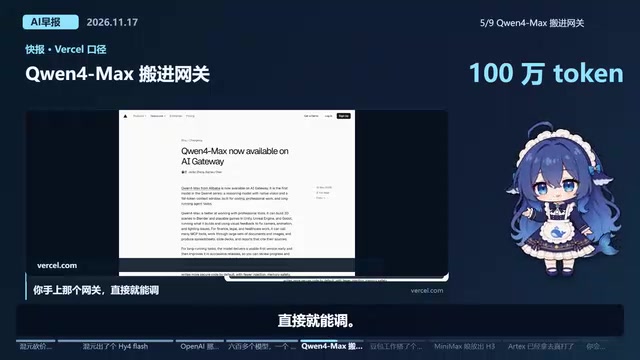
Tencent's own Keywin4 Max has also moved into the Versal gateway, supporting one-million-token context and native vision capabilities, callable directly from existing gateways.
ByteDance has built a workbench for Doubao, launching 21 professional scenarios, with the finance direction connected to Wind, 10jqka, and Guotai Haitong. The scenario coverage sounds comprehensive, but the video author's quip is amusing: none of the 21 scenarios relate to cooking — the standard for "professional" deserves more thought.
MiniMax's 200H3 open-weights image model has also been released, capable of both generation and editing, with up to sixteen reference images — open weights mean you can deploy it yourself.

Open-weights models refer to models whose parameter weights are publicly released by the vendor, allowing users to download and deploy them themselves, as opposed to closed-source models that only offer API access. They are not equivalent to fully open source — training data and training code may not be public, and licenses may restrict commercial use. The core value of open weights lies in private deployment: data never leaves the internal network, models can be fine-tuned for specific tasks, and they're unaffected by API rate limits or price increases — suitable for teams sensitive to data compliance or with extremely high call volumes. The trade-off is bearing GPU inference costs and operations work yourself, which can be less economical than pay-as-you-go APIs at small scale. The "four times cheaper on average" mentioned in the article typically compares self-hosted inference versus closed-source API costs at equivalent call volumes, and depends heavily on hardware utilization and batching optimization.
Model gateways and unified scheduling layers deserve a separate explanation. APIs from different vendors differ in authentication methods, request formats, parameter naming, and streaming return protocols; teams often have to change code, reconfigure keys, and rewrite load-test scripts every time they switch models. Gateway layers abstract these differences into a unified interface — business code is written against one protocol, and switching backend models only requires changing configuration. Such solutions can also enable multi-model routing (directing tasks to expensive or cheap models based on difficulty), automatic failover, unified billing, and log auditing. For teams doing A/B testing, unified scheduling means calling multiple models in parallel for comparison without maintaining multiple clients, significantly reducing the cost of trial and error in model selection.
A Security Warning
The FBI has disclosed that an open-source AI hacking tool called Artex has been used in real attacks, targeting a US IT company and the South Korean financial sector, gaining highest privileges in under three hours. Anyone can download open-source tools, lowering the barrier to attack — a reminder for any team running online services: default configurations, weak passwords, and unpatched vulnerabilities won't hold up long against automated tools.
Automated attack tools lowering the barrier is one of the core topics in current AI security discussions. Traditional penetration testing requires attackers to have deep system knowledge, while large-model-based attack tools can automatically complete information gathering, vulnerability identification, and exploit chain orchestration, compressing work that once took days into hours. The "highest privileges in under three hours" mentioned in the article typically starts from services exposed to the public internet, exploiting default passwords, unpatched known vulnerabilities, or misconfigurations to move laterally step by step. The direct lesson for online teams: asset inventory, timely patching, enforced strong passwords and multi-factor authentication, and the principle of least privilege — these foundational tasks are further elevated in priority in the face of automated attacks, not replaced by new AI technology.
Whether to Switch Models Depends on Your Call Structure
Back to the question: now that the pricing is out, should you replace your default model?
If your business is mainly large-scale text processing with modest demands on extreme reasoning capability, Hy4 Flash's cost advantage is hard to ignore. If tasks involve complex agent orchestration or long-chain reasoning, price is only one decision variable — stability, context capability, and tool-calling performance also matter. The video author's attitude is refreshingly relaxed — switch or don't, the key is to do your own math.
With the price war at this stage, developers benefit in the short term; in the long term, it depends on whether vendors can continue delivering reliable service on top of low prices. Five mao per million tokens sounds tempting, but when you actually run production workloads, latency, rate limits, and availability — the things not written on the price list — are what really determine whether you stay or leave.
One-line Summary
Tencent's Hunyuan Hy4 Flash shakes up the domestic large model market with five mao per million tokens, distributed across five entry points simultaneously.
Paragraph Summary
Tencent has released the Hunyuan Hy4 Flash model — five mao per million input tokens, two yuan output, two fen cache hits, with the same workload costing only one-twentieth of the previous generation; the video claims it's eight times cheaper than DeepSeek in equivalent scenarios. The model is available simultaneously across Tencent Cloud, Yuanbao, WeCom, QQ, and the IME input method, serving both developer APIs and seamless consumer use. Other news includes OpenAI's free Plus spots for researchers, Hugging Face's unified scheduling of 600+ open-weights models, Tencent's Keywin4 Max integrated into the Versal gateway, ByteDance's Doubao workbench, and MiniMax's open-weights image model. On the security side, the FBI disclosed that the open-source hacking tool Artex has been used in real attacks, gaining highest privileges within three hours. The author believes whether to switch models depends on your call structure — beyond low prices, latency, rate limits, and availability are the key production decision factors.
Related articles

Gemini 4 Neon Released: A Balance Between Frontier Intelligence and Efficient Task Execution
Google DeepMind releases Gemini 4 Neon, focused on frontier intelligence and fast end-to-end task execution. This article breaks down its benchmark performance in coding, enterprise analysis, scientific reasoning, and cybersecurity, its four thinking levels, pricing, and safety alignment data.

Is AI the Culprit Behind Global Outages? The Trust Crisis Behind the NSA and FAA Failures
Fourth major failure in five days hits NSA classified network. Microsoft blames a software bug, FAA denies its new AI system, NSA says routine maintenance. Senator Warner suggests AI accelerates vulnerability discovery, leading to rushed fixes — while 39% of Americans already view AI negatively, exposing a deepening trust crisis.

Robot Developer Builds Custom B-rep Kernel with 3,487 Tests
A robot developer builds a custom B-rep geometry kernel with 3,487 tests, exploring why robotics needs dedicated CAD tools and the barriers to building one.