Tenstorrent Valued at $6.2 Billion: The Independent Path of Open-Weight AI Chips

Tenstorrent raised $1.5B at a $6.2B valuation, staying independent and betting on open-weight AI chips.
Tenstorrent announced a $1.5 billion funding round at a $6.2 billion valuation, choosing independence after earlier acquisition interest. It positions itself as a champion of open-weight AI chips, emphasizing openness in hardware and software to compete with Nvidia's CUDA ecosystem. The article argues the funding reflects long-term capital interest in open alternatives, though ecosystem maturity will determine whether it can convert funding into real market traction.
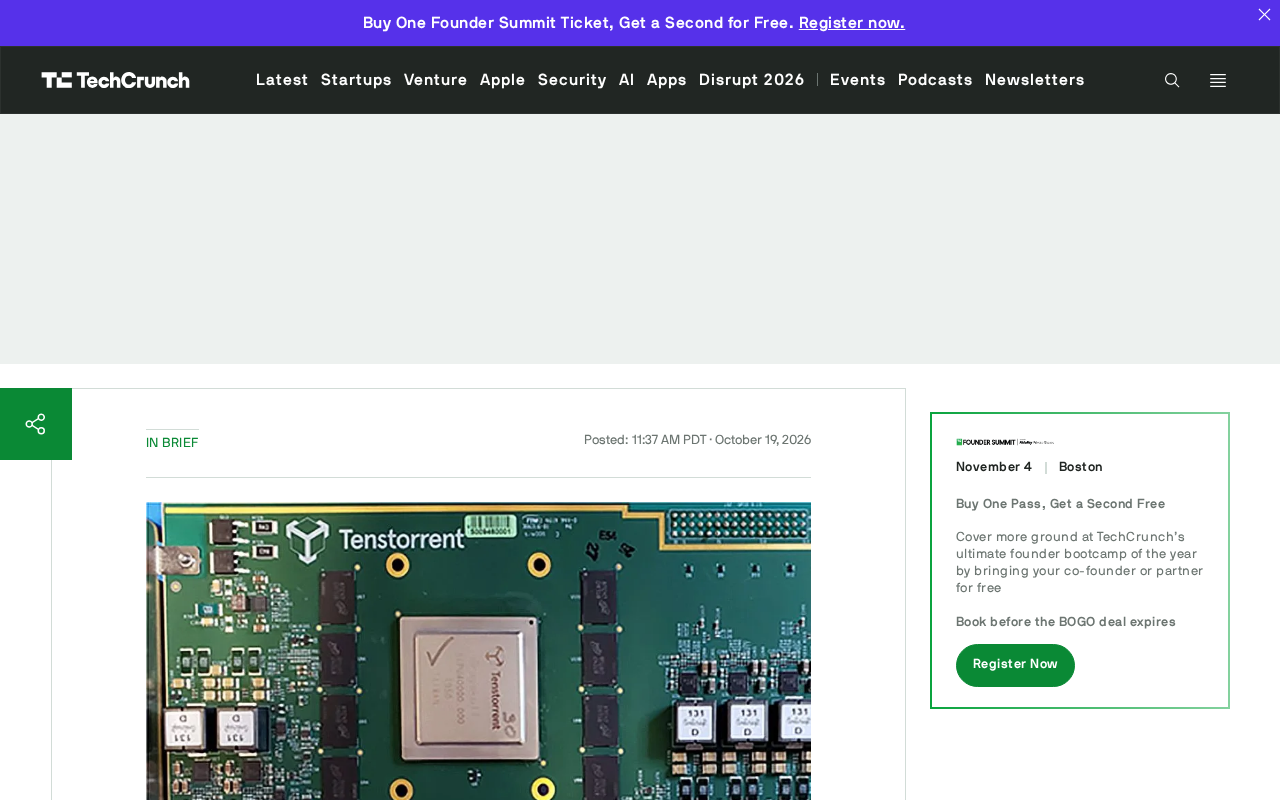
The competitive landscape in AI chips is quietly shifting. Tenstorrent, long viewed as one of Nvidia's challengers, recently announced it has raised $1.5 billion at a valuation of $6.2 billion. The funding not only allows the company to remain independent but also clarifies its chip strategy centered on "open weights."
From Acquisition Rumors to Independent Financing
According to the original report, Tenstorrent drew acquisition interest earlier this year but ultimately chose to raise capital to stay independent. The $1.5 billion injection pushed its valuation to $6.2 billion. The choice itself sends a clear signal: in AI chips—a field that is both capital- and technology-intensive—there is still capital willing to bet on the independent path.
For a company challenging Nvidia's dominance, staying independent means it can invest continuously in open-architecture R&D without being constrained by a parent company's strategy. But it also means it must deliver convincing results in product deployment and ecosystem building to justify that valuation.
What Open-Weight Chips Mean
Tenstorrent positions itself as a champion of "open-weight AI chips." Here, "open weights" does not refer to model weights; rather, it emphasizes the openness of its hardware and software stack—in contrast to the closed nature of Nvidia's CUDA ecosystem.
This approach appeals to developers and enterprise customers: they can deploy AI workloads without locking into a single vendor. Especially amid today's high AI compute costs, open architectures offer another option for companies seeking cost optimization and supply-chain diversification. However, the maturity of the open ecosystem and the completeness of the toolchain remain key to whether it can truly disrupt the market landscape.
It should be noted that "Open Weights" in the AI chip context differs from the concept of the same name in the open-source LLM space. In the model world, "open weights" means publishing parameters after training so others can download and fine-tune them; Tenstorrent, by contrast, emphasizes the openness and portability of hardware design specifications, instruction sets, and the accompanying software stack (compilers, runtimes, operator libraries), so customers are not deeply bound to a single vendor's proprietary ecosystem.
By contrast, Nvidia's CUDA is a closed parallel computing platform and programming model. Developers write GPU-accelerated programs through CUDA, and libraries and tools accumulated over more than a decade have created extremely high migration costs. The open route typically leverages open instruction sets such as RISC-V or open-source compiler frameworks (e.g., MLIR, TVM) to lower the barrier to porting, but the cost is that the vendor must bear the work of ecosystem building and compatibility validation itself.
The Collective Predicament and Opportunity of Nvidia Challengers
Tenstorrent's funding is a microcosm of the broader group of AI chip challengers. Nvidia's moat built on GPUs and CUDA remains deep, but market demand for alternatives has never been stronger. Cloud providers' in-house chips, startups' open architectures, and open instruction-set ecosystems are all advancing simultaneously.
A $6.2 billion valuation still looks small next to Nvidia's hundreds of billions in market cap, but it reflects capital's long-term expectations for a "second supplier" and even "open alternatives." Whether Tenstorrent can turn the funding into product competitiveness and customer orders will determine whether this money extends its life or accelerates it.
CUDA (Compute Unified Device Architecture) is the parallel computing platform and programming model Nvidia has built since 2006 and has become the de facto software standard for AI training and inference. Its moat lies not only in hardware performance but also in more than a decade of accumulated acceleration libraries such as cuDNN, TensorRT, and NCCL, as well as the developer habits, textbooks, and talent pool that have formed around it. Even competitors that approach Nvidia in chip compute often need to rewrite large numbers of operators and framework adaptation layers, making migration costly.
For this reason, challengers generally take two paths: one is to be compatible with CUDA interfaces to lower the migration barrier; the other is to bet on open compiler stacks (such as Triton and MLIR) to build a software layer reusable across hardware. Each path has trade-offs—the former is easily criticized as lacking originality, while the latter requires time for the ecosystem to mature.
Editor's Observation
Tenstorrent's funding story has two dimensions worth watching: first, capital's confidence in the open-chip route; second, the practical feasibility of independent operation in the AI chip race. Valuation is a starting point, not an endpoint. Whether open-weight chips can move from concept to large-scale commercialization ultimately depends on whether developers vote with their feet.
One-line Summary
Tenstorrent raised $1.5 billion at a $6.2 billion valuation, remaining independent and championing the open-weight AI chip path.
Paragraph Summary
Tenstorrent announced a $1.5 billion funding round at a $6.2 billion valuation, after earlier drawing acquisition interest but ultimately choosing independence. The company positions itself as a champion of "open-weight AI chips," emphasizing an open hardware and software stack to differentiate from Nvidia's closed CUDA ecosystem and attract customers seeking cost optimization and supply-chain diversification. The article notes that the funding reflects capital's long-term expectations for a "second supplier" and open alternatives in AI chips, though the $6.2 billion valuation remains small relative to Nvidia's hundreds of billions. The maturity of the open ecosystem and toolchain—and whether it can translate into product competitiveness and customer orders—will determine whether Tenstorrent merely survives or accelerates.
Related articles

Kimi K3.1 Hands-On Test: Open-Source Model Nears Opus, Video Generation Steals the Show
Kimi K3.1 completed motion graphics, 3D rendering, mini-games, and video generation in a live test. Analysis of its 2.8T MoE architecture, gap vs Opus/GPT, and hidden video generation.

Sam Altman: Why Life's Biggest Advice Should Still Come from Humans
OpenAI CEO Sam Altman on the limits of AI advice: AI can talk you out of an impulsive email, but life's biggest advice should still come from humans.

"Black October": Did AI Uncover 3% of All Critical Vulnerabilities Ever?
A Reddit post claims 3% of all critical software vulnerabilities ever were found in the past month, dubbed 'Black October.' We break down the statistical issues, how AI-assisted code auditing accelerates discovery, and how developers should respond.