Terence Tao on the Six Core Competencies of Mathematical Thinking

Tao summarizes six core mathematical competencies that can serve as a checklist for evaluating AI math ability.
Terence Tao published "Six Math Essentials" on his personal website, systematically outlining the six most critical abilities in mathematical work and emphasizing that they jointly form the underlying framework of mathematical work rather than isolated skill points. The article earned 322 points and 58 comments on Hacker News, reaching well beyond the professional mathematics circle—programmers, researchers, and AI practitioners can all find dimensions to compare against their own work. Tao's plain writing style lets readers examine the distribution of their own abilities one by one. The article further suggests that the six competencies can serve as a checklist for evaluating AI's mathematical reasoning ability, revealing the real gaps in defining problems and choosing levels of abstraction better than benchmark scores. The original material is an RSS summary; the specific items of the six competencies require reading the original article.
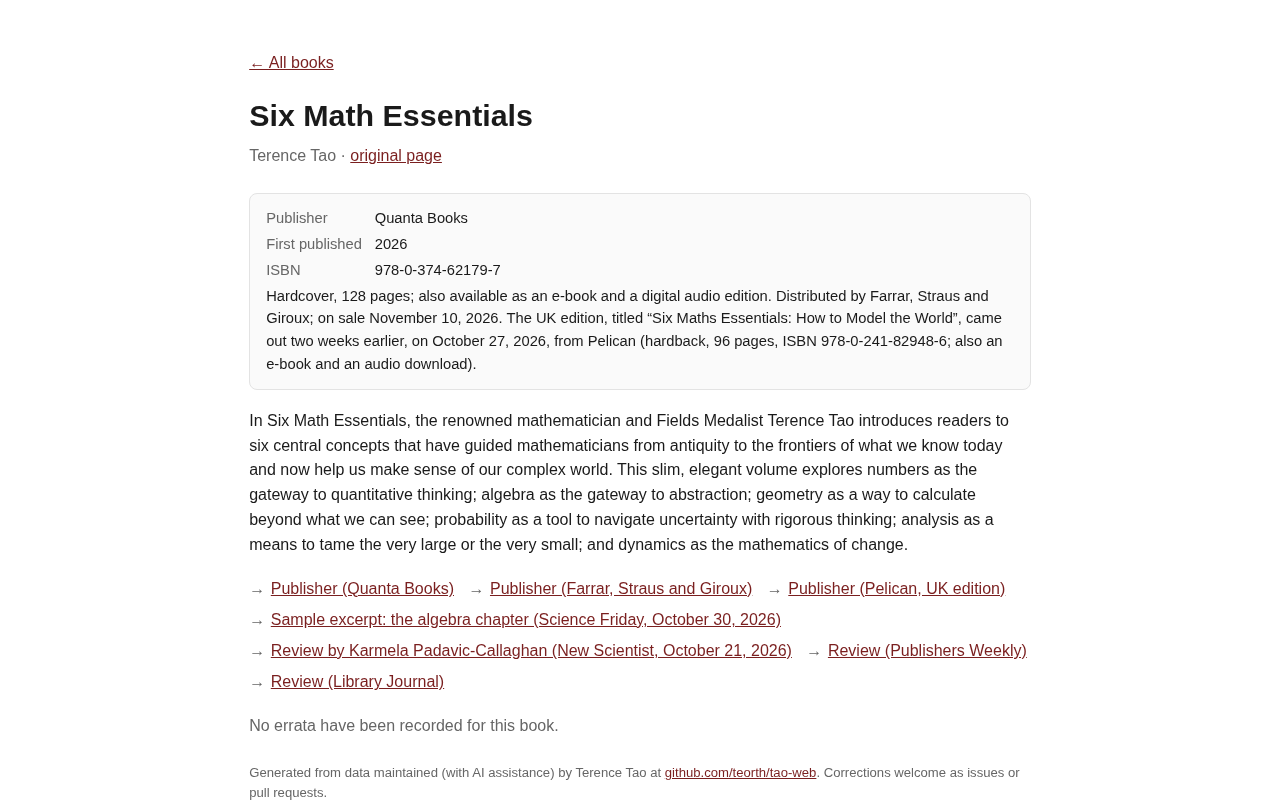
Mathematician Terence Tao published "Six Math Essentials" on his personal website, systematically outlining the six most critical abilities in mathematical work. The article sparked extensive discussion on Hacker News (322 points, 58 comments), drawing both professional researchers and a large number of engineering practitioners who hold mathematics in awe.
Tao has long been active in partial differential equations, number theory, combinatorics, and other fields, and is also a regular writer on mathematics for the public. This article does not list specific theorems but instead turns its focus back to "the mathematician's daily life"—which competencies truly underpin long-term research and problem-solving ability.
Positioning of the Six Competencies
The original article presents the six abilities as a whole, emphasizing that together they form the underlying framework of mathematical work rather than isolated skill points. This organizational approach itself conveys a judgment: mathematical ability is not a single-point breakthrough but the synergy of multiple competencies.
For readers without a mathematics background, this framework is equally valuable for reference. It breaks "being good at math" down from a vague impression into observable, trainable dimensions, and gives the relationship between AI and mathematics a more concrete point of entry for discussion.
Terence Tao is one of the most influential mathematicians of our time. He won the Fields Medal in 2006 and has long been active in partial differential equations, number theory, combinatorics, harmonic analysis, and other fields, and is also a regular writer on mathematics for the public. His personal blog (What's new) is known for accessible technical musings, often discussing meta-level topics such as mathematical research methods, tool use, and the academic ecosystem. This writing habit has given his views broad reach across both the professional mathematics community and engineering and AI communities. Understanding his background helps grasp the positioning of "Six Math Essentials": it is not a textbook-style skills checklist but a top researcher's reflective summary of his own long-term working methods, and is therefore better read as an experiential framework than as rigid standards.
Why Non-Mathematicians Should Care
The buzz of 58 comments on Hacker News shows that the article's audience extends far beyond the professional mathematics circle. Programmers care about abstraction and problem decomposition, researchers care about cross-domain transfer, and AI practitioners care about the shortcomings and potential of large models in mathematical reasoning.
Tao's writing style is consistently plain and free of jargon stacking. This mode of expression lets readers compare their own working habits against the six competencies one by one, and thereby examine the distribution of their own abilities—which dimensions are solid and which have long been neglected.
Hacker News is a technology community under Y Combinator, known for link aggregation and in-depth comments; its scores and comment counts are often used as a rough indicator of how widely an article has spread in tech circles. 322 points and 58 comments mean the article entered the day's hot discussions, and the discussion quality is usually high—participants are mostly engineers, founders, and researchers. For an article on a mathematical topic, this level of engagement shows the subject touches on the common concerns of tech practitioners, such as abstraction, problem decomposition, and AI reasoning. When evaluating such community data, readers can understand it as a signal of "cross-community attention" rather than a strict academic evaluation.
Mathematical Competencies and the AI Era: Complementary Perspectives
Large models continue to improve on mathematical benchmarks, but the truly difficult part is often not computation—it is defining the problem, choosing the level of abstraction, and judging whether a proof path is worth pursuing. These correspond precisely to the competency dimensions Tao lists.
One perspective worth noting: using the six competencies as a checklist for evaluating AI's mathematical ability reveals where the gaps lie better than looking at benchmark scores alone. Current models perform well on standardized problems, but there is still a clear distance in scenarios that require independently proposing conjectures and choosing research directions.
Benchmark refers to standardized datasets and scoring systems for evaluating AI model capabilities, such as GSM8K and MATH in the mathematics domain. Such tests can efficiently compare model accuracy on given problem types, but they also have clear limitations: problems are pre-defined by humans, scoring looks only at final answers, and they cannot reflect whether a model can propose conjectures, choose levels of abstraction, or judge proof paths. Therefore, looking only at benchmark scores can easily overestimate a model's mathematical competence, and frameworks like Tao's six competencies happen to offer an evaluation perspective that shifts from "solving problems" to "doing mathematics." Readers can treat benchmarks as a lower-bound indicator and the competency checklist as an upper-bound reference.
Original Link
The full article is available at: teorth.github.io/tao-web/six-math-essentials.html. Community discussion is at Hacker News.
(Note: This material is an RSS summary containing only the article title, link, and community engagement data; the specific items of the six competencies are not listed in the source material. Readers are advised to read the original article for the full content.)
Related articles
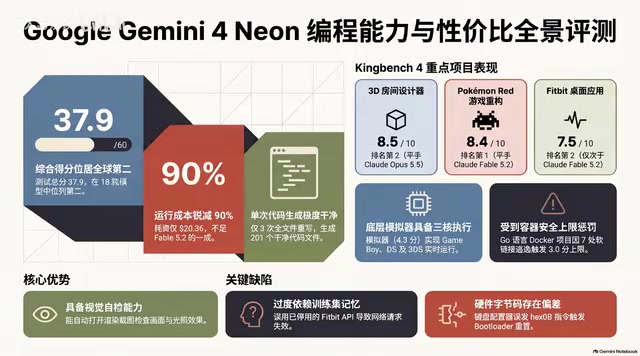
Gemini 4 Neon Hands-On: Value King or Confident Catastrophe?
Gemini 4 Neon review: 1M-token context, four thinking levels, 201 files in one KingBench4 pass at one-tenth Fable 5.2's cost—but it hallucinates fake data, leaves 7 symlink escapes, and bricks keyboards.

Google Gemini 4 Neon Hands-On: 6 3D Works That Impress and Fail
Hands-on with Google Gemini 4 Neon on a 3060 laptop: 6 3D works tested. Sunshower Fishing Harbor and mechanical keyboard impress; soft-body physics and faces fall short.
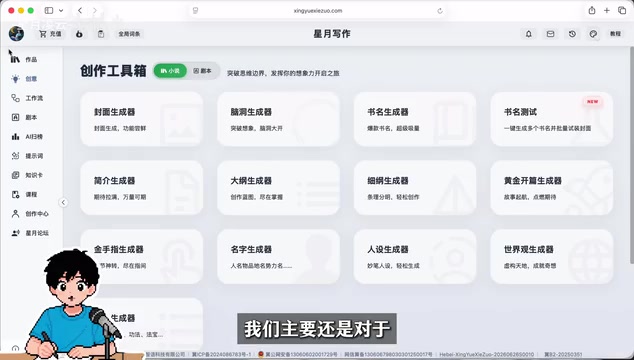
Gemini 4 Neo Web Novel Writing Test: Faint AI Flavor, Textured Dialogue
Bilibili creator's first-look review of Gemini 4 Neo for Chinese web novel writing: testing a Three Kingdoms transmigration opening with faint AI flavor, emotionally textured dialogue, and strong crisis building, plus comparison of 4A/4H/4C models and full workflow demos.