Terence Tao: We Need More Mathematicians in the Age of AI, Not Fewer

Terence Tao argues AI amplifies mathematical capability, making human mathematicians more needed, not less.
Fields Medalist Terence Tao argues that as AI advances in mathematical proof, demand for human mathematicians will grow rather than shrink. His core logic distinguishes execution from judgment — AI automates mechanical work like symbolic manipulation, freeing mathematicians to focus on posing questions and guiding research. AI-generated proofs also create a new verification bottleneck requiring experts fluent in formal tools like Lean. Supporters cite the Jevons Paradox, while skeptics wonder if the optimism only holds during a transitional phase. For practitioners, the key takeaway is to proactively master AI collaboration and formal proof systems.
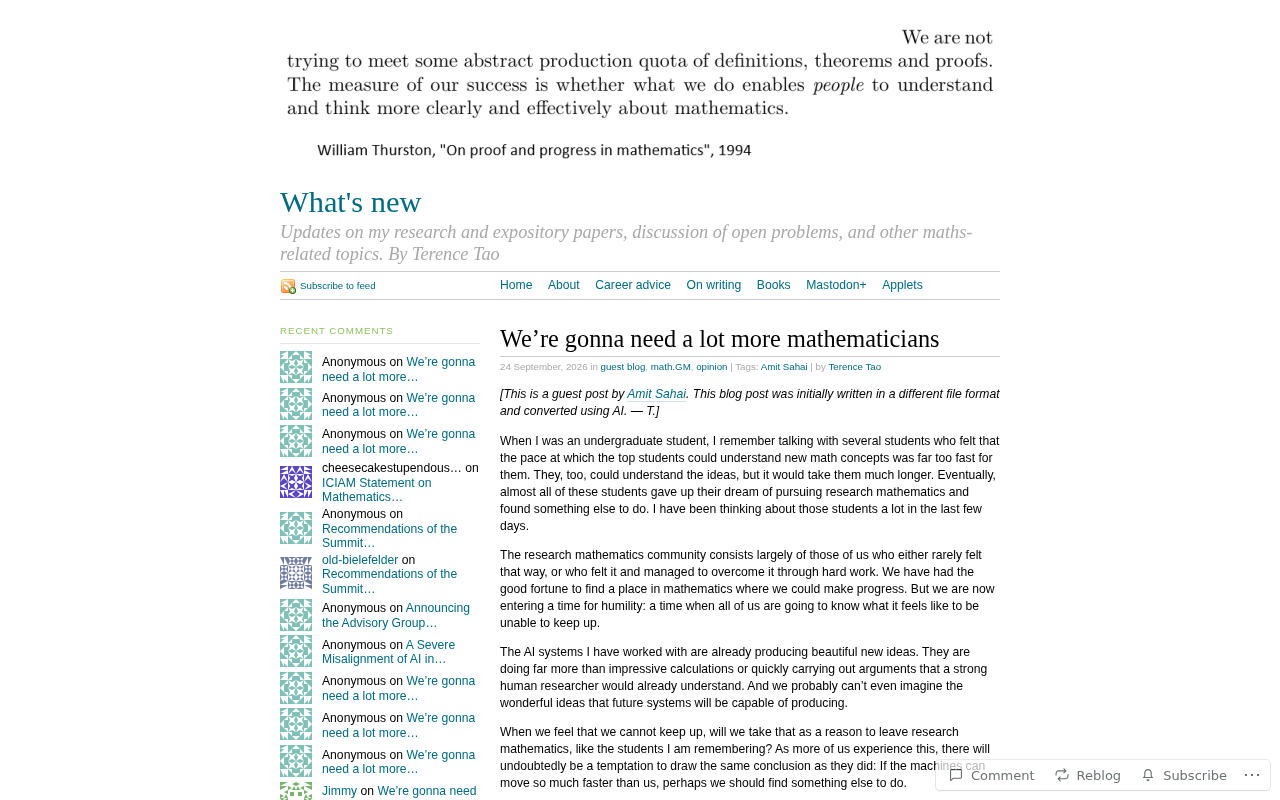
Fields Medal winner Terence Tao published a blog post titled We're gonna need a lot more mathematicians, sparking a lively discussion on Hacker News with over 300 comments (228 points). The post centers on a seemingly counterintuitive claim: as AI rapidly advances in mathematical proof and reasoning, human mathematicians won't be replaced — in fact, demand for them will grow.
Note: Since the original source material only contains metadata such as the title, link, and discussion metrics, this article's reconstruction of Tao's specific arguments is limited. The analysis is primarily based on his consistent public positions and the core stance conveyed by the title.
A Counterintuitive Claim
As large language models and formal proof tools like Lean increasingly demonstrate the ability to solve mathematical problems, a widespread anxiety has emerged: will the profession of mathematician be automated away? Tao's title offers the opposite answer — we will need more mathematicians, not fewer.
This view is consistent with positions he has taken on multiple occasions. Tao has long been an active practitioner of AI-assisted mathematics. He has publicly used GPT-series models and the Lean proof assistant to support his research, emphasizing that these tools change how mathematicians work — they don't eliminate the value of mathematicians themselves.
Tools Amplify Rather Than Replace Human Capability
The key to understanding Tao's argument lies in distinguishing between execution and judgment. AI can efficiently handle tedious symbolic manipulation, verify lengthy proof steps, and search for potential counterexamples — precisely the mechanical work that used to consume large amounts of a mathematician's time. Once this is automated, mathematicians can focus their energy on higher-level activities: asking good questions, building new concepts, and deciding which directions are worth exploring.
Historically, every powerful new tool — from calculators to computer algebra systems — has not reduced demand for mathematical talent. Instead, it has expanded the frontiers mathematics can reach. When the marginal cost of research falls, people tackle more and harder problems, which requires more experts with sound judgment to guide and validate the work.
Verification and Trust Become the New Bottleneck
AI-generated proofs can be long and difficult to trust outright, making verification a central new challenge. Formal verification tools like Lean play a key role here — they can mechanically check whether each logical step holds. But translating informal mathematical ideas into machine-verifiable formal language is itself a high-skill task requiring deep mathematical expertise.
In other words, the more powerful AI becomes and the more candidate results it can generate, the greater the need for people to frame the problems, scrutinize the outputs, and assess their significance. This "human-in-the-loop" requirement won't disappear — it will grow as the scale of output expands.
Lean is an interactive theorem prover developed by Microsoft Research and belongs to the family of "formal mathematics" tools. Its core idea is to translate mathematical proofs into logical expressions that can be mechanically verified by a computer, fundamentally eliminating the subtle errors that human reviewers might miss. In 2023, Tao collaborated with other mathematicians to use Lean in verifying a proof of the "polynomial Freiman-Ruzsa theorem" — a milestone marking top-tier mathematicians incorporating formal tools into cutting-edge research workflows. The Lean community maintains Mathlib, a vast library of formalized mathematics covering theorems from basic algebra to topology, providing AI models with a structured mathematical knowledge base to learn from and build upon. Translating a naturally written mathematical proof into Lean often takes more time and effort than writing the original proof — which is precisely why human experts remain indispensable in the AI era.
Diverging Views in Community Discussion
The discussion on Hacker News was far from unanimous. Supporters saw this as a confirmation of the Jevons Paradox — efficiency gains tend to increase total demand, just as automation didn't eliminate software engineers but gave rise to a vastly larger industry.
Skeptics worry, however, that if AI eventually becomes capable of independently completing the full chain from posing a question to verifying an answer, the optimistic forecast of "more mathematicians" may only hold during a transitional period. This divide reflects a fundamental uncertainty about the upper limits of AI capability: is it a powerful assistive tool, or a potential full replacement?
The Jevons Paradox was first proposed by British economist William Stanley Jevons in his 1865 work The Coal Question: improvements in steam engine efficiency did not reduce coal consumption — on the contrary, lower operating costs led to a dramatic increase in total consumption. This phenomenon is widely cited in the economics of technology to illustrate that "efficiency improvements tend to stimulate demand growth rather than proportionally reducing resource use." In software, the emergence of IDEs, compilers, and code generation tools did not reduce the number of programmers — it gave rise to a far larger software industry. Similarly, the invention of spreadsheets didn't eliminate accountants; it expanded the scope of financial analysis. Applying this framework to mathematics suggests that AI, by lowering the "unit cost" of mathematical research, will prompt society to pose and attempt to solve far more mathematical problems across science, engineering, finance, and beyond — generating greater demand for the human mathematicians who can guide this process.
Implications for Practitioners
Whatever the ultimate outcome, Tao's stance points to a pragmatic course of action: rather than resisting or fearing these tools, actively learn to use them. Familiarity with formal proof systems and the ability to collaborate with AI in posing and verifying mathematical claims are becoming essential skills for the next generation of researchers.
Mathematics education and talent development will need to adapt accordingly — future mathematicians may need to combine traditional mathematical intuition with the ability to work alongside machines. From this perspective, "needing more mathematicians" is not just a quantitative prediction, but a new set of demands on the capabilities those mathematicians must possess.
Related articles

Workbuddy for Absolute Beginners: How a Desktop AI Agent Fits Into Real Workflows
A beginner's guide to the Workbuddy desktop AI agent: installation, claiming credits, file management, and building automated workflows—compared with CodeX for fit and cost, helping professionals shift from AI question-askers to AI managers.

OpenAI's New Agent Stack: Computer Use, Decisions API, and Ultra-Fast Workflows
OpenAI Dev Day unveiled a new agent stack: Computer Use outperforms humans, Decisions API delivers ultra-low-latency classification via Luna, Agents API opens the same Computer Use capabilities, and GPT-6.1 Sol costs only one-seventh of Astra. Core updates, benchmark data, and developer insights.

Liang Wenfeng Open-Sources DeepInfo Inference Framework, Takes On U.S. Ban
DeepSeek open-sources its DeepInfo inference framework after its models, featuring GPU/CPU cross-pipelining, small-model prediction with large-model verification, and full Huawei Ascend and NVIDIA chip support—facing the U.S. federal ban head-on. This article analyzes its significance for AI deployment and open-source strategy.