Termi Protocol: Watch AI Coding Agents in a 3D Room and Hand Off Tasks Across Models

Termi Protocol visualizes coding agents at 3D desks and supports cross-model handoff and team orchestration.
Termi Protocol tackles mixed logs and unclear states when multiple coding agents run in parallel by placing real agents like Claude Code, Codex, and Gemini in a 3D room showing file operations, commands, and edits as desks. Its key update is cross-model handoff: when an agent hits usage, rate, or context limits, it saves goals, changed files, errors, and to-dos for an agent on another model to continue. A boss agent handles decomposition and assignment, deleted agents go to a recycle bin, and it covers three platforms. With 72 votes and 16th place on Product Hunt, it's still early — whether 3D visualization becomes noise at scale and whether handoff state is complete remain to be verified.
AI coding tools are moving from "code suggestions in a chat box" to "agents that actually do the work for you." But new problems come with that: when agents like Claude Code, Codex, and Gemini quietly read and write files and run commands in the background, all you usually see is a stream of scrolling logs — it's hard to tell what they're actually doing, and even harder to judge progress. Termi Protocol's solution is a bit counterintuitive: put coding agents in a 3D room, have them sit at their own desks working like colleagues, and let you observe every action as if you were walking through the office.
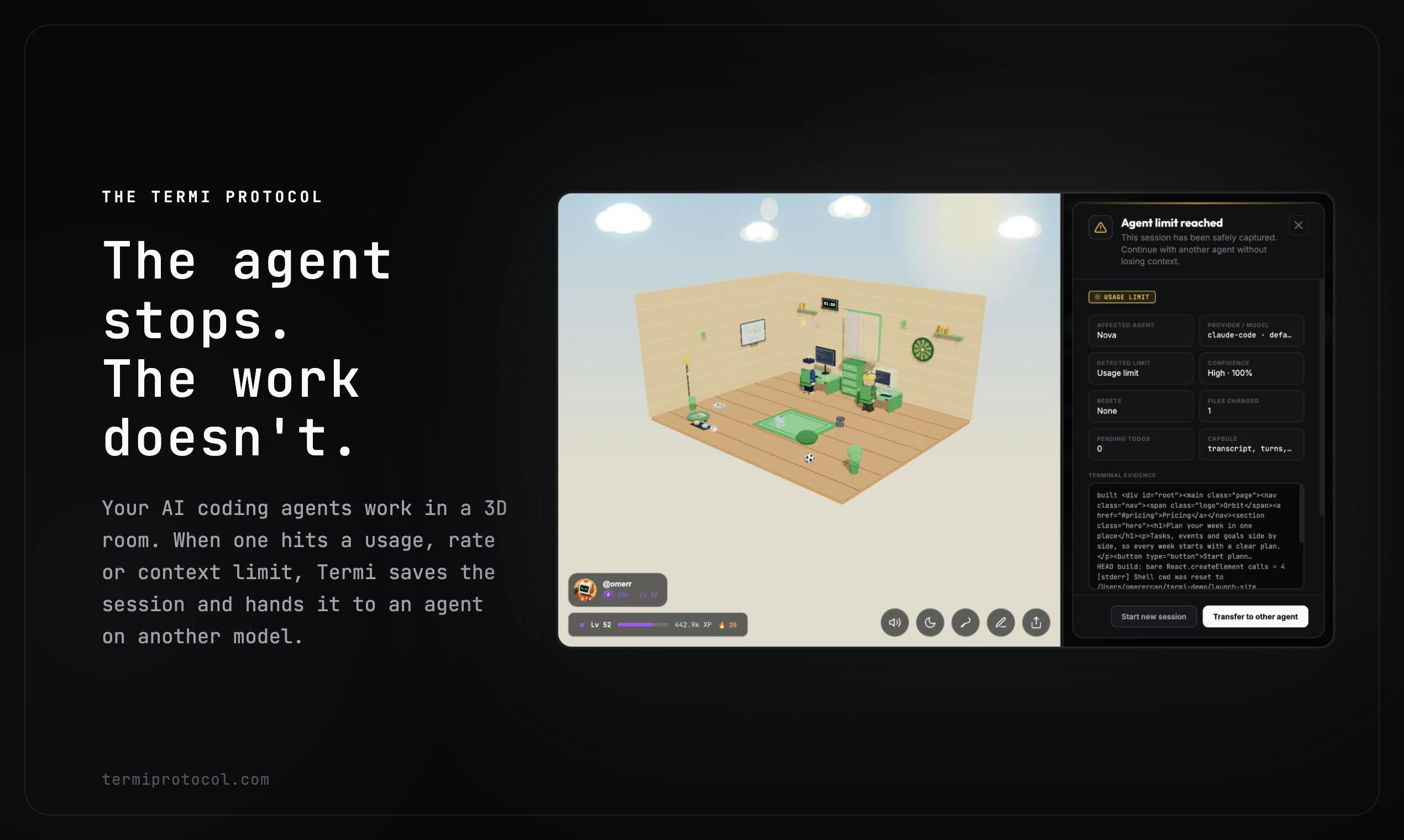
From Scrolling Logs to 3D Desks: What Visualization Actually Solves
The core design of Termi is to spatialize the "agent execution process." Each real coding agent (Claude Code, Codex, Gemini, OpenCode, etc.) has its own desk in the 3D room. What you see isn't a text stream, but a real-time visual representation of every file read, command execution, and code edit.
On the surface this just looks like a UI gimmick, but it addresses a real pain point: when multiple agents work in parallel, traditional logs mix their outputs together, making troubleshooting like finding a signal in noise. Once spatialized, you can tell at a glance which agent is doing what and where it's stuck. For developers running multiple models simultaneously, this is more intuitive than any log-filtering feature.
Cross-Model Handoff: One Agent Hits a Wall, Another Picks Up
The most notable feature in this update is task handoff. When an agent hits a usage cap, rate limit, or context window limit, Termi saves its goal, modified files, error information, and to-do items, then hands the work off to an agent on another model to continue.
This mechanism targets an awkward reality in AI coding workflows: context exhaustion or quota depletion often happens mid-task, and previously users had to manually organize state and start a new session, losing significant context. Termi automates this "shift change" process, effectively filling in a key piece of the multi-model collaboration puzzle. It doesn't solve the problem of any single model's capability ceiling, but it prevents tasks from being completely interrupted by one agent's hard limits.
Context window is the total token limit a large language model can process in a single inference, including system prompts, conversation history, tool call results, and generated content. Coding agents constantly read files, execute commands, and feed back results during long tasks, consuming tokens quickly. Once the window is exceeded, the model either truncates earlier context or simply errors out. Rate limiting is the API provider's constraint on the number of requests or tokens per unit of time; once hit, you must wait for a cooldown. These two types of limits differ from usage quotas: quotas are account-level totals, while rate limits and windows are hard boundaries per session or per unit of time. Understanding this is key to seeing why cross-model handoff has value — it turns "state migration" from a manual operation into a protocolized process, letting tasks survive beyond a model's hard boundaries.
Boss Agent and Recycle Bin: Managing Multi-Agent Systems as a Team
Termi also introduces the concept of a "boss agent," where a master agent breaks down a goal and distributes it to multiple agents on the team for execution. This differs from simple parallel running — the decomposition and assignment are done by the agent itself, with humans playing more of an observer and decision-maker role.
Another detail is that deleted agents go to a recycle bin rather than simply disappearing. This aligns with developers' expectations for "recoverable operations" and also hints that Termi positions itself as a management layer for agents, not just a display layer.
Multi-agent orchestration refers to a scheduler decomposing a goal into subtasks, then dispatching them to multiple agents with tool-calling capabilities for parallel or sequential execution, and finally aggregating results. Common patterns include supervisor-worker, pipeline, and debate-style collaboration. The boss agent is a supervisor pattern: it doesn't write code directly but handles planning, assignment, and acceptance. The difficulty of this architecture lies in subtask boundary definition, result consistency verification, and failure retry strategies. Termi putting deleted agents into a recycle bin is essentially a recoverable design for orchestration state — in multi-agent systems, accidentally deleting an agent that holds context could break the entire task chain, and the recycle bin provides room for rollback.
Points Worth Noting
Termi currently covers macOS, Windows, and Linux. It received 72 votes and ranked 16th on Product Hunt — not particularly high discussion heat, indicating it's still in an early stage. Whether 3D visualization becomes new information noise as the number of agents grows, and whether the state saving for cross-model handoff is complete enough to cover complex refactoring tasks — these all need real-world use to verify.
For developers who frequently orchestrate multiple coding agents simultaneously, Termi offers a different approach from terminal logs: treat agent collaboration as a team that needs managing, rather than a bunch of processes that need watching. This perspective itself may be more worth learning from than the 3D room.
Product Hunt ranking reflects community votes and engagement on the day of launch, not a long-term adoption metric. 72 votes and 16th place means it gained some attention within the launch window, but is far from top-tier product exposure. For developer tools, early rankings say more about conceptual novelty than production readiness. When evaluating such tools, focus more on integration depth with existing terminal workflows, state persistence mechanisms, and resource overhead under multi-agent concurrency, rather than launch-day vote counts.
One-line Summary
Termi Protocol visualizes coding agents at 3D desks and supports cross-model task handoff and team orchestration.
Paragraph Summary
Termi Protocol aims to solve the problem of mixed-up logs and hard-to-distinguish states when multiple coding agents work in parallel. Its core is placing real agents like Claude Code, Codex, and Gemini into a 3D room, showing file reads/writes, command execution, and code edits in real time as desks. The most notable update is cross-model handoff: when an agent hits usage, rate, or context window limits, it automatically saves goals, changed files, errors, and to-dos, handing them to an agent on another model to continue. It also introduces a boss agent for task decomposition and assignment, with deleted agents going to a recycle bin. The product covers three platforms, received 72 votes and ranked 16th on Product Hunt, and is still early-stage — whether 3D visualization becomes new noise as agents multiply, and whether handoff state is complete enough, remain to be verified.
Related articles
Hands-On Review of an Open-Source Multi-Agent Business Simulation Project
Hands-on review of a Bilibili creator's open-source multi-agent sandbox business project: architecture, memory, HITL, evaluation, and LLM vs rule-engine results.
AI Engineering in Practice: The Complete Workflow of Claude Code and Agent Skill Development
A Bilibili hands-on course analyzes AI engineering: using Claude Code, Codex, and WorkBuddy to develop enterprise-grade Agent Skills, covering WeChat article drafts, quantitative analysis, and automated Xiaohongshu posting, while explaining the paradigm shift of Skill-driven development and tool selection.
LangChain for Beginners: A Practical Guide to Structured Output and Agents
Starting from zero with LangChain: clarify the difference between low-code platforms and large model application development, covering structured output, tool calling, Agent practice, and multi-tenant RAG enterprise deployment—ideal for engineers with development experience looking to transition into AI application development.