Termy: The AI Coding Agent Hidden in the MacBook Notch

Termy integrates coding agents like Claude Code and Codex into a pull-down terminal in the MacBook notch, reducing window switching.
Termy is a new product launched on Product Hunt that stuffs coding agents like Claude Code and Codex into the MacBook notch, presented as a pull-down terminal similar to the iOS Notification Center. Developers can view agent status, approval requests, and output without switching windows. Beyond the terminal shell, Termy also offers an agent office view, a local server browser, on-device dictation, and checkpoint rollback, attempting to become a workbench around coding agents. The product received 69 votes on Product Hunt and ranked 14th, reflecting early attention, and since it's tied to notch models, non-notch devices may have a limited experience.
The MacBook's notch has always been an awkward presence: it eats up screen space but only houses the camera. A new product on Product Hunt called Termy wants to change that—it stuffs coding agents like Claude Code and Codex into the notch, letting developers summon a pull-down terminal at any time.
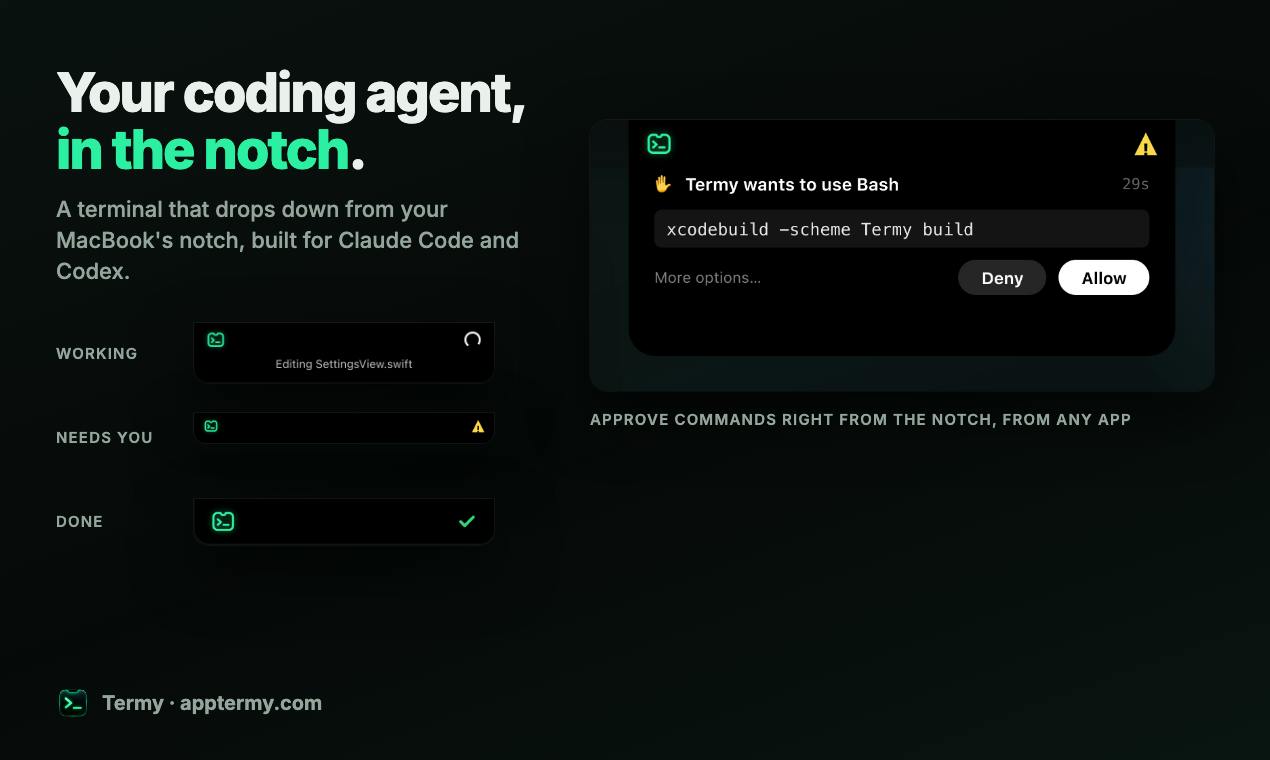
The Notch Becomes an Agent Entry Point
Termy's core interaction is straightforward: the terminal expands downward from the MacBook notch, much like the iOS Notification Center. Developers can check the status, approval requests, and output of Claude Code and Codex without switching windows or opening a separate app. The official description highlights several capabilities: real-time status, approvals completed right from the notch, an agent office view, a local server browser, on-device dictation, and checkpoints.
This design targets a real friction point in using coding agents. When an agent executes tasks in the background, developers often need to frequently switch back to the terminal to confirm progress or approve operations. Pinning the entry point to the top edge of the screen could theoretically reduce context-switching costs.
Claude Code and Codex are two representative types of coding agents today. Claude Code is a command-line tool released by Anthropic, built on the Claude model, which can read codebases, edit files, execute commands, and iterate based on results in the terminal; Codex originates from OpenAI's code model series and later evolved into a coding agent that can run in the cloud or locally, supporting task delegation and code generation. What they share: they are driven by natural language instructions, autonomously complete multi-step coding tasks, and request user approval before key operations (such as modifying files or running commands). This "autonomous execution + human approval" model is exactly the interaction scenario Termy aims to optimize.
More Than a Terminal Shell
Judging from the feature list, Termy isn't content to be just a pull-down terminal. It offers an "office of your agents" view, implying multiple agents can be managed side by side; a built-in browser for accessing local servers, convenient for previewing web apps generated by agents; on-device dictation letting developers input instructions by voice; and a checkpoint mechanism for rolling back to a certain state after an agent changes code.
Together, these features look more like a workbench built around coding agents than a mere terminal emulator. For developers running multiple agent tasks simultaneously while needing quick approvals and result previews, this centralized entry point has some appeal.
Checkpoints, in the context of coding agents, refer to code snapshots or version markers that the agent automatically saves before modifying code. When an agent's changes don't meet expectations, developers can roll back to a checkpoint, avoiding manual undo or reliance on Git commits. This mechanism reduces the risk brought by autonomous agent editing and also reduces the burden of frequent commits on developers. Termy treats checkpoints as one of its core features, indicating it tries to provide a safety net within the agent workflow rather than merely displaying output.
Market Signals and Limitations
Termy received 69 votes and 4 comments on Product Hunt, ranking 14th. This result shows it has gained initial attention in the developer tools category, but the sample size is still small, and how mature the product is and whether long-term maintenance can keep up remain to be seen.
Another uncertain factor is platform lock-in. Termy is explicitly designed for the MacBook notch, which means non-notch models (such as external monitor users or older Macs) may not get the full experience. For cross-platform teams, this is a point to weigh.
Overall, Termy represents a trend worth watching: "shell layer" tools built around AI coding agents are emerging—they don't produce models but optimize the interaction interface between agents and developers. Whether the notch can become a permanent entry point for coding agents depends on whether such tools can turn novelty into daily habit.
Product Hunt ranking is the platform's leaderboard position calculated based on the day's votes, comments, and engagement. Ranking 14th means Termy is in the upper-middle range among products launched that day but still some distance from the top. 69 votes and 4 comments are a small sample, typically reflecting early adopters' interest rather than large-scale market validation. For developer tools, Product Hunt attention often isn't fully correlated with subsequent retention and word of mouth, so this signal should be interpreted cautiously.
One-line Summary
Termy integrates coding agents like Claude Code and Codex into a pull-down terminal in the MacBook notch, reducing window switching.
Paragraph Summary
Termy is a new product launched on Product Hunt that stuffs coding agents like Claude Code and Codex into the MacBook notch, presented as a pull-down terminal similar to the iOS Notification Center. Developers can view agent status, approval requests, and output without switching windows. Beyond the terminal shell, Termy also offers an agent office view, a local server browser, on-device dictation, and checkpoint rollback, attempting to become a workbench around coding agents. The product received 69 votes on Product Hunt and ranked 14th, reflecting early attention, and since it's tied to notch models, non-notch devices may have a limited experience.
Related articles

AI Tools Quietly Altering Settings: Postman Silently Installs Plugin, Codex Sharing Option Auto-Resets
AI Daily reports: Postman silently installs a Mac plugin and self-approves startup hooks, logged as auto-existing upgrade; Hacker News developers say Codex data-sharing opt-out flips back. Plus Simon Willison's raw float weight experiment with QEN 3.8-27B.

AI Learns to Rewrite AI: MIT's "Weightspace Programming" Redraws the Path to Recursive Self-Improvement
MIT team proposes weightspace programming: GPT-6 Astra reads and edits AI model weights directly. Math scores jump several-fold, hand-written networks beat trained models. Eight experiments analyzed, plus Anthropic's same-day warning and the real boundaries of recursive self-improvement.

Running Qwen 3.8 on a Laptop to Read Raw Weights: 46 Minutes Per Answer
Simon Willison reproduced weight space programming with Qwen 3.8 27B on a laptop: a 17GB model file, 46 minutes per answer, 43,506 reasoning tokens, Pong over an hour, Freeway failed. Suited for interpretability researchers.