Terse Durable Actors: Low-Cost Infrastructure for Multiplayer AI Applications

Open-source project Terse provides lightweight stateful infrastructure for multiplayer AI apps with 'one actor, one micro-VM, one SQLite'.
Terse - Durable Actors is the #20 open-source project on Product Hunt, positioned as an open-source alternative to Cloudflare Durable Objects. It assigns an independent micro-VM and embedded SQLite database to each AI resource or agent, enabling local state storage and tenant isolation while avoiding lock contention. Each micro-VM handles one request at a time, ensuring concurrency safety through architecture—ideal for serial AI agents. Built-in WebSocket servers let any client subscribe to resource events for multiplayer real-time interaction. While it emphasizes cost efficiency at scale, hot bottlenecks and operational details need validation before production use.
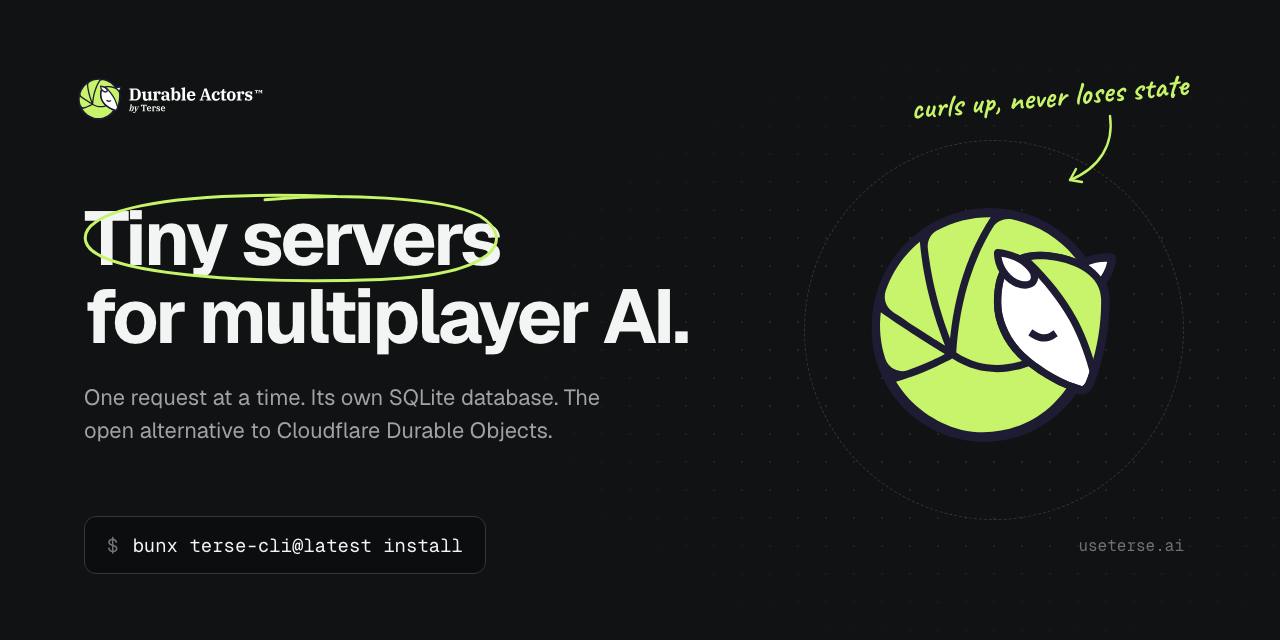
Multiplayer AI applications are moving from demos to real products, but the underlying infrastructure choices are often overlooked. The open-source project Terse - Durable Actors, ranked #20 on Product Hunt, proposes a lightweight approach: using a "micro-server + embedded database" to host each AI resource or agent, positioned as an open-source alternative to Cloudflare Durable Objects.
What problem does it solve
When building multiplayer AI products, developers typically face three headaches: concurrent requests interfering with each other, state being difficult to persist, and the cost of maintaining separate infrastructure for each session. Terse's approach is straightforward—each resource or agent gets its own micro-VM with an embedded, co-located SQLite database.
This "one person, one machine, one database" isolation approach means state is naturally stored close to where it's used, reads don't need to cross the network, and lock contention from multi-tenant shared databases is avoided. For AI products that need to maintain a large number of short-lived sessions (such as multiplayer game NPCs or collaborative AI assistants), this finer-grained resource partitioning better matches actual workload patterns.
micro-VM is a lightweight virtualization technology, with typical implementations including AWS Firecracker and Google gVisor. Unlike Docker containers that share the host kernel, micro-VMs provide each instance with an independent kernel, offering stronger security isolation and container-like startup speeds (millisecond-level). In Terse's design, a micro-VM hosts the complete runtime environment of a single actor, ensuring tenants don't interfere with each other while avoiding the minute-level cold start overhead of traditional virtual machines. This combination of "strong isolation + fast startup" is the key prerequisite for allocating an independent runtime unit to each agent.
Embedded SQLite and co-located storage: SQLite is an embedded relational database without a separate service process, with data stored as a single file within the application process. Placing SQLite on the same micro-VM as the actor means state reads and writes go through the local file system rather than network calls, with latency typically in the microsecond range. This eliminates the network round-trips and connection pool management of "application server → remote database" in traditional architectures. However, it also introduces new operational challenges: state is scattered across thousands of SQLite files, and backup, migration, and cross-instance queries require additional tooling—a trade-off to evaluate before adoption.
One request at a time, concurrency safety guaranteed by architecture
A key design of Terse is that each micro-VM processes only one request at a time. This means developers don't need to introduce complex locking mechanisms or optimistic concurrency control at the application layer—concurrency safety is guaranteed by the architecture itself.
The cost is that a single resource cannot process multiple requests in parallel, but for objects like AI agents that are naturally serial and need to maintain conversation state, this constraint is actually a reasonable abstraction. When horizontal scaling is needed, simply add more actors rather than making a single actor more complex.
The Actor model is a concurrent computation model in which each actor is an independent computational unit with private state, communicating with other actors only through asynchronous messages, with internal messages processed one at a time in order. This eliminates shared memory contention at the model level, so no locks are needed. Terse's "one request at a time" design is a direct manifestation of the actor model: each micro-VM corresponds to one actor, requests are messages, and serial processing guarantees state consistency. Understanding this helps determine the applicable boundaries—the actor model suits high-state, low-concurrency single-instance scenarios, but not tasks requiring single-point high-throughput parallel computation.
WebSocket lets any client subscribe to events
Each micro-VM runs a WebSocket server, and clients can connect in any form to listen for events on that resource. This provides a direct event push channel for multiplayer scenarios: player actions can be reflected in real time in the AI agent's state changes, which are then pushed to other subscribers.
Binding WebSocket to resource instances rather than maintaining a separate message middleware reduces the number of system components and makes the "one agent, one endpoint" model easier to understand and manage.
As an open-source alternative to Cloudflare Durable Objects
Terse explicitly positions itself as an open-source alternative to Cloudflare Durable Objects. Durable Objects provides a similar "single instance + persistent storage + connections" model but is a closed-source managed service. Terse offers comparable capabilities in an open-source form, appealing to teams that want self-hosting, want to avoid vendor lock-in, or need finer-grained cost control.
The project emphasizes that this is a "micro-server army," aimed at helping developers maintain cost efficiency at scale. The specific cost advantages need to be evaluated in the context of the deployment environment, but the idea of allocating lightweight resources on demand per actor is indeed different from traditional always-on large-instance approaches.
Cloudflare Durable Objects is a stateful compute primitive provided by the Cloudflare Workers platform: each Durable Object is a globally unique instance with persistent storage (SQLite-based storage API) and WebSocket connection capabilities, with only one instance processing requests at any given time, naturally achieving serialization and strong consistency. It is commonly used in collaborative editing, game rooms, chat rooms, and similar scenarios. However, it runs in Cloudflare's closed-source managed environment, which developers cannot self-host, and billing and regions are constrained by the platform. Terse attempts to replicate this programming model in an open-source, self-deployable way, allowing teams to obtain a similar "single instance + state + connections" abstraction on their own infrastructure.
Who it's for, and what to watch out for
Terse is better suited for AI products that need a large number of stateful, low-concurrency single instances, such as multiplayer AI games, collaboration tools, and real-time agent systems. If the business is primarily high-throughput stateless requests, traditional serverless functions may be more appropriate.
Note that the serial processing characteristic of a single actor means hot resources can become bottlenecks, so state should be distributed across multiple actors by design. Additionally, the startup and scheduling overhead of micro-VMs and how to operate SQLite across multiple instances are details worth verifying before going to production. The project currently has 78 upvotes and 6 comments on Product Hunt, with community feedback still in its early stages—small-scale load testing is recommended before production adoption.
One-line Summary
Open-source project Terse provides lightweight stateful infrastructure for multiplayer AI applications using "one actor, one micro-VM, one SQLite."
Paragraph Summary
Terse - Durable Actors is the #20 open-source project on Product Hunt, positioned as an open-source alternative to Cloudflare Durable Objects. It allocates an independent micro-VM to each AI resource or agent with an embedded, co-located SQLite database, achieving near-storage of state and tenant isolation while avoiding lock contention from multi-tenant shared databases. Each micro-VM processes only one request at a time, guaranteeing concurrency safety through architecture, suitable for naturally serial AI agent scenarios. Each instance has a built-in WebSocket server, allowing any client to connect and subscribe to resource events, serving multiplayer real-time interaction. The project emphasizes cost efficiency at scale, but serial processing of a single actor may create hot bottlenecks, and micro-VM scheduling and SQLite operations still need verification before production adoption.
Related articles

RePlan-VLA: Progress-Aware Replanning Breakthrough for Long-Horizon Robotic Manipulation
The RePlan-VLA framework converts VLA models' short-horizon capabilities into reliable long-horizon execution through progress-aware adaptive replanning, improving success rates by 21.9% and 10.4% on RoboCasa365 and CALVIN, and validating real-world deployment on a Franka Research 3 robot.

Geometric Bridge Flow Matching: A New Breakthrough in Blind Rigid Motion Correction
Geometric bridge flow matching enables blind rigid motion correction in head CBCT, achieving 37.1 dB PSNR and 0.27 mm RPE on simulated data in ~9.1 minutes, outperforming existing methods.

Google Releases Gemini 4 Hydrogen: 2.5x Faster Without Sacrificing Intelligence
Google releases the lightweight Gemini 4 Hydrogen: 2.5x faster task completion, AA Intelligence Index of 54 beating its flagship sibling, 7.3s single-step on Agent Arena faster than Claude and GPT rivals, four thinking levels with pay-as-you-need pricing, now available across AI Studio and more.