Tesla Cybercab Bans Children Under 13 — Even With a Parent Present
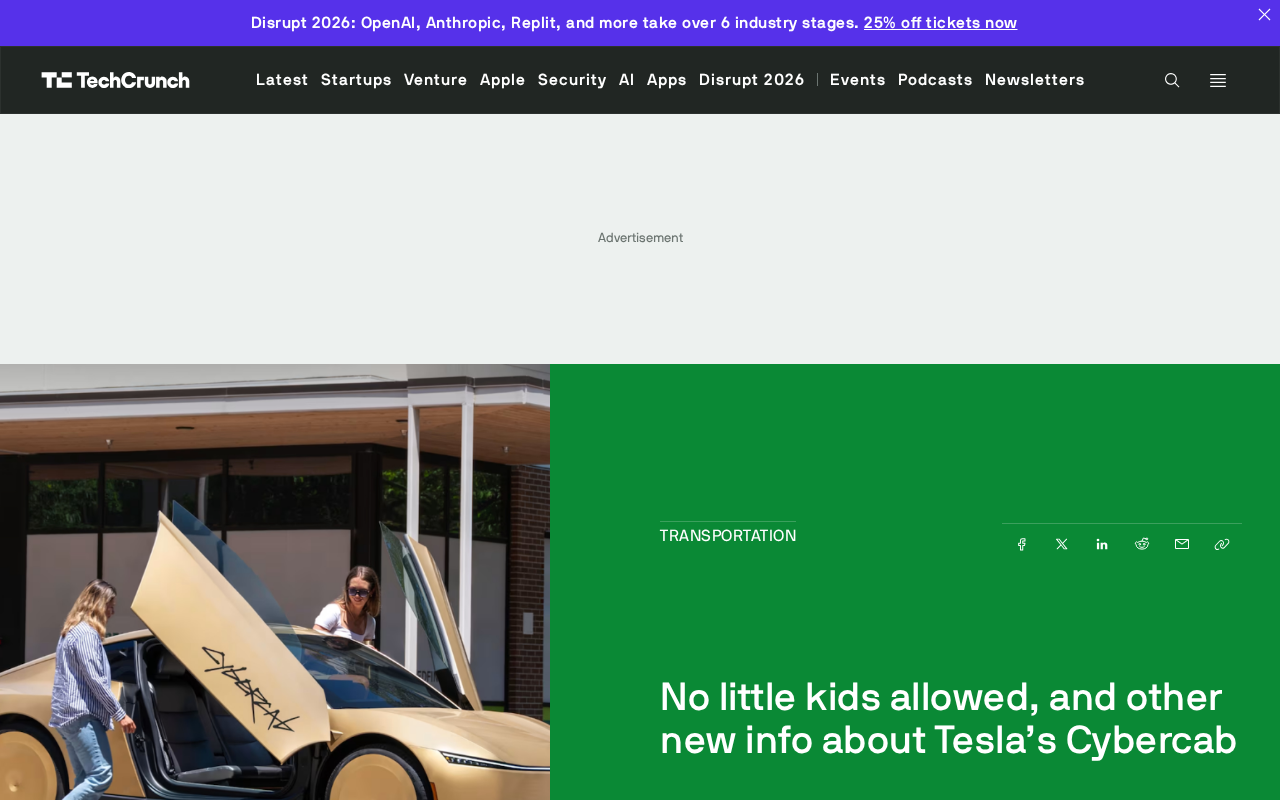
Tesla's Cybercab bans all children under 13, even with parental supervision.
Tesla has set a strict policy for its Cybercab autonomous taxi: no passengers under 13, even with a parent present. This is more restrictive than its Model Y robotaxi and the broader industry. The ban stems from the vehicle's fully driverless design with no human intervention capability, challenges with child safety seats, and unresolved legal liability issues. The policy may set a new industry benchmark as competitors navigate similar safety tradeoffs.
Strict Age Restriction: No One Under 13 Allowed
Tesla has set a notable ridership policy for its new autonomous taxi, the Cybercab: children under 13 are prohibited from riding, even if accompanied by a parent. This restriction is stricter than the policy for Tesla's Model Y SUV currently operating as a robotaxi, sparking a new round of industry discussion about safety standards for autonomous taxis.
Robotaxi Technology Background: A robotaxi is a taxi service that operates without a human driver, representing the convergence of shared mobility and autonomous driving technology. There are currently two major technical approaches globally: one is the high-precision LiDAR + HD map approach used by Waymo, which relies on sensor redundancy and detailed road data; the other is Tesla's vision-only + neural network approach, which uses cameras to simulate human vision. Commercializing robotaxis faces three major challenges — technological maturity, regulatory approval, and public acceptance — and currently only operates on a limited basis in a handful of U.S. cities like Phoenix and San Francisco.
The strictness of this policy has exceeded many people's expectations. In traditional ride-hailing and taxi services, children can typically ride with a parent as long as an appropriate child safety seat is used. However, Cybercab has taken a more conservative approach, setting the minimum riding age at 13.
Current Child Passenger Safety Regulations: In the United States, child passenger safety is governed by state laws, which generally require children under 8 years old or shorter than 4 feet 9 inches to use a child safety seat or booster seat. Ride-hailing services like Uber and Lyft enjoy exemptions in most states, allowing children to ride without a safety seat (with parental consent). However, regulations for autonomous vehicles are still being developed — NHTSA (National Highway Traffic Safety Administration) has yet to issue specific standards for child passengers in driverless taxis. Tesla's age-13 restriction is effectively a self-imposed risk management measure that exceeds current legal requirements.
Why Cybercab Says "No" to Children
There are multiple safety considerations behind this restriction.
No human intervention capability inside the vehicle. As a fully driverless vehicle, the Cybercab has no safety operator or driver on board. There are no means of human intervention in an emergency, and young children may be unable to properly respond to vehicle malfunctions or emergency evacuation scenarios.
Cybercab Vehicle Profile: The Cybercab is Tesla's purpose-built autonomous vehicle announced in 2024. Its biggest difference from the retrofitted Model Y robotaxi is that it was designed from the ground up without a steering wheel or pedals. This "born autonomous" design philosophy means the vehicle relies entirely on the FSD (Full Self-Driving) system to operate, with no physical interface for human takeover. The vehicle features a two-seat layout to reduce costs, with projected operating costs as low as $0.20 per mile — far below traditional ride-hailing. This aggressive design also brings higher safety verification requirements and regulatory hurdles.
Difficulty accommodating child safety seats. Autonomous taxis need to maintain quick turnaround times, but properly installing a child safety seat requires time and expertise. If a seat needs to be installed and removed every time a child passenger rides, it would severely impact vehicle operational efficiency.
Unclear legal liability. Liability determination for driverless vehicles remains in a gray area, and when young children are involved, assigning responsibility in the event of an accident becomes even more complex. By setting an age threshold, Tesla is mitigating this risk — a pragmatic business decision.
The Autonomous Driving Liability Challenge: Determining the responsible party when an autonomous vehicle is involved in an accident is a legal puzzle. In traditional vehicle accidents, the driver is responsible, but driverless vehicles may involve the vehicle manufacturer (hardware defects), software developer (algorithm errors), map provider (data errors), operating platform (service management), and other parties. The situation becomes more complex with children involved: if a child doesn't properly use safety equipment, is the guardian or the operator responsible? If the vehicle can't detect abnormal child behavior (such as unbuckling a seatbelt), is the algorithm design flawed? Currently, California and other jurisdictions apply a "presumption of fault" principle, requiring autonomous driving companies to prove they are not at fault — which incentivizes companies to adopt conservative passenger policies.
Policy Differences Between Cybercab and Model Y Robotaxi
Interestingly, Tesla's Model Y robotaxi service, currently in trial operation in some cities, does not have such strict age restrictions. As an autonomous taxi converted from a conventional vehicle, the Model Y still retains the possibility of human intervention, which is likely the key reason for the policy difference between the two.
The Cybercab was designed from the outset for fully driverless operation, so its safety standards and operating protocols are clearly more stringent. This difference also reflects the varying levels of maturity of autonomous driving technology across different use cases — retrofitted vehicles and purpose-built autonomous cars face different regulatory and safety requirements.
Impact on the Autonomous Taxi Industry
Tesla's policy could set a new benchmark for the entire autonomous taxi industry. Competitors like Waymo and Cruise face similar tradeoffs between safety, convenience, and market acceptance when formulating their own passenger policies.
Competitors' Passenger Policies: As the industry leader, Waymo currently allows children to ride when accompanied by an adult but does not provide child safety seats — passengers must bring their own. Cruise (a GM subsidiary) adopted a similar policy but suspended operations after a pedestrian-dragging incident in 2023, highlighting the importance of safety verification. In China, Baidu's Apollo Go and Pony.ai require children under 12 to be accompanied by an adult. Tesla's blanket ban is the strictest in the industry, reflecting its cautious approach to fully unmanned scenarios — after all, the Cybercab doesn't even have remote safety operators, unlike Waymo, which can handle anomalies through remote assistance.
From a consumer perspective, this restriction will undoubtedly narrow the Cybercab's potential user base. Family travel is an important use case for taxi services, and completely excluding young children means giving up a portion of the market. But Tesla clearly believes that a safety-first strategy is more important until the technology and legal landscape are fully mature.
As autonomous driving technology continues to advance and related regulations are gradually refined, these kinds of age restrictions may be relaxed in the future. But at least during the Cybercab's initial rollout, the age-13 threshold will be a firm red line.
Key Takeaways
Related articles

Python 3.15 New Feature: Is the sentinel Type Better Than None?
Python 3.15 adds the sentinel type, using named unique sentinel objects to replace None and bare object(), resolving confusion among missing values, explicit emptiness, and invalid input while avoiding type hint failures.

Deep Learning's Three Architectures and the Universal Approximation Theorem: A Complete Guide to MLPs, CNNs, and Transformers
Explaining the inductive bias differences among MLP, CNN, and Transformer, the existence meaning of the Universal Approximation Theorem (UAT), and the role of Taylor expansion in approximation analysis, while clearing up common misconceptions.

GitLab Emergency Patch Release: Analysis of Critical Security Fixes
GitLab releases critical patch 19.5.1, sparking 355 points of discussion on Hacker News. This article analyzes the background, upgrade steps for self-hosted instances, and verification points to help DevOps teams respond quickly to security updates.