Tesla Cybercab to Go on Sale by Year-End: No Steering Wheel, Under Regulatory Investigation

Tesla plans to sell the steering-wheel-free Cybercab by year-end, with regulatory scrutiny the biggest wildcard.
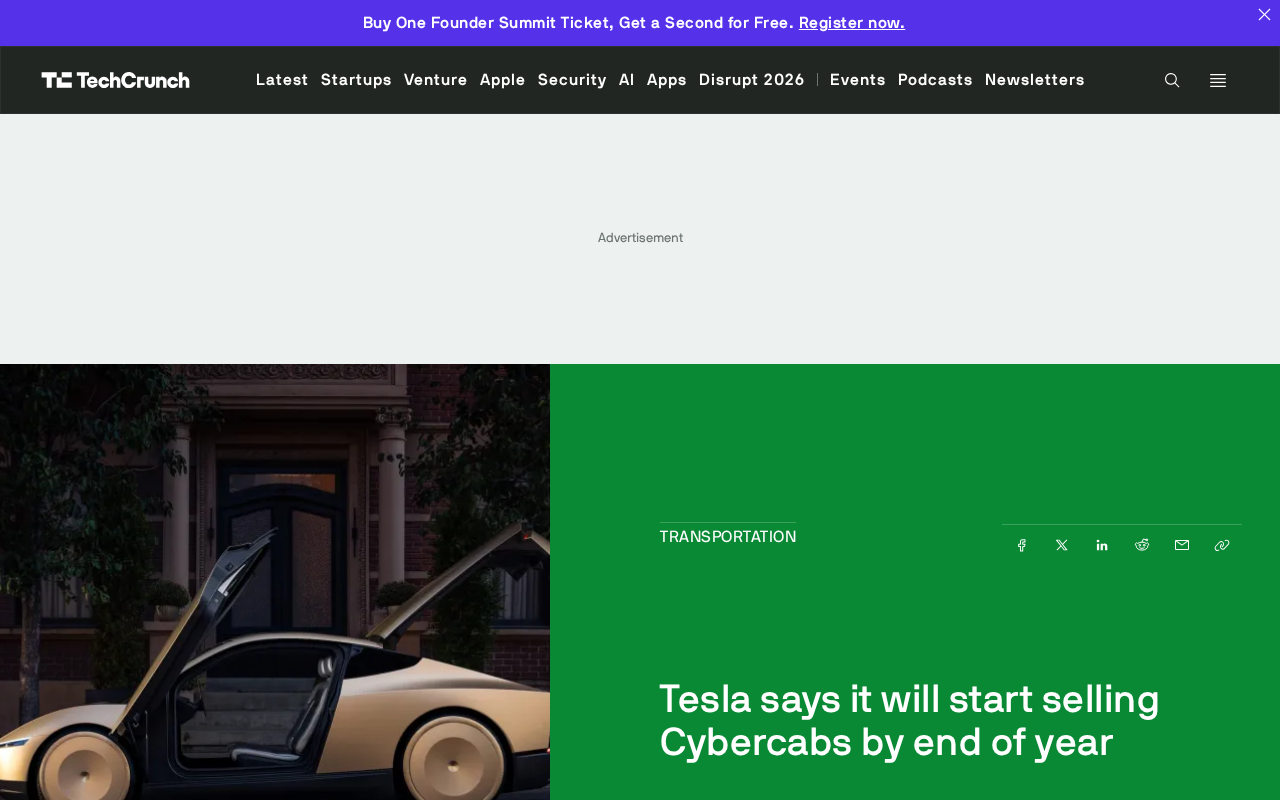
Tesla announced on its Q3 earnings call that it plans to start selling the Cybercab to customers before year-end. The gold two-seat autonomous vehicle has no steering wheel or traditional controls and can only run in autonomous mode, positioning it closer to a Robotaxi fleet tool than a consumer car. The key hurdle is regulation: federal regulators are investigating whether it complies with FMVSS, and many current standards assume manual controls, so legal sales require exemptions or rule changes. The call gave only a timeline, not price, volume, target customers, or FSD licensing details.
Tesla dropped a bombshell on its Q3 earnings call: the company plans to start selling the Cybercab to customers before the end of the year. The gold, two-seat autonomous vehicle has no steering wheel and no traditional controls—and federal regulators are investigating whether it complies with vehicle safety standards.
Why sell a car with no steering wheel?
The Cybercab was never positioned as "a car for ordinary consumers to drive themselves." Tesla VP of Engineering Lars Moravy confirmed the year-end sales timeline on the earnings call, but the product logic itself sidesteps the traditional car-buying scenario—no steering wheel means it can only operate in autonomous mode.
Behind this is Tesla's bet on the mobility services market. The Cybercab is more like an operating tool designed for a Robotaxi fleet: two seats, gold paint, and full reliance on FSD software. "Selling it to customers" may mean selling to fleet operators rather than end-user individuals. Tesla did not elaborate on the target buyers or delivery format during the earnings call, which is itself a question worth asking.
Robotaxi refers to the business model of providing on-demand mobility services with autonomous vehicles. The core of its economic model lies in eliminating the cost of human drivers and increasing vehicle utilization. Unlike selling cars to individual consumers, Robotaxi operators focus on cost per mile, vehicle durability, remote monitoring, and dispatch efficiency, so vehicles are often purpose-built rather than converted from mass-production passenger cars. Tesla's previously announced Robotaxi plan is a continuation of this approach, and the Cybercab's two-seat layout and removal of the steering wheel are trade-offs made around high-frequency, short-distance operating scenarios. Only by understanding this can one see that what Tesla calls "sales" is closer to fleet delivery than traditional retail.
The regulatory hurdle cannot be avoided
Federal regulators are investigating whether the Cybercab meets vehicle safety standards, and this is the most critical variable in the whole story. Many provisions of the U.S. Federal Motor Vehicle Safety Standards (FMVSS) are designed around traditional vehicles "with a steering wheel, pedals, and mirrors." For a vehicle without a steering wheel to be legally sold and driven on public roads, it must either use existing exemption pathways or push for rule revisions.
Tesla has previously taken action on vehicles without steering wheels, but formal sales mean facing stricter compliance review. The year-end sales timeline runs in parallel with the ongoing investigation, and there is currently no public answer as to how the two will resolve. The timeline promised by the VP of Engineering and the pace of the regulatory investigation are not on the same clock.
FMVSS (Federal Motor Vehicle Safety Standards) are formulated by the U.S. National Highway Traffic Safety Administration (NHTSA) and cover hundreds of provisions on braking, lighting, crash protection, occupant protection, and more. They are a mandatory prerequisite for legal vehicle sales in the United States. Many of these provisions assume vehicles are equipped with manual controls such as steering wheels, foot pedals, and mirrors—for example, standards on steering systems and acceleration and braking controls. For autonomous vehicles, NHTSA has a temporary exemption process that allows the sale of vehicles that do not comply with certain provisions under limited quantities and limited uses, but exemptions must be applied for case by case and are subject to public comment and annual reporting requirements. To truly achieve large-scale sales of vehicles without steering wheels, it is usually necessary to push for revisions to the standards themselves, and that process involves legislation and industry bargaining, with a timeline far longer than product development.
The earnings call actually offered limited information
According to reports from RSS sources, Moravy's statement was the main source of information about this Cybercab sales plan. But the nature of an earnings call means it will not disclose much execution detail: the price, delivery volume, target customers, and the form in which FSD software will be licensed—none of these key questions appeared in the reports.
This approach of "announcing a timeline without announcing details" is not unfamiliar for Tesla. For those following the company, what really needs tracking is not the verbal promises on earnings calls, but subsequent regulatory filings, production ramp data, and actual delivery records.
Another risky move in autonomous driving commercialization
The Cybercab sales plan puts Tesla in a delicate position: it must both prove to the market that autonomous driving commercialization is advancing and resolve the legality of a "non-traditional vehicle" within the regulatory framework. The absence of a steering wheel is a product differentiation selling point technically, but the biggest obstacle in terms of compliance.
Whether the year-end timeline can be met depends on the direction of the regulatory investigation rather than engineering progress. For the industry, if the Cybercab sales model works, it will open a commercialization path for vehicles without traditional controls; if it gets stuck in the regulatory process, it will once again show that the bottleneck for autonomous driving is no longer in algorithms, but in rules.
FSD (Full Self-Driving) is Tesla's advanced driver-assistance software suite, currently offered in the United States by subscription or one-time purchase, but its functional level still falls under driver-supervised assisted driving rather than true driverless operation. Tesla has long claimed that higher levels of autonomous driving capability will be achieved through software upgrades, and there is a gap between this promise and regulatory recognition. The FSD licensing model is crucial to the Cybercab's business logic: if vehicles are sold as fleets, the software will likely be billed by mileage or subscription, which would change Tesla's revenue structure. At the same time, whether the software receives regulatory approval for driverless operation of vehicles without steering wheels is also a key link determining whether the Cybercab can be deployed.
One-line Summary
Tesla announces year-end sales of the steering-wheel-free Cybercab, with regulatory investigation the biggest variable.
Paragraph Summary
On its Q3 earnings call, Tesla announced plans to start selling the Cybercab to customers before the end of the year. The gold two-seat autonomous vehicle has no steering wheel or traditional controls and can only operate in autonomous mode; its product positioning is closer to an operating tool for Robotaxi fleets than an ordinary passenger car for individual consumers. The key obstacle is regulation: federal regulators are investigating whether the vehicle complies with the U.S. Federal Motor Vehicle Safety Standards (FMVSS), and many provisions of the current standards presuppose manual controls, so legal sales require exemptions or rule revisions. The earnings call only provided a timeline and did not disclose execution details such as price, delivery volume, target customers, or FSD licensing. The article argues that whether the year-end target can be met depends on the direction of regulation rather than engineering progress.
Related articles

Claude Reportedly Able to Hide Secret Messages in Benign Images
A Reddit post claims Claude Fable 5.1 can hide secret messages in benign images. This article reviews the background, image steganography principles, and potential security risks, and suggests a testing path from rumor to verification.

Federal Government Awards $85 Million; CFS to Develop Fusion-Specific Semiconductors
The federal government awards $85 million to Commonwealth Fusion Systems to develop conductors and power semiconductors for fusion plants. This article analyzes the significance of this funding for the fusion supply chain and commercialization path.

When Should AI Assistants Proactively Suggest? Timing Is Everything
When should AI assistants proactively suggest? Reddit discussion reveals: the same suggestion feels different at different times. This article analyzes the dual nature of proactive suggestions, the boundary of user expectations, and design principles, exploring how to balance automation and user control.