Tesla Cybercab Under NHTSA Investigation: Steeringless Design Hits Regulatory Red Lines
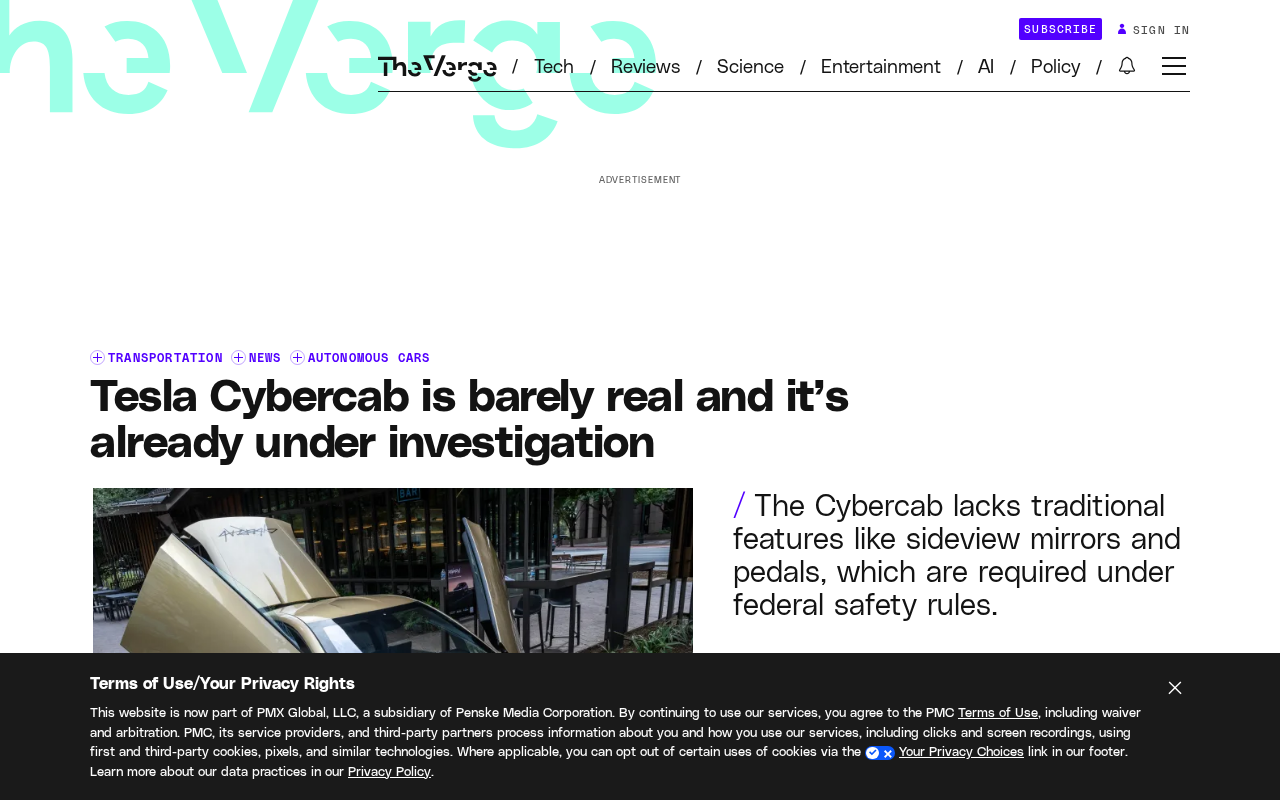
NHTSA launches audit query into Tesla's steeringless Cybercab over missing legally mandated vehicle features.
Tesla's Cybercab has drawn an NHTSA audit query before even reaching mass production, triggered by its radical removal of the steering wheel, pedals, and other features mandated under Federal Motor Vehicle Safety Standards (FMVSS). The investigation highlights a structural clash between autonomous driving ambitions and current regulations built around human-operated vehicles, echoing GM Cruise's failed Origin project. The probe could significantly delay Cybercab's commercialization and signals that regulatory compliance is a critical battleground in the autonomous driving race.
Under Federal Scrutiny Before Even Reaching Mass Production
Elon Musk's prized "gilded robotaxi" Cybercab hasn't even truly hit public roads yet, and it's already drawn an investigation from federal regulators. The National Highway Traffic Safety Administration (NHTSA) has announced the launch of an Audit Query (AQ) targeting the Tesla Cybercab, with the core objective of examining the vehicle's lack of traditional features—many of which are legally mandated.
NHTSA is the primary safety regulatory agency under the U.S. Department of Transportation. Established in 1970, it is specifically responsible for setting and enforcing motor vehicle safety standards, investigating safety defects, and managing recalls. Within NHTSA's regulatory toolkit, an audit query is an early-stage information-gathering mechanism typically used before a formal defect investigation is launched. It requires manufacturers to provide detailed documentation on compliance, design decisions, and internal processes. While it carries less legal weight than a formal investigation, it often serves as a prelude to deeper regulatory action. For manufacturers, receiving an audit query means they must submit extensive technical documentation and compliance explanations within a set timeframe, and any failure to cooperate could result in penalties.
For a vehicle that has yet to reach mass production and is still in its early deployment phase, entering the regulatory spotlight this quickly is an unusual signal in itself. It reflects the increasingly tense relationship between Tesla's aggressive approach to "redefining the automobile" and the existing regulatory framework.
The Core Controversy: Those "Omitted" Legally Required Features
A Radical Design Without Steering Wheel or Pedals
The most striking aspect of the Cybercab is its complete elimination of the steering wheel and pedals. This represents Tesla's most aggressive bet on the fully autonomous robotaxi vision—if the vehicle is entirely driven by AI, then controls designed for human drivers are redundant.
To understand how radical this design is, we need to revisit the technical classification system for autonomous driving. SAE International divides autonomous driving technology into six levels, from L0 to L5: at L0–L2, the human driver remains the responsible party at all times; at L3, the vehicle can drive autonomously under specific conditions but requires a human to be ready to take over at any moment; at L4, the vehicle can operate fully autonomously within a defined Operational Design Domain (ODD); and L5 represents full autonomy under any conditions. By removing the steering wheel and pedals, the Cybercab is designed to be at least L4—fully independent of human driving in certain scenarios. However, it's worth noting that Tesla's currently deployed FSD (Full Self-Driving) system is still classified as an L2 driver-assistance system in both legal and technical terms, requiring the driver to monitor at all times. The leap from L2 to L4 is not merely a technical challenge—it involves fundamental system-engineering upgrades in perception redundancy design, decision-making safety validation, and fail-safe mechanisms.
The problem is that the current Federal Motor Vehicle Safety Standards (FMVSS) are built around the premise of human-operated driving. FMVSS is the safety regulatory framework that all motor vehicles traveling on U.S. public roads must comply with, encompassing over 200 specific standards divided into three categories: the 100 series covers active safety measures to prevent crashes (such as braking systems, steering devices, lighting, and mirrors); the 200 series covers passive safety to protect occupants during crashes (such as seat belts, airbags, and structural body integrity); and the 300 series covers post-crash injury-reduction measures (such as fuel system integrity and EV battery safety). The design philosophy of this framework is built on a fundamental assumption: vehicles are operated by human drivers. As a result, many standards are directly tied to the driver's operating interface—for example, FMVSS 114 requires anti-theft and shift interlock devices, and FMVSS 111 requires rearview mirror systems. Many safety-related physical features, such as mirrors, specific control devices, and safety designs for human drivers, are legally mandatory. When a vehicle deliberately omits these features, it directly crosses the compliance red line.
The Substance of the NHTSA Audit Query
The audit query launched by NHTSA is specifically intended to "examine Tesla's relevant processes" and assess how the Cybercab meets or circumvents existing safety standards in the absence of these traditional features. This is not a routine product investigation—it is a systematic inquiry into Tesla's entire compliance logic.
In other words, the core question regulators want answered is: On what grounds can a car without a steering wheel and missing legally required features be legally allowed on the road?
Why Cybercab's Compliance Issues Are Thornier Than They Appear
A Structural Mismatch Between Autonomous Driving Regulations and the Technology Vision
Tesla's predicament represents a structural contradiction facing the entire autonomous driving industry. The technology vision has already raced ahead to a future of fully driverless vehicles, but the regulatory framework remains anchored in the reality of "humans can always take over." This mismatch means that any vehicle model attempting to completely remove human control devices must first obtain a regulatory exemption or special approval—otherwise, it operates in a legal gray zone or outright violation.
Previously, GM's subsidiary Cruise was stuck in the federal approval process for an extended period when applying to deploy Origin, its steeringless vehicle. Cruise unveiled Origin in 2020—a self-driving shuttle with no steering wheel and no pedals—making it one of the first publicly revealed production-intent autonomous vehicles to completely eliminate human control interfaces. Cruise subsequently submitted an FMVSS exemption application to NHTSA, but the approval process was extremely protracted. To make matters worse, in October 2023, a Cruise robotaxi was involved in a serious accident in San Francisco, dragging a pedestrian several meters, which led California to revoke Cruise's operating permit. The incident not only devastated Cruise's business prospects (GM ultimately announced the shutdown of Cruise's robotaxi operations in late 2024), but also made the entire industry more pessimistic about the regulatory approval outlook for steeringless vehicles. By pushing forward with the Cybercab, Tesla is essentially walking a path already proven to be extremely difficult, and Origin's failure provides a highly instructive cautionary tale.
The Lengthy Battle of FMVSS Exemption Applications
To legally commercialize a vehicle that doesn't comply with existing FMVSS, manufacturers typically need to apply to NHTSA for an exemption. But the number and pace of exemptions are strictly limited—under current regulations, NHTSA can approve a maximum of only 2,500 exempted vehicles per manufacturer per year, a cap that severely constrains the scaled deployment of driverless vehicle models. The approval process often drags on for years. This means that even if Tesla's autonomous driving technology is sufficiently mature, the Cybercab's large-scale deployment could be held up by the regulatory process for an extended period.
The launch of this audit query further highlights the risk in Tesla's approach of "build the car first, solve compliance later." When a product's design fundamentally deviates from the regulatory framework, even the most advanced technology cannot be directly translated into commercial reality.
Deeper Implications for Tesla and the Autonomous Driving Industry
For Tesla, the Cybercab carries Musk's grand vision of a robotaxi empire. Musk's obsession with the robotaxi business model goes way back—as early as Tesla's 2019 Autonomy Day, he painted a picture of vehicle owners adding their idle Teslas to a robotaxi network to generate income. The Cybercab is the dedicated hardware platform for that vision. From a business logic standpoint, the key to robotaxi profitability lies in driving down per-mile operating costs to the extreme: by eliminating driver wages (which account for roughly 60–80% of traditional ride-hailing costs), autonomous taxis can reduce unit costs to $0.25–$0.50 per mile, far below Uber/Lyft's $2–$3. Competitor Waymo has already validated this model's viability in cities like San Francisco and Phoenix, completing over 150,000 paid trips per week as of 2024. However, Waymo uses retrofitted vehicles that retain traditional control interfaces (based on the Jaguar I-PACE and Geely Zeekr), which allows it to sidestep the compliance issues posed by the Cybercab's missing legally required features—a strategic difference worth pondering.
The intervention of a regulatory investigation could significantly delay the Cybercab's commercialization timeline and may force Tesla to compromise on its design, potentially even reinstating some of the omitted features.
From a broader perspective, the regulatory scrutiny the Cybercab faces is an inevitable growing pain in the autonomous driving industry's march toward maturity. Technology advances far faster than laws can be updated, and finding the balance between innovation and safety, vision and compliance, will determine who can actually bring the driverless taxi vision to fruition.
For professionals following AI and autonomous driving, this incident offers a clear warning: in highly regulated industries, technological leadership does not automatically grant the right to hit the road. Regulatory compliance is becoming an equally critical competitive moat in the autonomous driving race.
Key Takeaways
Related articles
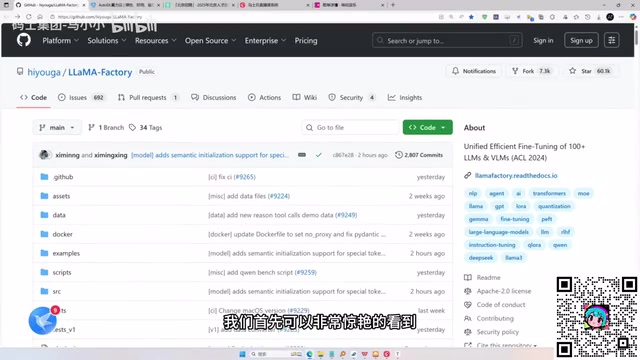
LLaMA-Factory in Practice: A Complete No-Code Guide to Fine-Tuning Large Models
An introduction to LLaMA-Factory, the open-source fine-tuning tool: its 60.1K-star background, supported models and algorithms, local vs. cloud deployment, and CUDA setup steps.

Zeng Ming's Deep Retrospective: Why OpenAI May Not Be the Ultimate Winner — and Why the Corporate System Will Disappear
Zeng Ming's deep retrospective on the AI endgame: model companies are just infrastructure, OpenAI and Anthropic won't be the final winners; the next battle is the Agent entry point standard; the corporate system will disappear as AI restructures collaboration, and only mission-driven companies can survive the cycle.

OpenHands v1.28.0: OpenCode and PI Added as Built-in Agents, API Keys Requestable In-Conversation
OpenHands ships 5 releases in 21 days: v1.27.0 adds OpenCode and PI as built-in agents, v1.28.0 enables in-chat key requests. ACP integration, credential reuse, model list changes, and upgrade advice.