Tesla Optimus Robot Mass Production Hits Wall: From 20,000-Unit Weekly Goal to Hundreds in Reality

Tesla's Optimus weekly output is just hundreds of units — about 100x below its 20,000-unit target.
According to The Information, Tesla's Optimus humanoid robot is only producing "hundreds of units" per week, roughly 100x short of its 20,000-unit weekly goal. To free up space for Optimus, Tesla converted its Model S and Model X lines for robot assembly — but the fundamental mismatch between automotive and precision robotics manufacturing has created new production headaches rather than solving them. This struggle reflects the broader immaturity of the humanoid robot industry: the engineering gap between a polished demo and reliable mass delivery remains enormous, and even resource-rich Tesla is still in the early stages of its production ramp.
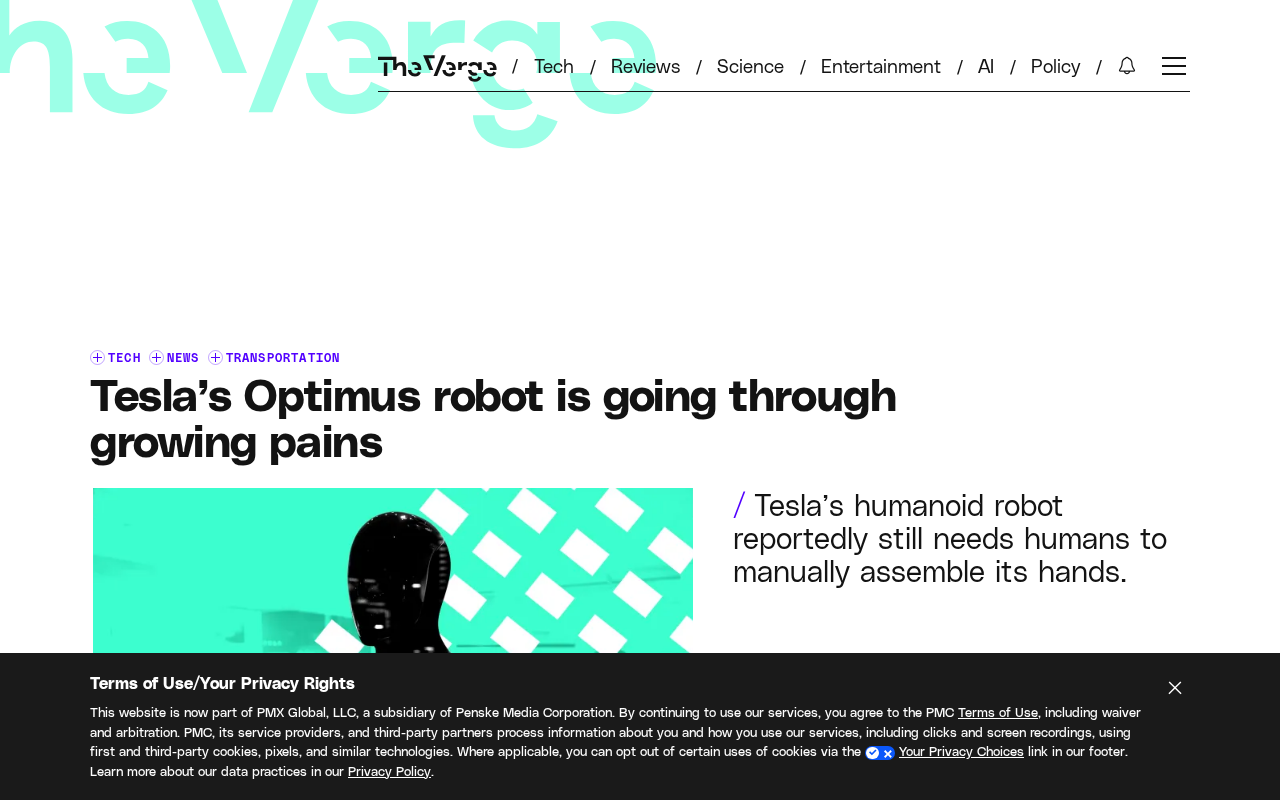
Tesla's ambitions in the humanoid robot space are running into a hard reality check. According to tech outlet The Information, Tesla's plan to produce 20,000 Optimus robots per week is facing significant challenges. Last month, actual output was only "hundreds of units per week" — a far cry from the company's grand targets.
A Risky Bet on Repurposed Production Lines
To make room for Optimus manufacturing, Tesla earlier this year converted its Model S and Model X production lines for robot assembly. The decision itself signals just how seriously Tesla is betting on humanoid robots — willingly sidelining its flagship vehicle lines to make way for the new venture.
However, automotive and robotics production lines differ fundamentally in terms of process requirements, precision tolerances, and assembly logic. According to reports, this repurposing strategy is generating a cascade of manufacturing headaches. Humanoid robots involve a large number of precision joints, sensors, and actuators — an assembly complexity that rivals or exceeds that of a full vehicle — and simply "converting" an existing line cannot easily meet mass production demands.
The Chasm Between Vision and Volume
A weekly output of 20,000 units implies an annual capacity of over one million — a figure that fires the imagination. The reality of "hundreds per week" represents a gap of roughly 100x. But this kind of shortfall isn't unique to Tesla; it's the "production hell" that nearly every cutting-edge hardware product encounters when scaling from prototype to mass manufacturing.
As a highly integrated and complex system, humanoid robots face mass production challenges on multiple fronts: supply chains for components remain immature, yield rates for precision actuators are difficult to guarantee, and assembly processes lack the accumulated know-how of more established industries. Tesla has endured painful production ramp-ups in the EV world before — the early-days "production hell" of the Model 3 is still a widely cited cautionary tale. That Optimus faces similar challenges is, to some degree, entirely predictable.
Tesla's Model 3 production hell unfolded in 2017–2018, when Musk ambitiously targeted 5,000 vehicles per week, only to see the line stall at a few hundred for months on end. The root cause was over-reliance on automation — Tesla tried to have robots handle nearly every assembly step, only to discover that many tasks still required human hands. The company ultimately had to erect a makeshift tent assembly line in a parking lot as a workaround. The lesson was clear: even Tesla, with its mature vehicle manufacturing infrastructure, paid an enormous price when introducing an entirely new production logic. Optimus is in a strikingly similar position — and arguably a more demanding one. The degree-of-freedom requirements for robot joints, sensor fusion, and torque control demand assembly precision far beyond the tolerance ranges typical in traditional automotive components. The pit of "production hell" may be even deeper this time.
The Universal Laws of Hardware Manufacturing
The struggles Optimus faces today reflect the overall maturity level of the humanoid robot industry as a whole. Despite increasingly fluid movements in demo videos, there is a vast engineering chasm between "capable of an impressive demo" and "able to deliver reliably at scale."
Manufacturing capability is often a truer measure of a hardware company's real-world strength than any technology demonstration. Software can iterate rapidly, but every step up in hardware production capacity requires synchronized optimization across supply chains, processes, and quality control — there are no shortcuts. Tesla's decision to repurpose vehicle lines for robot production was intended to accelerate the manufacturing timeline, but the new problems introduced by line adaptation may actually be slowing overall progress.
For observers tracking the humanoid robot space, this news offers a grounding perspective: even Tesla, with its substantial resources and rich manufacturing experience, is still in the early stages of ramping up Optimus production. The industry has a considerable road ahead before it achieves true large-scale commercial deployment.
Precision actuators are one of the core bottlenecks in humanoid robot mass production. Actuators drive movement at each joint and must simultaneously meet demanding specs — high torque density, low back-drive force, and millisecond-level response times. Currently, the number of global suppliers capable of delivering high-performance actuators at stable volume is extremely small. Yield rates compound the challenge throughout the supply chain: a typical humanoid robot has dozens of joints, and if a single actuator has a 99% yield rate, stacking 30 joints brings the whole-unit yield down to roughly 74% — putting severe pressure on cost control. This is precisely why competition in the humanoid robot sector ultimately tends to become a battle for control over key component supply chains, rather than a purely algorithmic software contest.
Related articles

Cursor Can Now Control Your Computer: AI Agents Can Drive Desktop Apps for Testing
Cursor adds desktop control: AI agents can drive desktop apps like the iOS Simulator to test their own features. We analyze the impact on dev workflows, possible technical approaches, and reliability concerns.

Vibecoding a Custom Inference Engine: High Hopes, Harsh Reality
A Reddit developer shares the real experience of vibecoding a custom inference engine: running GGUF Q4 models in the browser with WebGL2 and GLSL, only to fall into tokenizer debugging hell. This article analyzes the engineering challenges of browser-side LLM inference and why cloning llama.cpp is the more rational choice.

How High Are Anthropic's Early Investor Paper Returns Ahead of IPO?
Anthropic's early investor paper returns draw attention ahead of IPO. This article analyzes sources of book gains, capital structure, pre-IPO games and risks, and implications for the AI startup ecosystem.