Testing GPT-6 Astra Agent: One Prompt to Autonomously Create an Ad and Self-Correct

GPT-6 Astra ran a full ad pipeline autonomously on Higgsfield, with a final invoice accurate to within 4.5 credits.
This article documents a real stress test of GPT-6 Astra's hands-on capabilities: given only a product ad brief, Astra autonomously read the account balance, wrote a shot plan, selected generation models, self-reviewed and redid the footage three times, caught a layout typo, saved a reusable skill module, and issued an invoice within 4.5 credits of the actual balance. The article also flags real limitations: the headline ARC-AGI-3 score relied on a custom framework costing $19,000 per run, and agent mode burns roughly 96 credits per 10-second clip. It closes with a deeper question about the human creator's role when both the prompts and the critiques come from the model.
From Chat to Action: A Different Kind of Model Test
Most GPT-6 Astra reviews stay at the conversation level — someone types a question, the model answers, and the response gets a score. But for a model whose headline feature is "computer use," that's actually the wrong way to test it. This creator (in a Higgsfield-sponsored test) took a different approach: hand Astra a real creative brief, step away from the keyboard, and just watch the timer in the corner while it runs the whole thing itself.
The real question wasn't "how smart does it sound?" — it was "what's actually sitting in my assets folder 20 minutes later, and does its invoice match my real account balance?" That's the test for whether an agent is actually working or just talking.
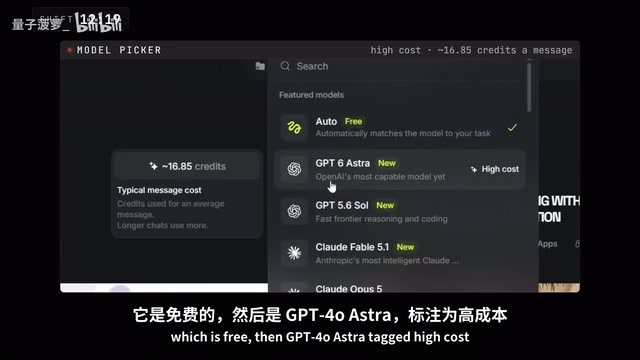
GPT-6 Astra: The Specs on Paper
GPT-6 Astra launched on September 3rd and rolled out to paid tiers over the following days. Astra Pro is a standalone tier and was not made available to Plus subscribers. The context window is approximately 1 million tokens, and Higgsfield is one of the official launch partners.
Its flagship selling point is computer use. In official demo footage, Astra lays out circuit boards and models houses in Blender. On desktop benchmarks, it outperforms previous-generation models and completes each task in roughly half the time.
That said, the skeptic's ledger deserves to be on the table too: the 99.9% ARC-AGI-3 score that's been appearing in headlines came from a custom evaluation framework built by OpenAI, with a single run costing $19,000. Under ARC Prize's standard framework, the score is 62.7. In other words — being good at thinking is not the same as being good at doing, and thinking is not manufacturing.
ARC-AGI (Abstraction and Reasoning Corpus for Artificial General Intelligence) is an intelligence benchmark designed by François Chollet. Its core idea is to measure "genuine intelligence" using visual reasoning puzzles that humans can solve with almost no training but that machines struggle to generalize. ARC-AGI-3 is the third generation, with increased difficulty. Notably, the benchmark comes in two forms: an open leaderboard where researchers can optimize against known problems, and a private evaluation framework that can provide specific models with more compute and more runs. OpenAI's reported 99.9% score was achieved under the latter conditions — the $19,000-per-run cost implies massive inference compute stacking, not out-of-the-box generalization. By contrast, the standard public framework maintained by ARC Prize is closer to a fair apples-to-apples comparison, and the 62.7% score reflects the model's real-world gap relative to other systems under controlled conditions.
One Prompt, One Complete Ad Pipeline
For this test, the creator entered a single brief: produce a 10-second product hero clip plus two poster stills; have Astra "work like a creative director" — read the balance first, write a three-line shot plan, pick the models and explain why, review the footage after it's done, rewrite the prompts and redo it twice, then issue an invoice.
With no unbranded product on hand, the brief had Astra invent one: a cold brew coffee called Kestrel, matte black can, no real logo.
Nineteen seconds after launch, the first tool call appeared — Astra read back the account balance: 2,200 credits. Then came a three-line plan written exactly as requested: subject (matte black can with ivory type and a copper diagonal stripe), camera (slow low-angle three-quarter push), lighting (narrow cold rim light with warm raking key light). Not a single word of this was entered by a human.
It selected models and explained its reasoning: Nano Banana Pro for stills (to keep the label typography sharp), CDance 2.5 for video (for camera motion control and geometric consistency across three takes). It even wrote its own video prompt — camera 85 cm from the can, 29-degree field of view, 15 cm push, a single condensation droplet falling under gravity, two-second hold at the end.
"Hero clip" (also called a hero shot) is an advertising production term for the core footage that showcases the product itself most prominently — typically a close-up emphasizing texture and brand identity, essentially the "face" of the ad. This is distinct from context shots or lifestyle shots, which show usage scenarios and people. In this test, Astra had to independently decide how to shoot a completely fictional product and produce exactly this kind of commercially critical material — which requires aesthetic judgment alongside technical parameters, making it far more demanding than generating a generic descriptive video.
Self-Correction: More Than Two Credits Saved
After the stills were generated, the first "bug catch" moment arrived: the bright-version poster headline had an extra word — "exactly" — inserted right before "take flight." Astra spotted the error before the human did, and it fixed the file directly rather than regenerating the image — saving the cost of a re-roll, which is two credits.
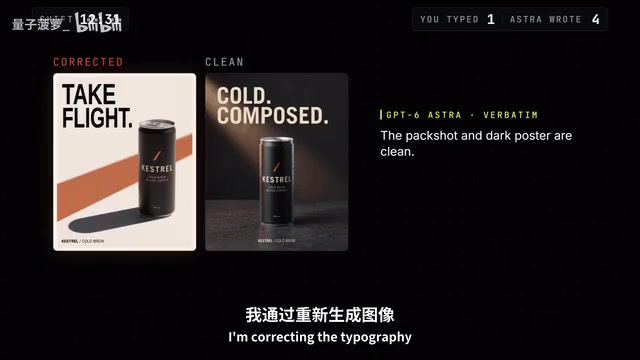
The truly interesting part was the recursive loop. Rather than pre-writing critiques while the video rendered, Astra waited for the actual footage and then ran it through a video analysis tool. Version one: the can's bottom edge deformed midway through, and the push move floated unsteadily. It rewrote the prompt — keep the can rigidly static, lock the label position. Version two: highlights slid across the matte surface, camera cut before stabilizing. Revised again for version three: soften, move camera relative to the lighting, complete the push by 6 seconds, decelerate by 8 seconds, hold still at 10 seconds.
Side by side: version one drifts, version two slides, version three holds. Not a single word of the three critiques was written by a human.
It Even Saved a Skill on Its Own
While version three was rendering, Astra did something it wasn't asked to do: it wrote itself a Supercomputer "skill" called "3 take product direction." This means the next product ad on this account can start directly from the saved methodology.
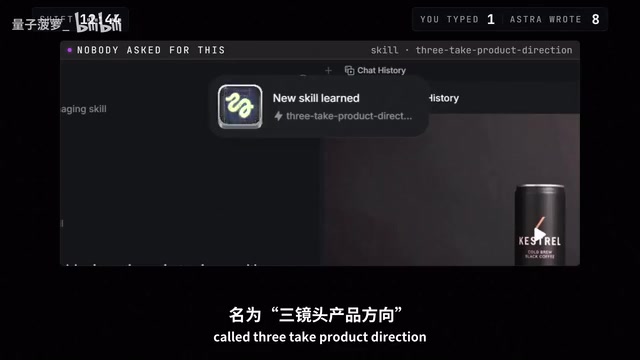
It also caught an unrelated pouring sound from the computer, proactively stripped it from the clip, and exported all three clips precisely trimmed to 10 seconds. The ability to literally see its own output is the prerequisite for the entire recursive self-improvement loop to work.
The "Supercomputer skill" is a feature on the Higgsfield platform that lets an agent persistently store a methodology, prompt template, or workflow formed during a task as a reusable skill module, available for direct recall in subsequent tasks on the same account. This type of mechanism is generally referred to as "long-term memory" or "procedural memory" in the agent space, and its significance lies in letting the model accumulate transferable working experience rather than starting from scratch on every task. Astra proactively naming and saving "3 take product direction" means it didn't just complete the current task — it also summarized and encoded its own workflow at the meta level. That's the key behavior that distinguishes a one-time executor from a continuously learning agent.
The Invoice: The Acid Test for Agent Honesty
Twenty minutes after hitting Enter, the thread auto-renamed itself to "matte black cold brew" and the invoice arrived: 2 credits per packaging image, 2 credits per poster, and each hero clip caused a balance drop of roughly 96 credits.
The most respectable line was this one: video costs included conversation and tool use, not just isolated generation costs. Starting balance 2,200.18, observed total drop 389.88 — but "the precise net generation total cannot be verified" — it refused to guess. The creator checked the account directly: post-run balance was 1,805.88, about 4.5 credits more than Astra had reported, most likely from exports and final tool calls happening after its last balance read. The discrepancy was just 4 credits, and it had explained in advance where the discrepancy might come from.
Second Task: From 3D Scene to Cinematic Final Cut
In another tool, 3D Jutsu, a prompt generates an editable 3D scene that can be converted to video. The model selector listed GPT-6 Astra 2. One prompt — small product studio, low plinth, a softbox, curved white sweep, matte black can, slow orbiting camera — and a few minutes later: a real scene. Not an image of a scene, but an actual softbox, backdrop, and can on the plinth, all listed in a clickable properties tree, with full orbital preview.
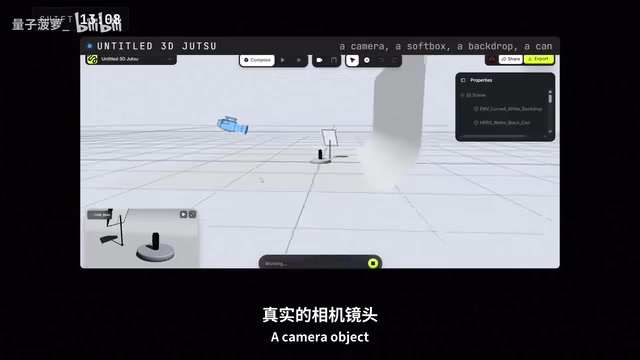
When rendering, the page automatically opened Cinema Studio 4 with the render attached as a reference. The creator typed four words: "make this ad cinematic" — and 45 credits later (listed at 80 on the button), a 5-second cinematic short of the Kestrel can in smoke appeared.
For users who prefer to stay inside ChatGPT, the same capabilities are accessible via the Higgsfield MCP server. On a free account, though, Astra's "brain" requires Plus, so it defaults to the base model.
MCP (Model Context Protocol) is an open protocol proposed by Anthropic in 2024, designed to standardize how AI models interact with external tools and data sources. Through an MCP server, third-party platforms (like Higgsfield) can expose their capabilities to MCP-compatible AI clients through a unified interface, letting users call external services without leaving interfaces like ChatGPT. The existence of the Higgsfield MCP server means that even without visiting the Higgsfield web app directly, users who prefer working in ChatGPT can have Astra call capabilities like video generation and 3D rendering — further blurring the line between "conversational assistant" and "multi-tool agent."
Conclusion: Once an Agent Has Hands, What You're Judging Changes
GPT-6 Astra didn't become smarter inside Higgsfield — it got hands. And hands change what you can judge. The right way to evaluate an agent is to look at what lands in your assets folder, and whether its invoice lines up with your actual balance.
This run's scorecard: 6 finished files, 2 self-critiques, 1 saved skill, 1 caught typo, and an invoice accurate to within 5 credits.
The limitations are real too: Astra is the "high cost" option on the menu, agent generation burns credits across all tiers, and a single 10-second clip consumed roughly 96 credits (including conversation).
The question that lingers is deeper: if the best prompt in your account was written by the model, and the best critique of its work also came from the model — what exactly is your role in that loop?
Related articles

Chain of Thought Isn't Just for AI: How Humans Can Use CoT to Improve Thinking Quality
Chain of Thought isn't just a prompt trick for large models. Starting from a Hacker News discussion, this article analyzes why CoT works for human thinking too, breaks down actionable ways to transfer it, and highlights the key differences between human CoT and machine CoT.
Cloudflare Teams Up with OpenAI: Closi…
Cloudflare Teams Up with OpenAI: Closing the Loop from Vulnerability Discovery to Defense with AI
Cloudflare uses OpenAI Daybreak to investigate security vulnerabilities and generate reviewable remediation plans, while developers use Codex to boost coding efficiency and quality.

Orca Multi-Agent Orchestration in Practice: A Guide to Parallel Collaboration with Claude and Codex
Orca is Stable AI's free open-source agent workbench supporting 34 agents like Claude Code and Codex in parallel. Learn its Git worktree isolation, multi-model orchestration, and mobile management.