Testing the 'AI Digital Employee' System: Exposing the Marketing Tactics Behind the 'Free' Offer
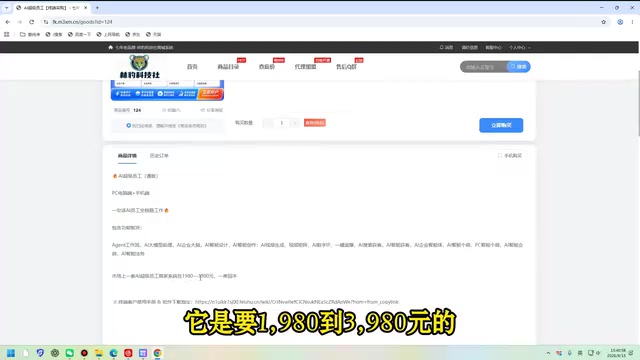
The 'AI Super Employee System' is just a low-cost LLM API wrapper dressed up as a private-traffic marketing funnel.
Promotional videos for 'AI Super Employee Systems' have gone viral on Bilibili, luring users with promises of free software 'worth thousands.' This article breaks down the technical reality: the system is simply DeepSeek and other LLM APIs bundled with multi-platform publishing integrations, demoing a video editing agent and a script assistant — both fully replicable with free official tools. The 'free' offer masks private-traffic and upsell motives, while requiring authorization of major social accounts creates real risks of account theft and bans.
Recently, a wave of promotional videos touting "AI Super Employee Systems" and "AI Digital Employees" has been flooding platforms like Bilibili. These videos typically claim to "fully take over entry-level roles" and "free your hands," using the hook of "originally priced at ¥1,980–¥3,980, now available for free" to lure users into DMing for access. Based on a typical promotional video of this kind, this article offers an objective breakdown of these systems' actual functionality and underlying marketing logic — to help interested users make informed decisions.
The Core Selling Points in the Ads
The video positions the system as an automation tool for "fully taking over entry-level positions," with the core pitch being that it replaces repetitive content production and marketing outreach. The promotional language emphasizes three things: rich features, free software, and a high market price (claimed to be worth ¥1,980–¥3,980).
This "high value + zero cost" combination is a textbook lead-generation tactic. Legitimate commercial software almost never gets distributed unconditionally with messaging like "originally costs thousands, now completely free." Behind the scenes, there's almost always a paid conversion funnel, private community funnel, or data monetization scheme. When users are drawn in by "free," they should stay alert to the acquisition channel and any follow-up requirements.
Noteworthy is the distribution method: rather than a public download, the video instructs users to "like, follow, and coin" the post, comment "666," and then receive what's described as an "official channel link" via direct message. This private-channel distribution model is itself at odds with how legitimate software is publicly released.
The Two Functional Modules Demonstrated
Based on the video demo, the system in this episode showcases two main modules. In technical terms, both are essentially wrappers around existing large model capabilities.
Multi-Account Authorization and Video Editing Agent
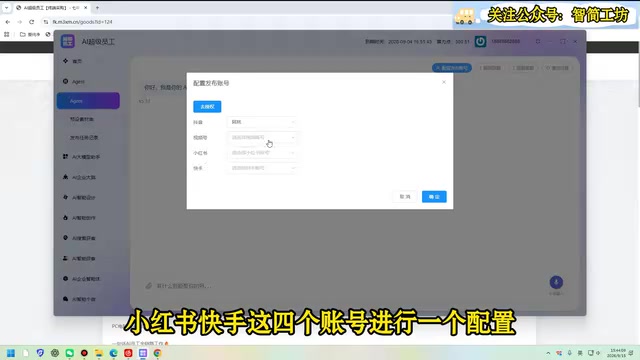
The first module is a content generation agent. Before use, you need to configure publishing accounts in an "Account Manager," which the video claims supports OAuth binding for four platforms: Douyin, WeChat Video Channel, Xiaohongshu, and Kuaishou. Once authorized, users can trigger content generation by entering a command (e.g., "help me edit a video").
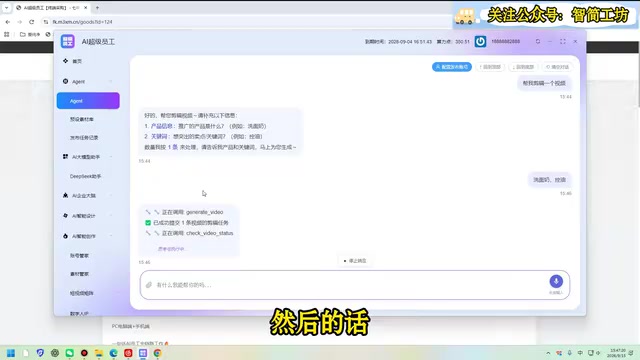
The demo mentions that video editing requires two inputs: product information (using "facial cleanser" as an example) and key selling points or keywords (using "oil control" as an example). The system also supports voice commands. Functionally, this is essentially a templatized tool that takes "product + selling points" and automatically produces marketing materials — suited for mass-producing cookie-cutter short-form commerce videos.
DeepSeek Script Assistant
The second module is a copywriting assistant powered by the DeepSeek model. Before use, you can choose between two model configurations. In the demo, the user inputs: "Generate a 15-second video with text descriptions, themed around a rural guesthouse, featuring mountains, a reservoir, and a farmhouse courtyard." The system returns a structured script including a title, duration (15 seconds), and a shot-by-shot breakdown (Shot 1, Shot 2, etc.).
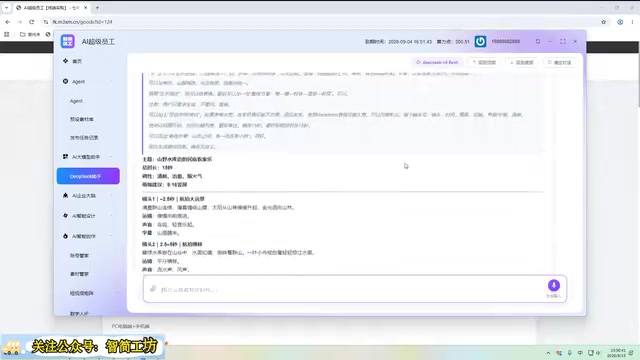
Looking at the output, this module is simply a wrapper around the DeepSeek large model API, packaging its general conversational generation capability into a "video script assistant" interface. Users can achieve exactly this through DeepSeek's official channels for free — no third-party "employee system" required.
The Technical Reality: A Repackaged Large Model
Strip away the "AI Super Employee" branding, and the technical foundation of this system is nothing mysterious. At its core, it integrates the text, image, and video generation capabilities of open-source or commercial large models (such as DeepSeek) with multi-platform publishing interfaces, all wrapped in a unified UI.
The underlying product concept — "Agent + automated workflow" — is legitimate and is indeed the mainstream approach for AIGC marketing tools today. The issue, however, is that the video demonstrates no proprietary model capabilities, data moats, or engineering innovations. Every feature shown can be replicated using publicly available tools. In other words, what users are paying for — or trading their private traffic for — is primarily the convenience of bundling, not any core technical value.
What is an "Agent"? An AI agent is a program that receives user instructions, calls external tools (such as search engines, APIs, or file systems), and autonomously completes multi-step tasks. Unlike a simple chat model, an agent breaks a complex goal into subtasks and executes them in sequence — for example: "generate copy → match assets → call platform API to publish." Automated workflows then lock these steps into a repeatable, triggerable pipeline. This architecture was popularized by open-source frameworks like LangChain and AutoGPT, and the barrier to entry has continued to fall. It's precisely because of this low barrier that the market is now flooded with "shell" products — technically just API calls to models like OpenAI or DeepSeek stitched together with a few platform publishing integrations, then sold at a premium under names like "Super Employee" or "Intelligent Agent Matrix." The real test of whether an Agent tool has genuine value lies in whether it has proprietary data, customized models, or unique engineering capabilities — not just a polished interface.
Risks Users Should Take Seriously
For entrepreneurs or individual users drawn in by this type of content, several real-world risks deserve careful consideration.
Account security risks: The system requires authorization for multiple platform accounts including Douyin, Xiaohongshu, and Kuaishou. Granting publishing permissions to an unknown third-party application creates exposure to account theft and violations that could result in bans.
Questionable distribution channels: Legitimate software is distributed through official websites and app stores — not via "DM me for the link" or "find me through the watermark." Software packages obtained through unofficial channels may bundle malware or collect user data.
Content compliance risks: Mass-produced, homogeneous marketing videos are already being throttled by platform algorithms. The "fully automated customer acquisition" promised in the ads typically underperforms expectations in real-world operation.
Opaque monetization motives: The true business model behind "free" is worth asking. Is it follow-up course fees? Community upsells? Traffic and data monetization? Users should stay clear-headed before signing up.
Conclusion
AI-powered content production and marketing automation are genuine technological trends, and models like DeepSeek have genuinely lowered the barrier to creation. But promotions like "AI Super Employee System" are more accurately described as private-traffic marketing campaigns riding the AIGC hype wave — with a significant gap between their claimed "revolutionary" capabilities and the actual technical substance.
For everyday users, instead of being swayed by the pitch of "claim a system worth thousands for free," you're better off using official tools like DeepSeek and CapCut directly — safer, and completely free. When it comes to any "miracle tool" that demands account authorization and private-message acquisition, a healthy dose of skepticism is never a bad thing.
Background: How Account Authorization Risks Actually Work
Account authorization on mainstream platforms typically uses the OAuth protocol, which in theory gives third parties only a limited-permission token without direct access to passwords. However, unverified desktop software carries deeper risks: the application may locally intercept cookies or tokens and upload them to a remote server, bypassing OAuth restrictions. Some software also asks users to scan a QR code to log in or enter their credentials directly — effectively handing over account access. Once a platform detects abnormal automated behavior (such as bulk publishing in a short timeframe or IP addresses inconsistent with usual devices), the account faces throttling, suspension, or permanent deactivation. For creators who have built up a following, this loss is irreversible. Before authorizing any third-party tool, it's worth checking whether it appears in the target platform's publicly listed "authorized applications."
Related articles

LynnReal-Omni: 32B Unified Video Diffusion Model Goes Open Source with Multi-Task Coverage in Four Steps
LynnReal-Omni is a 32B unified video diffusion model on MiniMax H3, covering text-to-video, pose guidance, style transfer, restoration in 4 steps. Flash version generates 540p video in 377ms on one H100.

Anthropic Co-Founder: AI 'Kill Switch' May Need to Be Mandatory by Law
Anthropic's co-founder tells the BBC that AI 'kill switches' may need to be legally mandated. We analyze the industry logic, technical challenges, and the tension between regulation and innovation.

The AI Data Center Boom Is Colliding With Cities Scarred by Heavy Industry
The AI data center boom is clashing with post-industrial communities. Philadelphia's case reveals structural conflicts between AI growth, energy use, water, and environmental justice.