TestSprite 4.0: The AI Testing Agent That Ends the "Fix One, Break Another" Cycle

TestSprite 4.0 uses a natural-language-driven testing agent to add a regression testing safeguard to AI coding.
TestSprite 4.0 is an AI testing agent that topped Product Hunt's daily chart, targeting the "fix one, break another" regression pain point of AI coding assistants. It remembers how the app should behave and checks all related features after each change. Users describe testing needs in natural language, and the agent explores the running app, writes and executes E2E tests, and analyzes failures to identify real bugs. It integrates with web, terminal, and PR workflows, covering coding, committing, and review. The article acknowledges its potential to reduce E2E test costs but notes that its coverage, bug accuracy, and integration with Playwright/Cypress remain to be validated.
TestSprite 4.0: The AI Testing Agent That Ends the "Fix One, Break Another" Cycle
In an era where AI coding assistants are increasingly common, there's an awkward reality: your coding agent just fixed a bug, but it may have inadvertently broken another feature. This "fix one, break another" cycle is exactly what TestSprite 4.0 aims to solve. This testing agent, which topped Product Hunt's daily chart with 145 upvotes, claims it can remember how your app is supposed to behave and thoroughly check everything after each change, making AI-generated code truly reliable.
Starting from "Fix One, Break Another": The Regression Pain Point of AI Coding
If you've used AI coding tools like GitHub Copilot or Cursor, you may have encountered this: you ask the AI to fix a function, and it does fix it—but another module that depends on that function quietly stops working. The reason is that AI coding agents typically focus only on local tasks and lack memory and verification of the app's overall behavior.
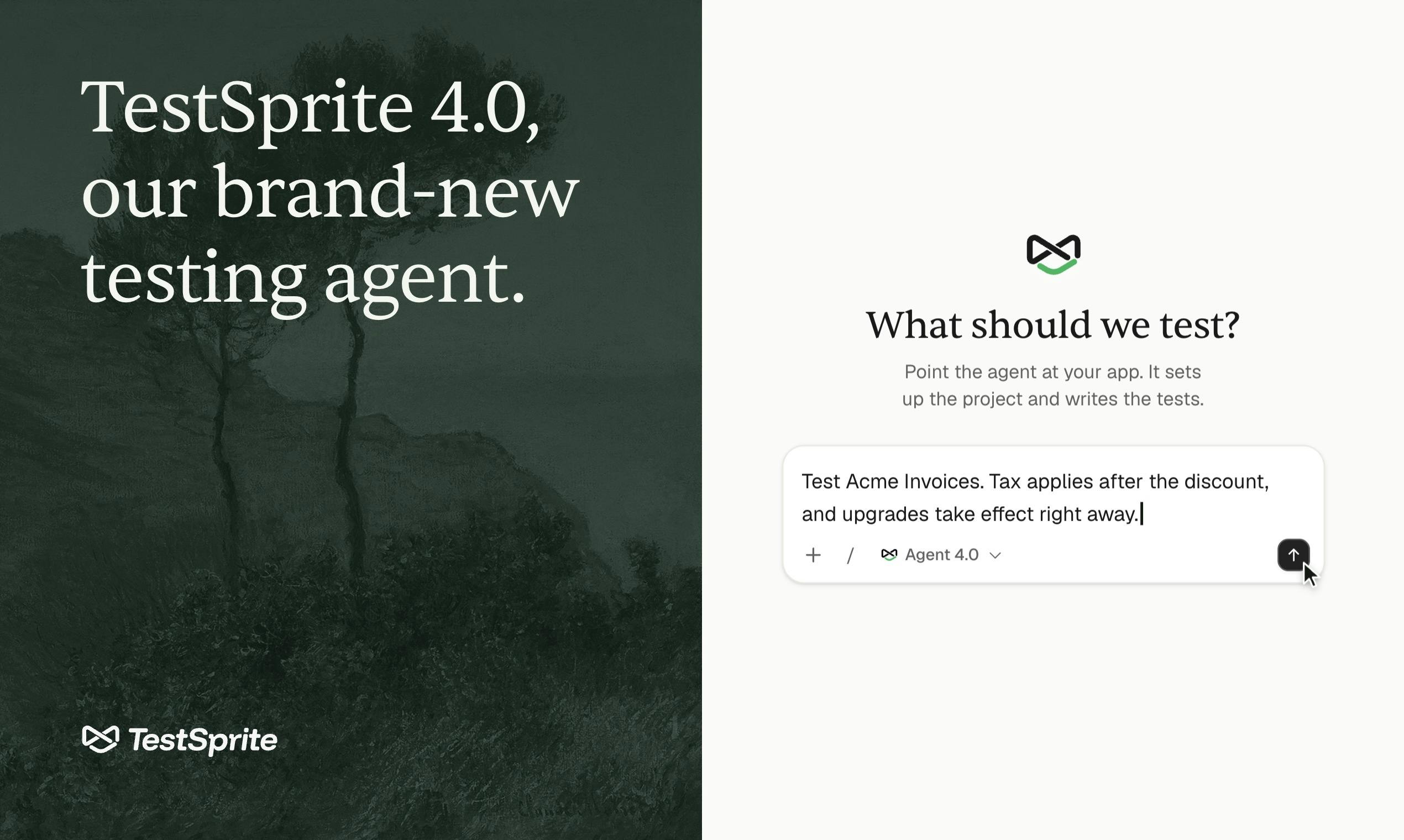
TestSprite 4.0 was born precisely to address this pain point. According to its Product Hunt page, it is a "brand-new testing agent" that can remember what your app is supposed to do and check all related behaviors after each change. This is essentially adding an automated regression testing safeguard to the AI coding workflow.
Regression testing refers to the testing activity of re-running existing test cases after a software modification to confirm that the change has not broken existing functionality. It is the opposite of "new feature testing"—it focuses on whether "old behavior is still correct." In traditional development, regression testing is usually triggered automatically by CI pipelines after each commit; but in AI coding scenarios, because the agent generates patches only for local tasks each time and lacks explicit modeling of global behavior, regression issues are more easily introduced and harder to detect. TestSprite 4.0's emphasis on "remembering how the app is supposed to behave" essentially shifts the baseline of regression testing from a manually maintained set of test cases to a behavior contract continuously maintained by the agent.
Driving Tests with Natural Language: How TestSprite 4.0 Works
The core interaction of TestSprite 4.0 is very intuitive: you just tell it what to test in plain language. For example, "after a user logs in, they should be able to see their profile page" or "after adding an item to the cart, the total price should update." The agent then automatically explores the running app, writes and executes end-to-end tests.
More importantly, it doesn't just run tests—it also analyzes the reasons for failures and tells you which failures are real bugs. This means developers don't need to manually filter through test reports and can focus directly on the issues that need fixing. This "explore-write-execute-analyze" loop transforms testing from a tedious manual task into an automated process driven by an agent.
End-to-end testing (E2E) refers to a testing approach that starts from the user's perspective and runs through a complete business flow—for example, "open the page → log in → enter the personal center → verify the displayed information." Unlike unit tests that verify only a single function, E2E tests actually drive a browser or client and cover the collaboration of the frontend, backend, and data layer. Their advantage is that they closely match real usage scenarios; their drawbacks are high writing and maintenance costs, slow execution speed, and difficulty in locating failures. TestSprite 4.0 lets you describe requirements in natural language and then has the agent automatically generate and execute E2E tests, which is exactly an attempt to lower the barrier to this step; and its ability to "analyze the cause of failures and determine whether they are real bugs" corresponds to the most labor-intensive part of E2E testing: failure attribution.
Full-Process Coverage: Seamless Integration from Terminal to PR
Another highlight of TestSprite 4.0 is its integration capability. According to the official description, it can continuously check every change in the web interface, the terminal, or your pull requests. This means that whether you're developing locally, going through a CI/CD pipeline, or in the code review stage, TestSprite can step in and run tests.
This full-process coverage design makes testing no longer an isolated island at the end of the development process, but something that runs through every stage of coding, committing, and reviewing. For team collaboration, this helps catch regression issues early and reduces fix costs. The 145 upvotes and 17 comments on Product Hunt also reflect developers' strong interest in this type of tool.
Multi-Source Perspective: The Value and Limitations of Testing Agents
Although TestSprite 4.0 has gained decent attention on Product Hunt, as a new product its actual effectiveness still needs to be tested by the market. From the official description, it emphasizes "remembering how the app is supposed to behave" and "specifying tests in natural language." If implemented well, these two points would significantly reduce the cost of writing and maintaining end-to-end tests.
However, the effectiveness of a testing agent depends heavily on its coverage when exploring the app and the accuracy of its bug determination. Currently, the official team has not disclosed specific technical details or performance metrics, and the developer community is waiting to see its actual performance. In addition, the relationship between testing agents and existing testing frameworks (such as Playwright and Cypress) is also a question worth watching.
The Playwright and Cypress mentioned in this article are two mainstream web end-to-end testing frameworks today. Playwright is maintained by Microsoft and supports multiple browser engines—Chromium, Firefox, and WebKit—and excels in cross-browser and multi-tab scenarios; Cypress is known for its developer experience, offering live reload and time-travel debugging, but was initially limited in cross-domain and multi-tab scenarios. Both require developers to hand-write selectors and assertion logic. Testing agents like TestSprite are not simple replacements for them: the agent may call these frameworks under the hood to execute tests, or it may build its own driver layer. For teams, the key question is whether the tests produced by the agent can be exported as readable Playwright/Cypress scripts and incorporated into existing CI assets; otherwise, it is easy to create a new tool silo.
Who Should Use TestSprite 4.0?
Judging from its product positioning, TestSprite 4.0 is mainly aimed at developers and teams using AI coding agents. If you frequently ask AI assistants to modify code and worry about introducing regressions, this tool can provide automated regression testing safeguards. At the same time, for teams looking to reduce the manual effort of writing end-to-end tests, the natural-language-driven testing approach is also quite attractive.
TestSprite 4.0 is currently live on Product Hunt and provides an official website link for further information. As AI coding becomes more widespread, testing agents may become an indispensable part of the development toolchain. Whether it can truly end the "fix one, break another" cycle still needs to be verified in real projects.
One-line Summary
TestSprite 4.0 uses a natural-language-driven testing agent to add a regression testing safeguard to AI coding.
Paragraph Summary
TestSprite 4.0 is an AI testing agent that topped Product Hunt's daily chart, targeting the regression pain point of AI coding assistants "fixing one thing and breaking another." It can remember how the app is supposed to behave and check all related functionality after each change. Users only need to describe testing requirements in natural language, and the agent automatically explores the running app, writes and executes end-to-end tests, and also analyzes failure causes to determine which are real bugs. The product supports integration across multiple environments such as the web interface, terminal, and pull requests, making testing run through the entire process of coding, committing, and reviewing. The article affirms its potential to reduce the cost of writing and maintaining E2E tests, but also points out that its exploration coverage, bug determination accuracy, and collaboration with existing frameworks such as Playwright and Cypress still need market validation.
Related articles

Prompt Engineering for Beginners: From Writing Prompts to Engineering Thinking
Starting from the essence and four functions of prompts, this article systematically explains the six-step process, four success criteria, learning value, and practical limitations of prompt engineering to help you build a complete understanding.

Anthropic Launches Nasdaq IPO: AI Giant's Listing and Risk Disclosures
Anthropic officially launches its Nasdaq IPO under ticker ANT, with market valuation expected to potentially exceed SpaceX's record. The prospectus devotes nearly 100 pages to AI risks, while first-half revenue grew over 14x but net losses widened sharply, reigniting the AI bubble debate.

Rust cURL Clone Uses 4,832 unsafe Blocks—Is the Memory Safety Myth Broken?
A Rust cURL clone uses 4,832 unsafe keywords, challenging Rust's memory safety narrative. We analyze what unsafe really means, compare Fil-C, and examine rewrite motives.