Tetriz Harness: Turning Team Experience into Agent Configuration

Open-source tool Tetriz Harness turns individual Agent tuning experience into a diagnosable, distributable team asset.
Tetriz Harness is an open-source project launched on Product Hunt that addresses the problem of fragmented Agent configurations when teams use AI programming tools. It consists of two modules: Harness Recommendations diagnoses configuration gaps across rules, skills, hooks, and permissions, using real team session data to identify problems; Control Plane syncs fixes to all members, closing the execution gap between knowing what to change and actually changing it. Supporting four mainstream tools — Claude Code, Codex, Cursor, and Kiro — it bets that Agent configuration needs CI/CD-style engineering management. With 54 upvotes and a #17 daily ranking, it has resonated with some developers, but discussion remains limited and the product may still be in its early stages.
The Pain Point of Team AI Programming: Everyone's Agent Is Different
When a team uses tools like Claude Code, Codex, Cursor, and Kiro simultaneously, a subtle problem gradually surfaces: every member's Agent configuration evolves on its own. One person has fine-tuned the permission rules, another has written a set of efficient hooks, and someone else has accumulated project-specific knowledge in their skills — but this experience stays on individual machines and doesn't automatically flow to teammates.
When new members join, they either start from scratch or manually copy a configuration that may or may not be outdated. The team's overall Agent capability ends up being dragged down by whoever is least familiar with the tools.
Tetriz Harness, an open-source project launched on Product Hunt, is aimed squarely at this problem. Its tagline is direct: "Turn what your team learns into everyone's agent setup."
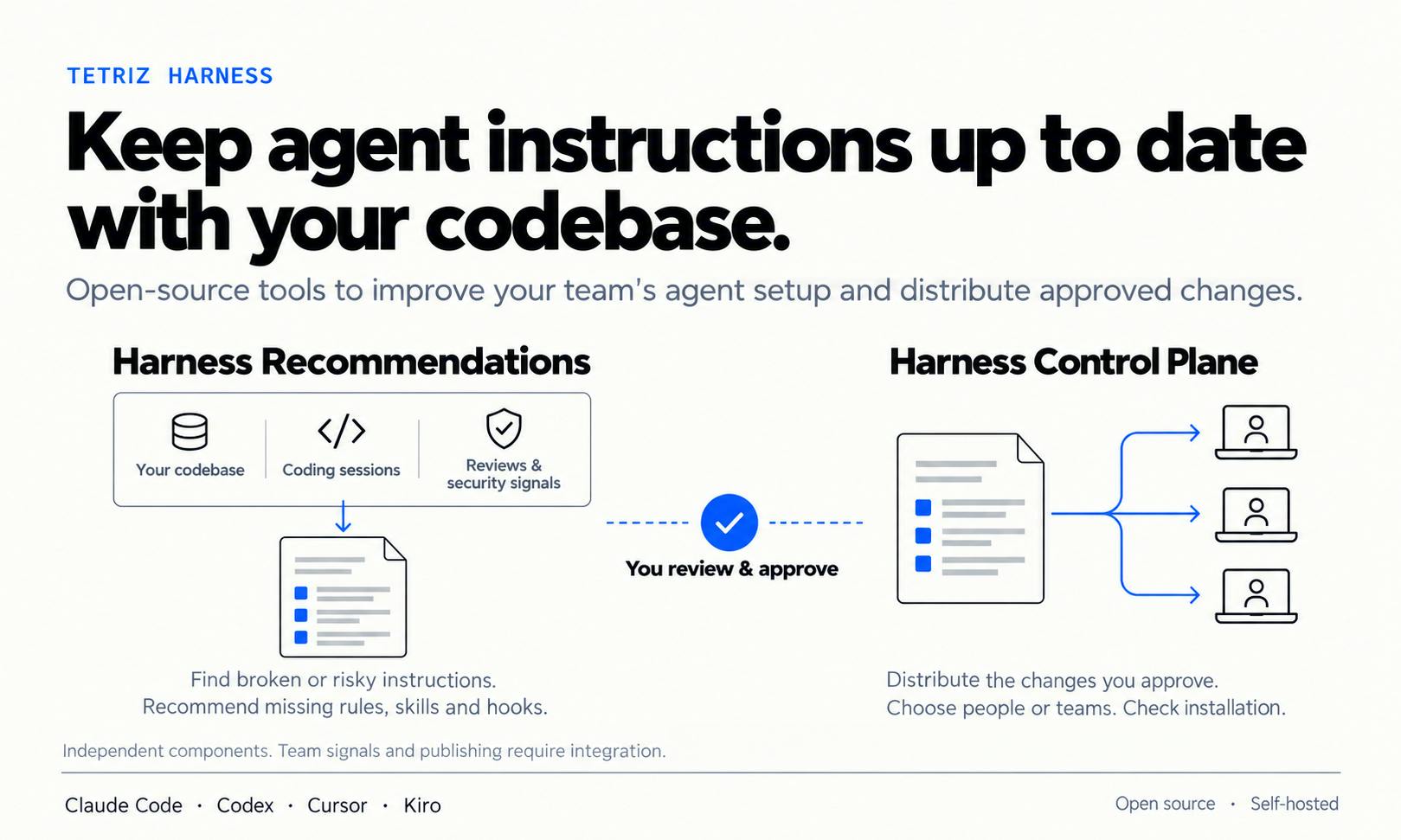
Two Core Modules: Diagnosis and Distribution
Tetriz Harness consists of two complementary tools that form a closed loop from "discovering problems" to "team-wide fixes."
Harness Recommendations: Finding the Gaps in Agent Configuration
The first module handles diagnosis. It analyzes the current state of your agents across four dimensions — rules, skills, hooks, and permissions — and combines that with the team's actual session records to determine what's going wrong and what capabilities are still missing.
This approach differs from generic lint tools. It doesn't just check whether configuration files are "compliant" — it works backward from real team usage behavior to judge whether the configuration is reasonable. For example, a permission rule that frequently causes the Agent to get stuck, or a type of task that repeatedly fails without any corresponding skill to catch it — these signals can only be captured by combining them with actual sessions.
Control Plane: Pushing Fixes to the Entire Team
The second module handles distribution. Once Recommendations identifies problems and proposes improvements, the Control Plane is responsible for syncing those fixes to all team members.
This step solves the execution gap between "knowing what to change but no one doing it." The traditional approach is to send a Slack message saying "everyone remember to update your permission config," and the actual compliance rate tends to be very low. Control Plane turns configuration changes into team-level operations, reducing the reliance on individual initiative.
Why Configuration Distribution Needs a Dedicated Control Plane
In distributed development teams, configuration drift is a common phenomenon: even if the initial configuration is identical, versions quickly diverge as members continue to make local adjustments. The value of a Control Plane lies in treating configuration as an object requiring centralized governance, similar to the role played by configuration centers (such as Apollo or Consul) in microservices architectures. It's not just "distributing files" — it also takes on the responsibilities of version control, change auditing, and rollback. For AI programming tools, this layer has been largely absent until now, with most teams relying only on verbal agreements or documentation to stay in sync. If Control Plane can provide mechanisms for permission convergence, change approval, and canary releases, it has the potential to become the de facto standard layer for team Agent management.
Why This Direction Is Worth Watching
The team-level adoption of AI programming tools is going through a subtle phase: the tools themselves are already powerful enough, but team-level configuration management is almost a blank slate.
Every developer is "training" their Agent in their own way, but there's no mechanism for sharing and improving. This is similar to early development teams that had no unified code standards and no CI/CD pipelines — everyone just wrote code based on personal habits.
Tetriz Harness is betting that Agent configuration also needs an engineering-style management approach. It's open-source and explicitly supports four mainstream tools — Claude Code, Codex, Cursor, and Kiro — giving it fairly broad coverage compared to similar projects.
Based on Product Hunt data, 54 upvotes and a #17 daily ranking show it resonated with some developers, but a single comment also reflects limited discussion — the product is likely still in its early stages.
What Are the Four Dimensions of Agent Configuration?
In tools like Claude Code, rules, skills, hooks, and permissions form the four-layer control plane for Agent behavior. Rules are the instruction set that guides how the model behaves — essentially a team version of system prompts. Skills are reusable task capability modules that encapsulate project-specific knowledge or workflows into callable packages. Hooks are automation scripts triggered before or after specific events, such as automatically running checks before code commits. Permissions define which operations the Agent can execute and which resources it can access. Together, these four correspond to "how to speak, what it knows, when to act automatically, and what it's allowed to do." If any layer is inconsistent, Agent behavior across the same team will diverge noticeably.
The Role of Session Data in Configuration Diagnosis
The key difference in Recommendations' emphasis on combining sessions (session records) to judge configuration quality — versus traditional static checks — is this: configuration files only reflect "written intent," while session records reflect "what actually happened." By analyzing the real interaction traces between the Agent and developers, it's possible to identify problems invisible to static configuration — for example, whether a permission rule frequently interrupts normal workflows, whether a type of task repeatedly fails, or which skills are never actually triggered. This "behavior-driven" diagnostic approach is closer to engineering practice, but it naturally raises considerations around data privacy and transmission boundaries, especially in enterprise environments.
Questions Worth Considering
This direction faces several practical challenges: different AI programming tools have very different configuration formats and extension mechanisms, and supporting four tools simultaneously means significant maintenance costs. The privacy boundaries of team session data also need to be clarified — where data is processed and whether it's uploaded when Recommendations analyzes sessions are details critical to enterprise adoption decisions.
Another issue is the mechanism for forming "team consensus." If automatically recommended configuration improvements are pushed directly without team discussion, they could introduce new inconsistencies. How to balance automation with human review is a question Control Plane needs to answer.
For engineering leaders who are bringing AI programming tools into their team workflows, Tetriz Harness offers a sample worth watching: it attempts to transform individual Agent tuning experience into a diagnosable, distributable, and accumulable team asset. That idea itself may be more noteworthy than the tool's current feature completeness.
Related articles

Chain of Thought Isn't Just for AI: How Humans Can Use CoT to Improve Thinking Quality
Chain of Thought isn't just a prompt trick for large models. Starting from a Hacker News discussion, this article analyzes why CoT works for human thinking too, breaks down actionable ways to transfer it, and highlights the key differences between human CoT and machine CoT.
Cloudflare Teams Up with OpenAI: Closi…
Cloudflare Teams Up with OpenAI: Closing the Loop from Vulnerability Discovery to Defense with AI
Cloudflare uses OpenAI Daybreak to investigate security vulnerabilities and generate reviewable remediation plans, while developers use Codex to boost coding efficiency and quality.

Orca Multi-Agent Orchestration in Practice: A Guide to Parallel Collaboration with Claude and Codex
Orca is Stable AI's free open-source agent workbench supporting 34 agents like Claude Code and Codex in parallel. Learn its Git worktree isolation, multi-model orchestration, and mobile management.