TextSphere: Shared Hyperspherical Alignment for Efficient Text-to-Image Generation

TextSphere combines hyperspherical sampling with CLIP text conditioning for efficient high-quality text-to-image generation.
TextSphere addresses Sphere Encoder's limitation of handling only class labels by injecting pretrained CLIP text embeddings via AdaLN, enabling free-text conditional generation while preserving the spherical sampling mechanism. To bridge the cross-modal representation gap, it designs the SSAU objective, jointly optimizing semantic alignment and representation uniformity on the hypersphere. Experiments show that with only 4 and 6 sampling steps, it achieves lower gFID than comparison diffusion and GAN models, with rFID below 1.0. The paper also finds that improved reconstruction fidelity does not necessarily improve generation quality, and uses PLS-SVD to explain modality gap compression geometrically.
Diffusion models have driven substantial improvements in text-to-image quality, but at the cost of high latency from multi-step iterative inference. Sphere Encoder offers a more efficient path—generating images with fewer forward steps—but is limited by its class-conditional design and cannot handle free-form text input. The core idea of TextSphere is to combine Sphere Encoder's hyperspherical sampling mechanism with language conditioning, and to bridge the cross-modal representation gap with a shared hyperspherical alignment objective.
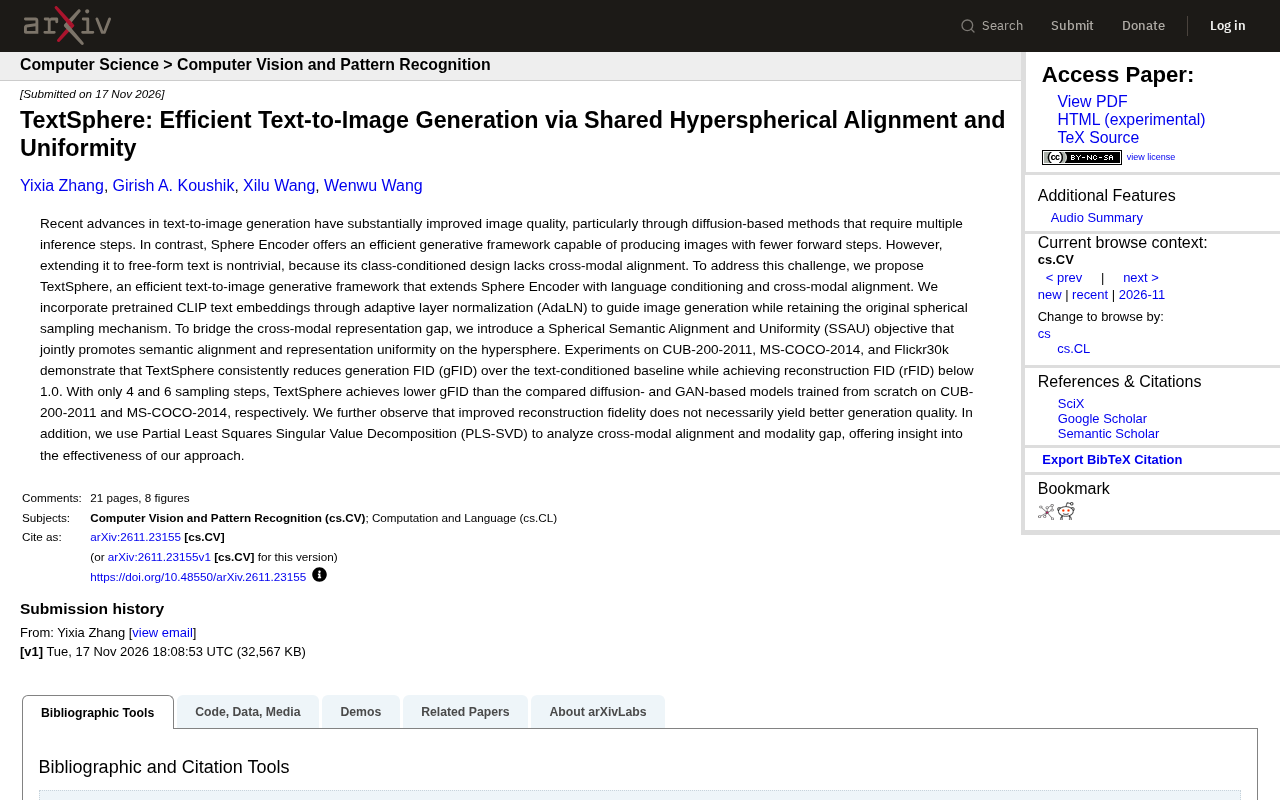
From Class Conditions to Free Text: What Needs to Be Solved
Sphere Encoder's efficiency comes from sampling on a hypersphere, but its conditioning input is discrete class labels rather than free-form text descriptions. Extending it to text-to-image generation faces at least two obstacles.
The first is the conditioning injection method. TextSphere chooses to introduce pretrained CLIP text embeddings through adaptive layer normalization (AdaLN) to guide image generation, while preserving the original spherical sampling mechanism. This reuses the language representations CLIP has already learned without breaking Sphere Encoder's efficient generation path.
The second is the cross-modal representation gap. Text embeddings and image representations reside in different semantic spaces, and direct concatenation or simple conditioning often leads to insufficient alignment. TextSphere's response is to introduce a dedicated training objective rather than relying solely on architectural changes.
Adaptive Layer Normalization (AdaLN) is a conditioning injection mechanism that does not directly concatenate condition vectors; instead, it uses conditioning information to dynamically scale and shift activations in normalization layers. Specifically, given a text embedding (c), AdaLN generates two sets of parameters (\gamma(c)) and (\beta(c)) through a learnable projection, applying a per-channel affine transformation to the feature map: (\text{AdaLN}(h, c) = \gamma(c) \cdot \frac{h - \mu}{\sigma} + \beta(c)). Compared with cross-attention, AdaLN has lower parameter overhead, is more stable to train, and does not alter the sequence structure of the backbone network, making it particularly suitable for efficient generation frameworks that need to preserve the original sampling path. TextSphere chooses AdaLN over cross-attention precisely to inject CLIP text conditions without disrupting Sphere Encoder's spherical sampling geometry.
SSAU: A Joint Objective for Alignment and Uniformity
TextSphere proposes the Spherical Semantic Alignment and Uniformity (SSAU) objective, which simultaneously optimizes two things on the hypersphere: semantic alignment and representation uniformity.
Semantic alignment brings text embeddings and corresponding image representations closer together on the sphere, which is the foundation of cross-modal conditional generation. Uniformity constrains the distribution of representations on the sphere from collapsing into local regions, thereby preserving generation diversity. Jointly optimizing both within the same spherical geometric framework is the key design of this work—alignment is responsible for "getting it right," while uniformity is responsible for "generating broadly."
This objective is geometrically consistent with Sphere Encoder's original spherical sampling mechanism, so no fundamental reconstruction of the generation framework is required.
Representation Uniformity is a metric proposed in the contrastive learning literature to measure whether feature vectors are overly concentrated on the unit hypersphere. Its typical form is (\mathcal{L}{\text{uniform}} = \log \mathbb{E}{x,y} e^{-t |f(x)-f(y)|^2}), where a smaller value indicates more dispersed representations. In generative models, insufficient uniformity leads to mode collapse—the model repeatedly generates a few samples and diversity decreases. SSAU introduces a uniformity constraint into the hyperspherical sampling space and jointly optimizes it with the semantic alignment term. In essence, this adds a geometric regularizer to the generation process, preventing conditioned representations from occupying local regions of the sphere, so that a broad generation distribution can still be covered under few-step sampling.
Experimental Performance: Competitiveness Under Few Steps
The paper validates on three datasets: CUB-200-2011, MS-COCO-2014, and Flickr30k. There are three main conclusions.
First, TextSphere consistently reduces generation FID (gFID) on text-conditioned baselines and pushes reconstruction FID (rFID) below 1.0.
Second, it remains competitive with very few sampling steps: using only 4 and 6 sampling steps, TextSphere achieves lower gFID on CUB-200-2011 and MS-COCO-2014 than comparison diffusion models and GAN models trained from scratch. This directly addresses the inference cost issue in practical deployment—fewer steps mean lower latency.
Third, the paper observes a counterintuitive phenomenon: better reconstruction fidelity does not necessarily lead to better generation quality. This indicates that when evaluating such efficient generation frameworks, rFID and gFID need to be considered separately, and reconstruction ability should not be treated as a proxy for generation ability.
FID (Fréchet Inception Distance) is a commonly used metric for evaluating generated image quality. It computes the Fréchet distance between two Gaussian distributions of real and generated images in the Inception network feature space; a lower value indicates that the two distributions are closer and generation quality is higher. This paper distinguishes rFID and gFID: rFID (reconstruction FID) measures the model's ability to reconstruct a given input, while gFID (generation FID) measures the model's ability to freely generate new samples. In few-step generation frameworks, reconstruction fidelity and generation quality may decouple—a model can reconstruct training samples well but fail to sample diverse and reasonable new images on the sphere. Therefore, reporting rFID and gFID separately can more accurately characterize the true capability boundary of efficient generation frameworks.
The Modality Gap from a PLS-SVD Perspective
In addition to metric comparisons, TextSphere also uses partial least squares singular value decomposition (PLS-SVD) to analyze cross-modal alignment and the modality gap, providing a geometric-level explanation for the method's effectiveness.
The value of this analysis is that it does not only answer "whether the metrics are better" but also attempts to explain "why they are better"—how the distribution of cross-modal representations on the hypersphere changes with the SSAU objective, and how the modality gap is compressed during training. For researchers interested in the intersection of representation learning and generative models, this part provides reusable analytical tools.
Partial Least Squares Singular Value Decomposition (PLS-SVD) is a dimensionality reduction method for analyzing the association structure between two sets of multivariate data. It first uses partial least squares to find projection directions that maximize the covariance between the two sets of variables, then performs singular value decomposition on the projected matrices to extract latent factors shared across modalities. In cross-modal representation analysis, PLS-SVD can project text embeddings and image representations into the same low-dimensional subspace and observe their overlap and residual differences in that subspace—the latter being the so-called "modality gap." Compared with PCA or CCA, PLS-SVD focuses more on maximizing cross-modal covariance, so it can more directly quantify the alignment quality between text conditions and image generation representations, providing geometric-level evidence for the effectiveness of the SSAU objective.
Rebalancing Efficiency and Quality
The significance of TextSphere is not in topping a leaderboard, but in validating a path: using geometric constraints (hyperspherical alignment and uniformity) to replace a large number of sampling steps can significantly reduce inference cost while maintaining generation quality.
Its relationship with diffusion models is more complementary than substitutive—diffusion models pursue the upper bound of quality, while frameworks like TextSphere explore how high the lower bound of quality can be pushed under few steps. For applications that need to deploy text-to-image capabilities in latency-sensitive scenarios, every quality improvement in few-step generation frameworks directly corresponds to an improvement in usability.
The paper also leaves an open question: when reconstruction fidelity and generation quality diverge, how should training objectives and evaluation systems be designed? The answer to this question may influence the direction of subsequent research more than metric improvements from any single model.
One-line Summary
TextSphere combines hyperspherical sampling with CLIP text conditioning for high-quality few-step text-to-image generation.
Paragraph Summary
To address Sphere Encoder's limitation of handling only class labels, TextSphere proposes injecting pretrained CLIP text embeddings via AdaLN, enabling free-text conditional generation while preserving the spherical sampling mechanism. To bridge the cross-modal representation gap, the paper designs the SSAU objective, which jointly optimizes semantic alignment and representation uniformity on the hypersphere, balancing conditioning accuracy and generation diversity. Experiments on CUB-200-2011, MS-COCO-2014, and Flickr30k show that with only 4 and 6 sampling steps, it achieves lower gFID than comparison diffusion and GAN models, with rFID below 1.0. The paper also finds that improved reconstruction fidelity does not necessarily lead to improved generation quality, and uses PLS-SVD to explain the compression of the modality gap from a geometric perspective.
Related articles

Prompt Engineering for Beginners: From Writing Prompts to Engineering Thinking
Starting from the essence and four functions of prompts, this article systematically explains the six-step process, four success criteria, learning value, and practical limitations of prompt engineering to help you build a complete understanding.

Anthropic Launches Nasdaq IPO: AI Giant's Listing and Risk Disclosures
Anthropic officially launches its Nasdaq IPO under ticker ANT, with market valuation expected to potentially exceed SpaceX's record. The prospectus devotes nearly 100 pages to AI risks, while first-half revenue grew over 14x but net losses widened sharply, reigniting the AI bubble debate.

Rust cURL Clone Uses 4,832 unsafe Blocks—Is the Memory Safety Myth Broken?
A Rust cURL clone uses 4,832 unsafe keywords, challenging Rust's memory safety narrative. We analyze what unsafe really means, compare Fil-C, and examine rewrite motives.