Thanksgiving Dessert Idea: Pecan Salted Caramel Cream Pastry Slices

A food creator transforms a traditional Romanian dessert into salted caramel pecan pastry slices, perfect for the Thanksgiving table.
Carolina Gelen shared a dessert on YouTube perfect for the Thanksgiving table — salted caramel pecan cream pastry slices, building on the traditional Romanian dessert creme schnitte with pecans. The core is the salted caramel custard layer, with the key being to caramelize the sugar to a deep amber for intense caramel flavor; egg yolks, sugar, and cornstarch are mixed and tempered with warm liquid, then heated to a gentle boil to thicken, with cornstarch helping the custard maintain thickness after cooling to support the layers. Store-bought puff pastry is pricked and baked until golden — one sheet for the base, one crushed for the top. The candied pecans on top are coated in a glossy sugar shell using sugar, salt, and butter, echoing the flavor of the salted caramel layer. The entire pastry can be made ahead and is easy to slice — a low-risk way to try something new for Thanksgiving.
When a Romanian Classic Meets Thanksgiving
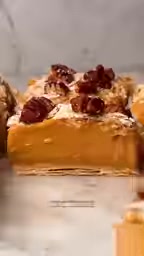
Food creator Carolina Gelen shared a dessert on YouTube that's perfect for the Thanksgiving table: salted caramel and pecan cream slices, which build on the traditional Romanian dessert creme schnitte by incorporating pecans. This dessert is designed for custard lovers, featuring golden puff pastry sandwiching a rich salted caramel custard layer, topped with candied pecans and powdered sugar. For families who want to try something new at Thanksgiving without giving up the traditional nutty flavors, this is a solution that balances familiarity with novelty.
The Key to Caramel Flavor: Cooking the Sugar to a Deep Amber
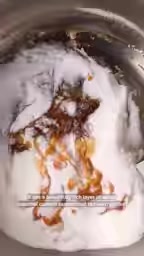
The soul of this dessert lies in the salted caramel custard layer. Gelen emphasizes that the source of caramel flavor comes from caramelizing the sugar to a "very deep amber color" — the darker the color, the more intense the caramel flavor in the final product. This step requires patience and judgment of heat — too light and the flavor will be thin, too dark and it easily turns bitter.
The Stable Structure of Custard
Once the caramel is ready, mix egg yolks, sugar, and cornstarch, then temper with a warm liquid, followed by heating the whole mixture to a gentle boil until the custard thickens. The tempering step is key to preventing the egg yolks from curdling, while the cornstarch helps the custard maintain enough thickness after cooling to support the layered structure.

Tempering is the key technique in making custard that prevents egg yolks from curdling due to sudden heat. The specific method is: first whisk together the egg yolks with dry ingredients like sugar and starch, then while stirring continuously, slowly pour in a small amount of warm liquid (such as milk or cream) so that the temperature of the egg mixture gradually rises and approaches that of the hot liquid. This process allows the proteins in the egg yolks to denature slowly, avoiding instant coagulation into lumps when directly exposed to high heat. After tempering is complete, pour the mixture back into the pot and heat the whole thing to a gentle boil — at this point the starch fully gelatinizes and the custard becomes smooth and thick. If you skip tempering and mix directly, the final product will easily develop egg-drop-like curds, resulting in a rough texture that's difficult to remedy.
Minimal Handling of the Puff Pastry
This dessert uses store-bought puff pastry — no need to make it from scratch. The method is simple and direct: unfold the puff pastry, prick the surface all over with a fork to prevent excessive puffing, then bake until golden. Place one baked sheet at the bottom of the container, pour in the custard, then crush the other sheet and scatter it on top to form a crispy topping.
Store-bought puff pastry is a laminated dough made by repeatedly folding and rolling dough with butter. During baking, the moisture in the dough turns to steam when heated, pushing apart the layers of butter to create a light and flaky structure. Because of this, before baking you need to prick the surface evenly with a fork to give the steam an outlet, preventing the pastry from puffing up irregularly and losing its layers. The advantage of store-bought puff pastry is that it saves the long chilling and multiple folding steps required for making laminated dough from scratch, making it accessible for home cooks; however, it is temperature-sensitive and should be used as soon as possible after thawing to prevent the butter from melting and causing the layers to collapse. Baking until golden gives you a stable crispy texture, suitable for both layering and crushing as a topping.
Caramelization is a series of decomposition and recombination reactions that occur when sugar is exposed to high heat. Sugar molecules break down and generate hundreds of flavor compounds, producing a flavor spectrum ranging from creamy sweetness to slightly bitter caramel notes. Color is the most intuitive indicator of the degree of caramelization: when the sugar is light golden, the flavor is on the sweet side with limited complexity; as it turns deep amber, bitterness and toasted notes gradually emerge, giving the most intense flavor; continued heating will cause carbonization and bitterness. Therefore, when making caramel, avoid stirring frequently to prevent sugar crystallization, and gently swirl the pan for even heating. After adding butter and cream, the temperature drops sharply and the reaction stops — at this point, add salt to season and you'll get a salted caramel that is sweet with a savory edge and well-defined layers of flavor.
Candied Pecans: The Finishing Touch
The candied pecans on top are the textural highlight of the entire dessert. Combine pecans with sugar, salt, and butter, stirring until the nuts are coated in a beautiful glossy sugar shell. The addition of salt echoes the savory note in the caramel layer, giving the overall sweetness more dimension. Finally, dust with powdered sugar and top with the pecans before serving.
Why This Dessert Suits the Holiday Table
Structurally, this pastry can be made ahead of time, and the combination of puff pastry and custard is easy to slice and serve at holiday gatherings. Pecans are themselves a common ingredient in Thanksgiving desserts, and using them to reinvent the traditional Romanian dessert creme schnitte preserves the holiday association with nuts while introducing a different flavor direction — caramel custard. For families already accustomed to pumpkin pie and pecan pie, this is a low-risk way to try something different.
Key Points Recap
- Cook the caramel to a deep amber for the richest flavor
- Temper the egg yolk mixture with warm liquid, then heat to a gentle boil to thicken
- Prick store-bought puff pastry and bake until golden — one sheet for the base, one crushed for the top
- Cook pecans with sugar, salt, and butter until coated in a glossy sugar shell
- Dust with powdered sugar and top with candied pecans before serving
Related articles

Gemini 4 Neon Hands-On: Value King or Confident Catastrophe?
Gemini 4 Neon review: 1M-token context, four thinking levels, 201 files in one KingBench4 pass at one-tenth Fable 5.2's cost—but it hallucinates fake data, leaves 7 symlink escapes, and bricks keyboards.

Google Gemini 4 Neon Hands-On: 6 3D Works That Impress and Fail
Hands-on with Google Gemini 4 Neon on a 3060 laptop: 6 3D works tested. Sunshower Fishing Harbor and mechanical keyboard impress; soft-body physics and faces fall short.

Gemini 4 Neo Web Novel Writing Test: Faint AI Flavor, Textured Dialogue
Bilibili creator's first-look review of Gemini 4 Neo for Chinese web novel writing: testing a Three Kingdoms transmigration opening with faint AI flavor, emotionally textured dialogue, and strong crisis building, plus comparison of 4A/4H/4C models and full workflow demos.