Thanksgiving Hackathon: fly.io Teams Up with Typesafe and Others for a $5,000 Prize Pool

fly.io and four tech teams host a Thanksgiving hackathon with $5,000 in prizes and free compute; judge backgrounds hint at AI plus real workflows.
This article covers the Thanksgiving hackathon hosted by fly.io with Typesafe, Box, Pinecone, and Ollama. It offers a $5,000 prize pool and free compute, with judges spanning type-safe tools, enterprise collaboration, vector databases, and local models. The article analyzes how free compute lowers entry barriers and notes that judge backgrounds suggest tracks may favor AI applications like RAG and local inference combined with real workflows. It also advises participants on compute quotas, early team formation, and technology choices, and recommends checking the event link for details. Ultimately, the hackathon's value lies beyond prizes—in prototype polishing and collaboration experience.
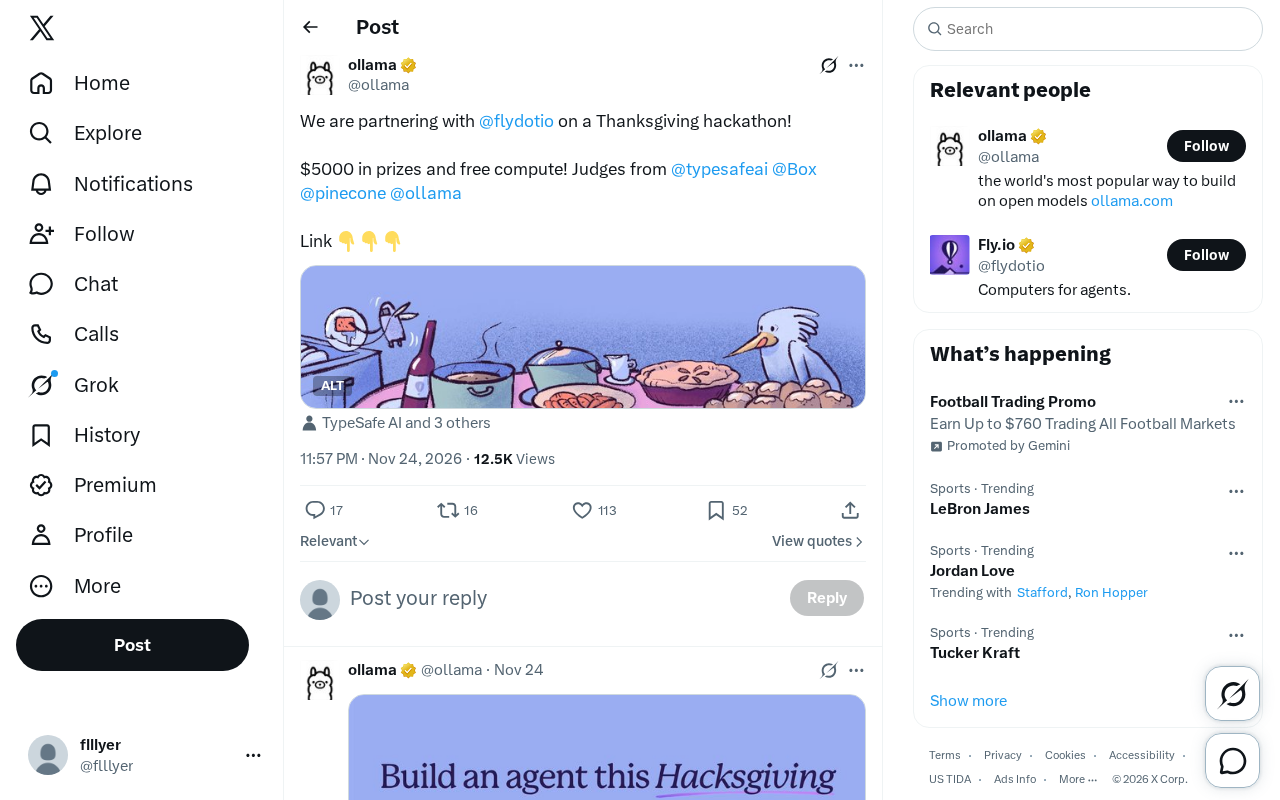
If you're looking for a technical challenge over the Thanksgiving holiday, a hackathon co-hosted by @flydotio might be worth your attention. According to the official tweet, this event not only offers a $5,000 prize pool but also includes free compute, with judges drawn from technical teams including @typesafeai, @Box, @pinecone, and @ollama. The news was first posted on Twitter and quickly sparked discussion in the developer community.
Event Highlights at a Glance
Based on what the tweet reveals, the key elements of this Thanksgiving hackathon center on three things: cash prizes, infrastructure support, and judge backgrounds. A $5,000 prize pool is a mid-to-upper level incentive for small and medium-sized hackathons of this kind, and the promise of "free compute" directly lowers the barrier to entry—especially for teams that need to run large model inference or deploy distributed applications, where compute costs are often the first obstacle.
The judge lineup is equally noteworthy. @typesafeai has long-standing expertise in type safety and developer tools, @Box represents an enterprise content collaboration platform, @pinecone is a well-known vector database provider, and @ollama focuses on local large model runtime tools. Having judges from these four diverse backgrounds suggests that the evaluation criteria may cover engineering rigor, product viability, depth of AI application, and toolchain friendliness.
The tweet includes a link to the event at the end, but the original material does not elaborate on specific tracks, timelines, or registration methods. Developers who are interested will need to visit the link directly for complete information.
fly.io is a platform that provides edge deployment and lightweight application hosting services. Its core feature is allowing developers to deploy applications (including containerized services and static sites) to edge nodes geographically close to users, thereby reducing latency and simplifying operations. For hackathon scenarios, fly.io's value lies in the fact that developers don't need to manage underlying servers—a single fly launch command can get a prototype online, and it supports usage-based billing. Combined with the "free compute" promise, this significantly lowers the deployment barrier for participants.
Typesafe was originally the commercial support company for the Scala programming language and the Akka toolkit, later acquired by Lightbend, but the @typesafeai account may point to an independent project or team related to type safety and developer tools. In the AI context, type safety typically refers to introducing structured constraints in prompt engineering, model output parsing, or tool calling to reduce runtime errors. This background suggests that judges may focus on code robustness and maintainability.
Box is a veteran enterprise content management and collaboration platform offering cloud storage, file sharing, and workflow automation services. Its participation means that hackathon projects involving document processing, team collaboration, or enterprise data integration may receive extra attention.
Pinecone is a representative provider in the vector database space, designed specifically for similarity search and retrieval-augmented generation (RAG) in machine learning applications. Its presence strongly suggests that tracks will include vector retrieval-based AI applications such as semantic search, recommendation systems, or knowledge base question answering.
Ollama is an open-source tool focused on running large models locally, allowing developers to easily run models like Llama and Mistral on personal computers or private servers without relying on cloud APIs. Its participation points toward privacy-first, offline-capable AI application scenarios.
Why This Hackathon Deserves Developers' Attention
Free Compute Is Becoming Standard for Hackathons
Over the past year, the number of AI-related hackathons has grown noticeably, but participants face a practical problem: models won't run locally, and running them in the cloud risks runaway bills. fly.io excels at edge deployment and lightweight application hosting, and by providing free compute, it's essentially turning the "deployment" step from a burden into part of the experience. Participants can focus on creativity and implementation rather than constantly weighing environment configuration against cost control.
The Judge Lineup Reveals Track Directions
Although the official tracks haven't been announced, the combination of judge affiliations already provides clues. @pinecone's involvement typically means vector retrieval and RAG projects will receive attention; @ollama's presence points to local models and privacy-first AI applications; @typesafeai and @Box correspond to code quality and enterprise collaboration scenarios respectively. If your project can touch on both "AI capabilities" and "real workflows," you may have an advantage in the judging phase.
According to the original tweet, judges for this event come from @typesafeai, @Box, @pinecone, and @ollama, with a total prize pool of $5,000.
RAG (Retrieval-Augmented Generation) is a technical paradigm that combines information retrieval with large language models. Its core process is: first, documents or knowledge bases are split and converted into vector embeddings stored in a vector database (such as Pinecone); when a user asks a question, the system retrieves the most relevant fragments from the database, injects them as context into the prompt, and the large model generates the final answer. RAG can effectively mitigate hallucination problems in large models and allows models to answer questions about private knowledge beyond their training data. In a hackathon, if judges come from a vector database company like Pinecone, it often means that the technical implementation depth and retrieval quality of RAG projects will be key scoring criteria.
Things to Think Through Before Participating
The appeal of a hackathon lies in explosive output within a short cycle, but the Thanksgiving holiday window also means participants need to make trade-offs between family gatherings and coding. Strategically, forming teams early, clarifying roles, and completing technology selection and environment setup before the event starts are common practices for improving completion rates. Although free compute lowers costs, resources usually come with quota limits, so it's advisable to confirm compute specifications and available hours immediately after registration.
Another easily overlooked point is judge preferences. The four judging organizations cover four directions: toolchains, enterprise collaboration, vector databases, and local models. If participating projects can echo at least one of these directions in their technology choices, it will be easier to build resonance during the demo. For example, using ollama for local inference, pinecone for retrieval augmentation, and deploying through fly.io can string together a complete narrative.
How to Get More Information
The original tweet provides an event link, but specific rules, submission deadlines, and judging details are not elaborated in the tweet. It's recommended to visit the event page directly through the link in the tweet, or follow @flydotio and related judge organizations for subsequent announcements. For developers who cannot commit full-time during Thanksgiving, it's also worth checking whether the event offers online participation channels or asynchronous submission mechanisms.
The value of a hackathon goes beyond prizes. Collaborating with developers from different backgrounds in a short time, polishing a presentation in front of judges, and compressing an idea into a runnable prototype—these experiences are themselves irreplaceable resume material. The $5,000 prize pool and free compute are the entry point; the real rewards often only become apparent after delivery.
One-line Summary
fly.io teams up with four tech teams for a Thanksgiving hackathon with a $5,000 prize pool and free compute; judge backgrounds hint at AI applications combined with real workflows.
Paragraph Summary
This article introduces the Thanksgiving hackathon hosted by fly.io in partnership with Typesafe, Box, Pinecone, and Ollama. The event offers a $5,000 prize pool and free compute, with judges covering four directions: type-safe tools, enterprise collaboration, vector databases, and local models. The article analyzes how free compute lowers the barrier to entry and notes that judge backgrounds suggest tracks may lean toward AI applications like RAG and local inference combined with real workflows. It also reminds participants to watch for compute quota limits, form teams early, and make technology choices, and suggests getting specific rules through the event link. Finally, it emphasizes that the value of a hackathon goes beyond prizes—it's about prototype polishing and collaboration experience.
Related articles

Nothing CMF Buds 2A Drops to $17.89 on Black Friday: A New Low for ANC Earbuds
Nothing CMF Buds 2A wireless earbuds Black Friday deal: just $17.89 on Amazon, about $11 off retail and a record low. ANC earbuds at an entry-level price.

When AI Creation Gets Accused of "Spitting": Hacker News Heats Up Over the Glaude Controversy
A Hacker News post, "Spitting in the Face of Glaude," sparks debate on AI creation transparency and attribution ethics. This analysis examines the blurred creator identity behind the controversy and offers practical advice for AI content production.

Akai Embraces Custom Firmware: MPC Sample 1.4 Lets Users AI-Program Their Sampler
Akai embraces the modding community with MPC Sample 1.4 firmware, supporting vibe-coded custom firmware and effects. We analyze the impact of this open strategy on music hardware and AI-assisted programming.