The $4.1 Trillion AI Infrastructure Gamble: Power Is the Real Bottleneck

Grid interconnection, not chip supply, may be the true bottleneck for AI infrastructure growth.
UBS forecasts $4.1 trillion in global AI infrastructure investment by 2028, but the model assumes power will follow capital — an increasingly unreliable assumption. Grid interconnection queues, unlike chip shortages, can't be solved with money or bypassed with more GPUs. Recent signals from TVA, Denmark, and PJM show power constraints are worsening, creating a blind spot in capital forecasting models.
The Hidden Assumption Behind Trillions in Capital
UBS recently released a forecast that set the industry buzzing: by 2028, global AI infrastructure investment will reach a staggering $4.1 trillion. While the figure is enough to electrify the entire tech sector, a deep discussion from the Reddit community threw cold water on the hype — this $4.1 trillion model is built on a dangerous implicit assumption: that once the money is in place, power will simply appear.
For years, market attention has been almost entirely focused on chip supply. NVIDIA GPUs are impossible to get, advanced node capacity is tight, and chips seem to be the sole bottleneck for AI expansion. But mounting signals suggest that the real chokepoint for AI data centers may not be silicon, but grid interconnection.
Grid interconnection is far more than plugging a cable into a substation. It refers to the full approval and engineering process for connecting new large-scale electrical loads (or generation facilities) to the existing power transmission network. Grid operators must systematically assess how new loads affect regional grid stability — including voltage fluctuation, frequency stability, power flow distribution, and short-circuit current levels. In the U.S., this process is regulated by the Federal Energy Regulatory Commission (FERC), with Regional Transmission Organizations (RTOs) handling implementation. A typical interconnection application goes through feasibility studies, system impact studies, and facilities studies — each stage can take months or even years, and any issues found at any stage can send the entire plan back to square one.
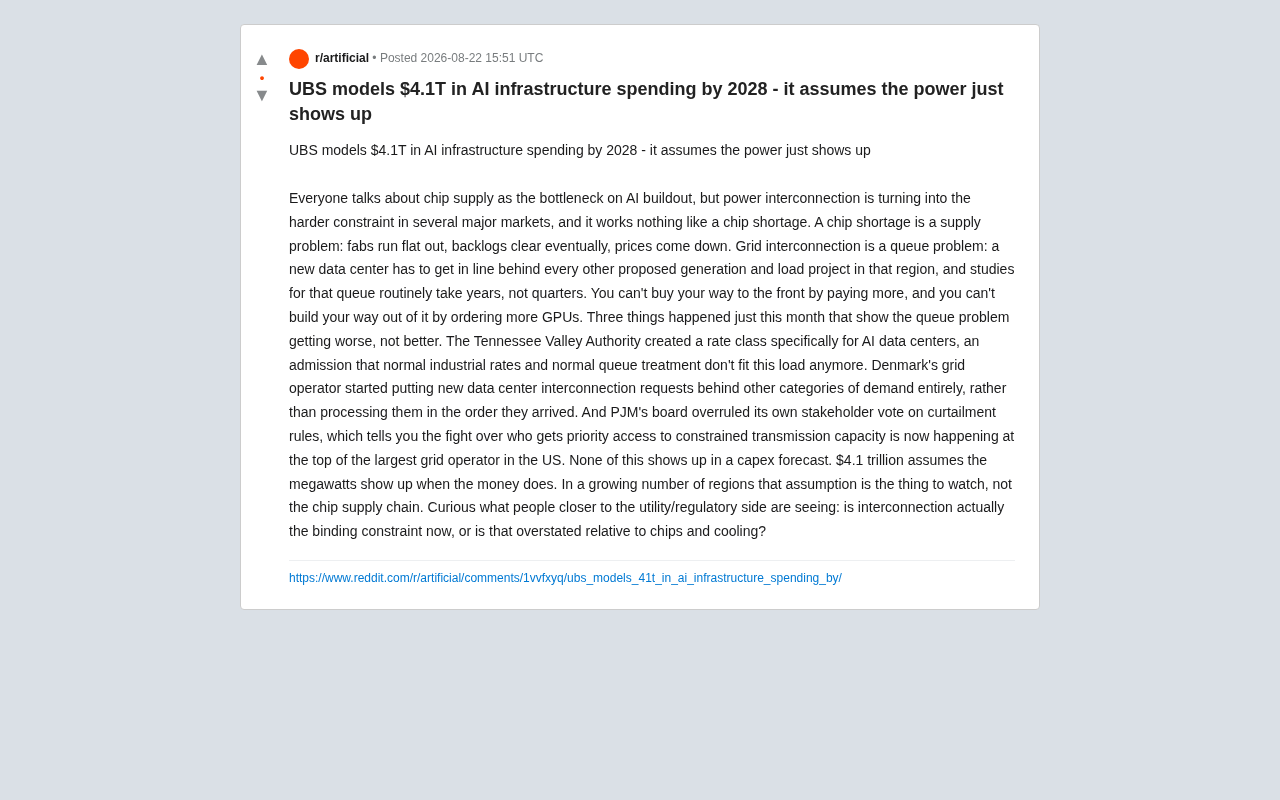
Chip Shortages vs. Grid Queues: Two Fundamentally Different Constraints
The original poster made a remarkably insightful distinction: chip shortages are a supply problem, while grid interconnection is a queuing problem — and the two operate on entirely different logic.
Supply Problems Eventually Ease
Chip shortages are fundamentally a mismatch between capacity and demand. Fabs running at full capacity will eventually work through their backlogs, and prices will fall as capacity expands. This is a problem with a clear solution path — given enough capital and time, supply will catch up with demand. TSMC, Samsung, and Intel are aggressively building fabs worldwide, and the U.S. CHIPS Act has injected tens of billions in policy funding to accelerate the process. While advanced node construction typically takes 3-5 years, the direction is clear: more money means more capacity.
Queuing Problems Can't Be Solved with Money
Grid interconnection is an entirely different beast. A new data center must get in line behind every other generation and load project already submitted in that region. The study and evaluation cycle for this queue is measured in years, not quarters.
To grasp the severity, consider the power demands of modern AI data centers: a hyperscale AI training cluster typically requires 100-500 megawatts — equivalent to the total electricity consumption of a mid-sized city. Recent building plans from Microsoft, Google, and Amazon include single campuses with planned capacity at the gigawatt level — equivalent to the output of a nuclear reactor. Adding to the challenge, AI training loads require 24/7 full-power operation with virtually no flexibility for demand response, placing unprecedented pressure on grid dispatch.
More critically, this queue has two brutal characteristics:
- You can't pay to cut in line. Offering more money won't move you to the front. Grid interconnection approvals follow strict first-come-first-served principles, and each project's assessment must account for cumulative impacts on all preceding projects — skipping any step could invalidate the entire systemic risk assessment.
- You can't bypass it with more GPUs. No amount of chip orders solves the problem of having no power delivered. A data center packed with cutting-edge H100/B200 GPUs but no grid connection is just an expensive warehouse.
This means capital accumulation may hit a wall at the power gate. When $4.1 trillion is ready to deploy, the megawatts to match may not arrive on the same timeline.
Three Signals: The Grid Queue Problem Is Getting Worse
The post highlighted three events from just the past month, all pointing to the same conclusion — grid constraints aren't easing, they're intensifying.
Tennessee Valley Authority (TVA) Creates AI-Specific Power Rates
The Tennessee Valley Authority is a federally owned corporation established during the Great Depression in 1933. It's one of the largest public power companies in the U.S., serving approximately 10 million people across Tennessee and seven neighboring states, with over 30 gigawatts of installed capacity. Due to its federal background and relatively low rates (about 80% of the national average), TVA's service area has become a hot target for data center siting.
TVA created a new rate category specifically for AI data centers. This is effectively an official acknowledgment: standard industrial rates and standard queue processing can no longer accommodate this new type of massive load. When the power provider has to create custom rules for a specific customer class, it means the existing system has been pushed to its limits. It also hints at a deeper issue — without differentiated pricing, explosive growth in AI data centers could crowd out power supply for ordinary residents and traditional industrial users, triggering public interest conflicts.
Denmark's Grid Deprioritizes Data Centers
Denmark's grid operator began ranking new data center interconnection applications behind other categories of demand, rather than processing them in order of submission. This is a strong policy signal — data center power demand is being actively "deprioritized" in favor of other societal electricity needs.
Denmark's case is particularly noteworthy because Nordic countries have traditionally been ideal locations for data centers — cold climates reduce cooling costs, abundant renewable energy (wind, hydro) provides green power, and mature infrastructure lowers construction barriers. When even such "data-center-friendly" countries start capping new loads, the global power constraint trend is unmistakable. This also reflects a broader societal negotiation: governments are reassessing whether scarce grid capacity should be allocated first to tech giants' AI ambitions or reserved for residential heating, industrial manufacturing, and EV charging — needs with greater social benefit.
PJM Board Overrules Its Own Vote
PJM Interconnection is the largest RTO in the U.S., coordinating wholesale electricity markets and grid operations across 13 states and Washington, D.C., covering about 65 million people and managing over 80,000 megawatts of generation capacity. As of 2024, the total capacity of projects waiting in PJM's interconnection queue exceeds 2,600 gigawatts — far beyond the grid's actual carrying capacity — and average wait times have stretched from 2-3 years to over 5 years.
PJM's board overruled a stakeholder vote on curtailment rules. This shows that the battle over "who gets priority access to constrained transmission capacity" has escalated to the highest decision-making level of the largest grid operator. When rule-making itself is mired in conflict, the difficulty of connecting new loads speaks for itself. Curtailment rules are essentially a power allocation mechanism under resource scarcity — policies that determine which users must reduce or interrupt their electricity consumption when grid capacity can't meet all demand.
The Fatal Blind Spot in Capital Forecasting Models
These three events share one thing in common: none of them will show up in any capital expenditure (capex) forecast.
The $4.1 trillion model describes capital flows — the procurement scale of data centers, servers, and chips. But it silently assumes that once investment is in place, the required megawatts will follow. In an increasing number of regions, this assumption is becoming unreliable.
This forecasting blind spot is not uncommon in financial modeling. Wall Street analysts excel at tracking capital flows and enterprise orders, but physical infrastructure constraints — especially those determined by regulatory processes and natural resources — are often simplified as "exogenous variables" rather than built-in model constraints. It's like forecasting a city's real estate development by counting only the developers' capital and land reserves while ignoring building permit bottlenecks and construction labor shortages.
This is the variable that investors and industry observers should really be watching. The chip supply chain matters, but its problems have clear solutions. The grid interconnection queue, however, involves grid infrastructure construction, regulatory approvals, and regional interest allocation — a series of structural challenges with no shortcuts.
The Three Major AI Infrastructure Bottlenecks: Is Power Really the Ultimate Constraint?
You may not have noticed, but the original poster didn't jump to conclusions. Instead, they posed an open question to practitioners closer to utility and regulatory frontlines:
"Is grid interconnection really a hard constraint now? Or is it being overestimated relative to chip and cooling issues?"
This is an honest and important follow-up. AI infrastructure bottlenecks may not come down to a single factor, but rather a dynamic interplay among chips, power, and cooling:
- Chips: Supply-driven, addressable through capacity expansion. TSMC's CoWoS advanced packaging capacity is rapidly scaling, and NVIDIA's next-gen Blackwell architecture is ramping to volume production. Chip supply tightness is expected to ease significantly by 2025-2026.
- Power: Queue-driven, constrained by grid infrastructure and regulation. Grid construction timelines are extremely long — a new high-voltage transmission line typically takes 7-10 years from planning to commissioning, and substation upgrades require 3-5 years. These timescales are wildly mismatched with the AI industry's 18-month iteration cycle.
- Cooling: Engineering-driven, tied to site selection, water resources, and thermal management technology. AI chip power density (heat dissipation per square centimeter) is climbing rapidly. Traditional air cooling is no longer sufficient, and the industry is accelerating toward liquid cooling (including direct-to-chip and immersion cooling). But liquid cooling requires substantial water resources, creating additional siting constraints in arid regions.
In different regions and at different points in time, any one of these three could be the binding constraint. For example, in Northern Virginia's "Data Center Alley" (the world's largest data center cluster), power interconnection is already a de facto hard constraint. In some emerging markets, chip availability may still be the primary obstacle.
Conclusion: Money Isn't a Master Key
$4.1 trillion is an era-defining number, but this discussion reminds us: in the grand narrative of AI infrastructure, capital has its limits. You can buy chips with money, expand capacity with money, but the grid interconnection queue is immune to capital.
When everyone is focused on how many GPUs NVIDIA can produce, perhaps the better question is: when those GPUs are plugged in, where does the power come from? In the years ahead, whether power interconnection can keep pace with capital's sprint may well be the decisive factor in AI infrastructure's success or failure.
Notably, some tech giants are already attempting to "bypass" the traditional grid: Microsoft has signed power purchase agreements with fusion startups, Amazon has acquired data centers adjacent to nuclear plants, and Google is signing large-scale contracts for small modular reactors (SMRs). While these "self-sourced power" strategies point in the right direction, SMR technology has yet to achieve commercial deployment, and construction timelines are similarly measured in years. In the near term, the grid queue problem remains the sword of Damocles hanging over AI infrastructure.
Key Takeaways
Related articles

Amphibious Transforming Drone: Beyond 100x Power Savings, What Are the Real Needs?
Is the amphibious transforming drone just a gimmick? Starting from the 100x power difference of the M4 Morphobot, explore real application scenarios and thesis topic ideas, analyzing boundary conditions where pure drones and pure ground robots both fail.

Warhound Raises $200 Million: Genetically Engineered "War Dogs" Paired with Anduril Gear
Warhound raises $200M, backed by Ben Lamm and Palmer Luckey, to genetically engineer dogs for military and law enforcement use and equip them with Anduril gear. This article analyzes its technology direction, funding logic, and ethical controversy.

Claude API Comes to Google Cloud: IAM Integration and SDK Access Guide
Anthropic hosts the full Claude API on Google Cloud with IAM-controlled permissions and unified billing. This guide covers the Vertex AI and Anthropic-hosted entry points, IAM role configuration, and SDK access.