The $60 Billion Cursor Acquisition: Birth and Deep Dive into the AI Programming Operating System

SpaceX's $60B acquisition of Cursor signals AI programming tools becoming full software development operating systems.
SpaceX acquired AI coding tool Cursor for $60 billion, marking the most expensive AI acquisition ever. This deep dive explores how Cursor evolved from a VS Code fork into a complete software development OS featuring Agent orchestration, RAG-powered context retrieval, in-house model training, automated workflows, and Origin—an AI-native code hosting platform directly competing with GitHub. The acquisition creates a vertically integrated stack from GPU compute to developer experience.
A $60 Billion Acquisition That Reshapes the AI Programming Landscape
The most expensive acquisition in AI history has landed: SpaceX acquired AI programming tool Cursor for approximately $60 billion in an all-stock deal. How can a software editor from a company only 4 years old with $4 billion in annual revenue be worth that much?
The answer lies in three keywords—Wide Tooling, Agent Orchestration, and Origin Code Hosting. Cursor is no longer just an editor that autocompletes your code. It's a full-cycle software development operating system spanning code writing, automation, and PR review and merging.
Let's look at some numbers: Cursor is currently the most influential AI programming tool globally, with an ARR of approximately $4 billion—a 20x increase in 18 months—and more than half of Fortune 500 companies using it. It has over 1 million daily active users, 3 million weekly active users, roughly 1 million paying users, and a conversion rate as high as 50%. NVIDIA alone contributes over 30,000 seats, and 70% of Stripe's 3,000+ engineers are active users.
This article breaks down why Cursor is called the "operating system of software development"—from its rise, technical foundation, and model strategy to its business logic and security governance.
Cursor's Rise: From Forking VS Code to an Agent Workbench
The story begins in 2022. Three AI-background founders established Anysphere, initially researching program synthesis before quickly pivoting to a large language model editor after GPT's release. They made a critical decision: Fork VS Code rather than build from scratch, directly inheriting the Language Server Protocol and extension ecosystem, and pouring all R&D resources into the AI layer.
The strategic significance of this decision goes far beyond the surface. VS Code is Microsoft's open-source code editor built on the Electron framework, with two ecosystem cornerstones at its core: the Language Server Protocol (LSP) and the extension marketplace. LSP is a standardized client-server protocol that enables editors to access code completion, go-to-definition, refactoring, and other language features through a unified interface, currently covering hundreds of programming languages. Forking VS Code meant Cursor overnight inherited over 40,000 community extensions, the keyboard shortcut muscle memory of tens of millions of developers, and the entire VS Code plugin developer ecosystem. This avoided the 3-5 years of infrastructure investment required to build an editor from scratch, allowing the team to concentrate all engineering resources on AI inference layer innovation—where competition actually happens.
The funding trajectory is equally staggering: valuations jumped from $29.3 billion to nearly $50 billion, with NVIDIA continuously investing—the GPU giant clearly understands that AI programming tools are amplifiers of compute demand.
Cursor 3, released in April 2026, was officially called "the third milestone in software development." It's no longer "an editor with an AI panel" but rather "an editor within an Agent workbench"—a fundamental shift in information architecture.
Cursor 3 has three killer features:
Three Core Capabilities of Cursor 3
First, multi-repository support. A single Agent can reason and make changes across multiple Git repositories—modifying a shared library automatically syncs downstream microservices. This is especially critical for enterprises using microservice architectures—modern large applications are typically split into dozens or even hundreds of independent repositories, and modifying a shared API interface may require synchronously updating calling code across a dozen downstream services.
Second, visual verification. You circle a UI element in the browser, and the Agent immediately locates the corresponding code; a built-in browser lets the Agent launch the application after writing code to verify results.
Third, seamless local-cloud switching. Session state can be serialized and packaged—close your laptop and it continues running in the cloud, and you can even check progress on your phone.
Each Agent has isolated context without cross-contamination. You can launch three Agents simultaneously—one refactoring, one writing tests, one running integration.
Technical Foundation: Engineered Context and RAG Retrieval Pipeline
Many people assume Cursor stuffs the entire codebase into the model context. It doesn't. A project with 100,000 files can't all fit. Cursor uses a RAG (Retrieval-Augmented Generation) pipeline.
RAG is an architectural pattern that combines external knowledge bases with large language models. The core idea is: even if a model supports a 1-million-token context window, it's insufficient for large codebases and extremely costly (inference costs per request scale proportionally with input tokens). RAG's approach is to chunk the codebase, vectorize it, build an index, and retrieve only the most relevant snippets for each request. The vectorization process converts code snippets into points in a high-dimensional vector space via embedding models, where semantically similar code is closer together; queries use approximate nearest neighbor search (ANN) to find the most relevant code blocks in milliseconds, making real-time responses possible.
The first step is AST-aware chunking: parsing code with Tree-sitter, cutting along syntax boundaries, each chunk approximately 500 tokens, never splitting mid-function—because embedding quality depends on semantic completeness, and half a function produces noise.
Tree-sitter is an incremental parser generator tool that builds concrete syntax trees (CST) for source code, supporting over 100 programming languages with extremely fast parsing (millisecond-level). AST (Abstract Syntax Tree) is a tree-structured representation of program source code where each node represents a syntactic structure—function declarations, conditional statements, variable assignments, etc. Traditional text chunking cuts at fixed character counts, potentially splitting a function in half, causing both fragments to lose semantic integrity; AST-aware chunking cuts along syntax boundaries, ensuring each code block is vectorized as an independent semantic unit, significantly improving retrieval accuracy.
The synchronization mechanism is even more clever: each file gets a hash, parent nodes combine their children's hashes, and the root hash represents the entire codebase's "fingerprint." During sync, if root hashes match, zero transfer occurs; if they don't match, it drills down layer by layer, transmitting only changed leaves. For a 50,000-file workspace, raw hash data is 3.2MB, but daily syncs only transmit a few leaves.
This mechanism is essentially a variant of Merkle trees (hash trees)—a data structure proposed by Ralph Merkle in 1979, later widely adopted by Git version control and blockchain. Its efficiency is extreme: verifying whether the entire codebase needs syncing requires just one root hash comparison, and locating changed files requires only O(log n) comparisons, far superior to the O(n) complexity of file-by-file scanning.
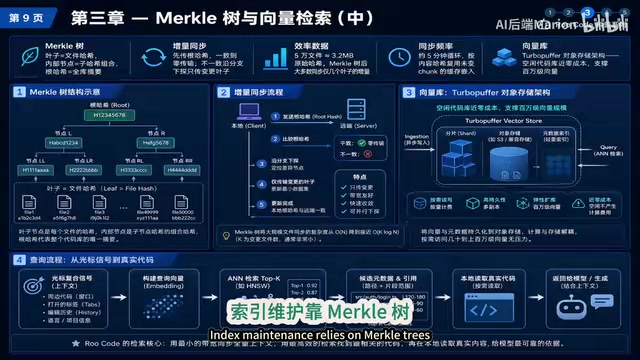
Cursor's context has three layers: File Set (parsing function scope and imports), Project Set (building mappings between blocks and intent), and User Profile (recording your habits—for example, if you always add type annotations to React components, it defaults to enabling this next time). Tab completion isn't a mini GPT at all but rather an independent intent prediction engine that combines dependencies and interface definitions to infer what you actually want.
Model Strategy: From Router to In-House Model Trainer
Cursor charted a path from pure model router to in-house model development. The first-generation Composer routed requests to third parties; Composer 2 is their flagship in-house model, built on Moonshot's Kimi K2.5 with continued domain training and reinforcement learning, optimized for multi-file editing, tool calling, and long-context reasoning.
Reinforcement learning (RL) plays a key role in code model training here. Traditional supervised fine-tuning teaches models "what the correct answer is," while reinforcement learning teaches models "what strategy ultimately solves the problem." In code scenarios, RL reward signals come from multiple dimensions: whether code compiles, whether unit tests pass, whether multi-file edits maintain consistency, whether tool call sequences are efficient, etc. This "pre-training + supervised fine-tuning + reinforcement learning" three-stage training paradigm is the standard process used by top models like GPT-4 and Claude, but Cursor has deeply optimized it specifically for software engineering scenarios.
On benchmarks, it scores 61.7 on Terminal Bench 2.0—lower than GPT-5.4's 75.1 but higher than Claude Opus's 58.0—with multi-file refactoring capabilities on par with top-tier models. The strategy is clever: give in-house models high quotas because in-house costs are low, so users can use them heavily without anxiety; simultaneously maintain model neutrality with dozens of options including OpenAI, Anthropic, Gemini, and Grok, plus an Auto mode that recommends based on task complexity—fast models for completion, strong models for refactoring.
The strategic significance of multi-model routing: not being locked in by any single model provider, giving model choice to users and automatic routing.
Agent mode isn't simple Q&A but a loop: rapid planning → tool calling → observing results → applying changes → iterating again. Terminal output, Lint diagnostics, and test results are all critical observation signals. There are three execution environments—local, cloud 24/7, and remote SSH—but regardless of which, all final changes require human approval.
Automation and Origin: Asymmetric Scaling and the Code Hosting Revolution
Automation's core thesis is called "asymmetric scaling": AI generates code far faster than humans can review and maintain it, so Agents must run automatically on schedules or events. Auto-review after PR merges, auto-fix on CI alerts, auto-generate weekly audit reports.
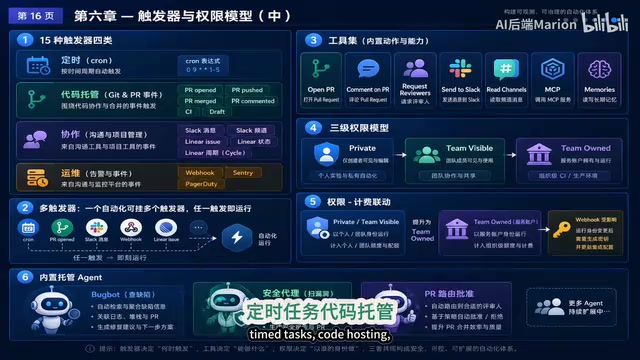
Agents have 15 triggers across four categories: scheduled tasks, code hosting events, collaboration tools, and ops alerts. The latest update upgraded automation to event-driven subscriptions: an Agent can subscribe to a PR, waking up repeatedly as comments land, working continuously until the issue is resolved, then automatically stopping.
The complementary Bills cloud execution substrate solves a real pain point: every time an Agent starts, it must clone the repo and install dependencies—minutes of waiting for large codebases. The solution is background snapshots every hour; Agents directly reuse the latest build, with internal startup 10x faster and first task loops 3x faster.
Origin: Directly Competing with GitHub as AI-Native Code Hosting
The most aggressive move is Origin—an AI-native code hosting platform directly competing with GitHub. The background involves two pain points: fragmented workflows (switching between IDE and browser to manage PRs), and bottleneck transfer—when Agent-generated PRs exceed 35% of total, traditional PR workflows become unsustainable.
Technically, Origin inherits stacked PR technology. The old problem with traditional workflows: splitting a feature into three steps means either one branch with a PR too large to review, or multiple branches requiring repeated rebasing. The stacked approach builds a PR chain where each PR is based on the previous one, breaking large changes into independently reviewable small pieces, with tools automatically managing dependencies and rebasing, and AI resolving conflicts.
The stacked PR concept originated from Facebook/Meta's internal code review practices. Research shows that PR review effectiveness degrades significantly beyond 400 lines of code changes—reviewers' attention and defect-detection ability decline sharply as PR size increases. The stacked approach splits large features into ordered PR chains of 200-400 lines: PR-1 is foundational refactoring, PR-2 builds core logic on PR-1, PR-3 adds tests on PR-2. When a lower-level PR is modified, tools automatically propagate changes upward. In an era where Agent-generated code proportions keep growing, this workflow is crucial for maintaining human review quality—an Agent can generate ten PRs in an hour, but human reviewers need each PR to remain at a digestible size.

Origin also has two mechanisms designed specifically for Agents: machine-readable review status (structured output that Agents can query directly without parsing natural language), and Agent data tracking (recording which model generated each line of code—something standard GitHub doesn't have). Strategically, it doesn't hard-compete with GitHub but maintains bidirectional sync, lowering enterprise migration barriers.
Security Governance: From Nice-to-Have to Enterprise Adoption Ticket
The first barrier to enterprise adoption of AI programming tools is data security. Cursor's Privacy Mode is enabled by default in the enterprise version, with zero data retention agreements signed with OpenAI, Google, Anthropic, and xAI—your code isn't used for training. With privacy mode opted in, servers retain only vectors and metadata.
The most distinctive governance mechanism is Hooks: defining security policies in JS that inject directly into the Agent loop. Three core hooks—before terminal command execution, before MCP tool calls, before file reads—can all enforce allow/warn/deny. Security teams can write rules like "prohibit reading key files" and "allow only whitelisted MCP," enforced by the loop rather than relying on developer discipline.
MCP (Model Context Protocol) mentioned here is an open standard released by Anthropic in late 2024, designed to establish a unified communication protocol between AI models and external tools. Similar to how USB-C unified physical interfaces, MCP simplifies the integration complexity of AI Agents calling external tools from M×N to M+N. In Cursor, MCP enables Agents to invoke external capabilities like database queries, API testing, and deployment pipelines. But openness also brings risk: malicious MCP servers could manipulate Agents through prompt injection to execute unauthorized operations, making whitelist controls and Hooks security policies indispensable.
But security isn't just on paper. Known incidents include a CVSS 9.9 critical vulnerability, and attack vectors from prompt injection to arbitrary code execution objectively exist.
CVSS (Common Vulnerability Scoring System) is the industry-standard vulnerability severity assessment framework with a maximum score of 10. A 9.9 score means the vulnerability can be remotely exploited with virtually no prerequisites and has an extremely broad impact. In AI programming tool scenarios, prompt injection is the primary threat vector: attackers can embed malicious instructions in code comments, README files, or even dependency package documentation. When an Agent reads this content, it can be manipulated into executing arbitrary terminal commands, leaking sensitive files, or modifying critical code. This attack is particularly dangerous because AI Agents typically have developer-level file system and terminal access permissions.
The standard enterprise hardening playbook: upgrade to the latest version, enforce Firefly read-only mode, deploy zero trust, and audit MCP whitelists before committing. Zero trust architecture in this context means: even every operation by internal Agents requires authorization verification, with no default trust of any input source.
Security has evolved from a nice-to-have to a ticket for admission.
Competitive Landscape and the Deep Logic Behind the $60 Billion Acquisition
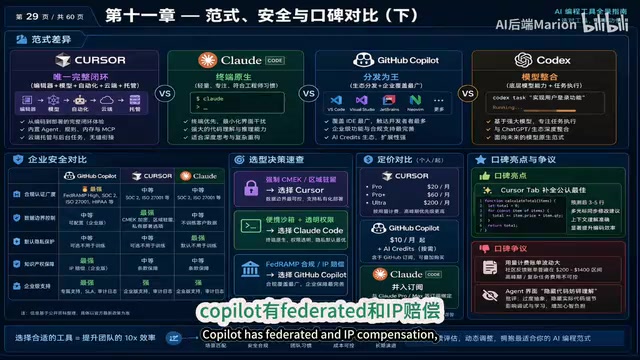
AI programming shows a three-way landscape: Cursor leads with its complete closed loop, Claude Code has advantages in regulated industries with native distribution and virtual ecosystems, and Codex catches up with model integration. The selection logic is simple: choose Cursor for enforced data sovereignty, Claude Code for portable sandboxes and transparent permissions, Copilot for FedRAMP certification.
On the business model side, Cursor's pricing ranges from free to $200/month for Ultra, with usage-based billing at its core. $20 per month equals roughly $1 per workday—if it saves you 15-60 minutes daily, the ROI is exceptional. The ARR curve went from $100 million to $2 billion, then surged to $4 billion post-acquisition, forming a flywheel of "product upgrades drive more usage → usage drives ARR → in-house Composer + SpaceX's GPUs lower costs."
The controversy lies here too: heavy users' monthly bills might jump from $200 to $1,400, far exceeding the $20 psychological expectation. But this isn't a Cursor-specific problem—industry consensus is forming: model inference costs are real, usage-based billing is inevitable, and the key is transparency and controllability.
The Strategic Core of SpaceX's Cursor Acquisition
In April, SpaceX reached an agreement with Cursor, securing an option of "$60 billion acquisition or $10 billion breakup fee"; the agreement was announced in June; xAI was renamed SpaceX AI in July; and in August, Cursor officially became a SpaceX AI division. The deal is $60 billion in all-stock, approximately 15x revenue, making it one of the largest startup acquisitions in history.
The $60 billion valuation at 15x annual revenue needs to be understood in the AI industry context. Traditional SaaS companies are typically valued at 5-15x ARR, depending on growth rate, gross margin, and market size. Cursor's uniqueness lies in: a growth rate of 20x in 18 months far exceeding normal SaaS (50-100% annual growth is already excellent); the total addressable market (TAM) for AI programming tools is essentially equivalent to global software development spending—approximately 28 million developers worldwide, with enterprises spending over $50 billion annually on development tools; and most critically, the platform effect—having evolved from tool to platform, Origin code hosting brings user lock-in and network effects that justify higher valuations.
The strategic core of the acquisition is vertically integrating models, compute, tools, and hosting platform under one roof. Through this, Cursor gains access to the world's largest GPU fleet (xAI's 100,000 H100 cluster), enabling training of stronger and more economical models. Joke 4.5 is the first joint model, positioned for coding Agents. This forms a complete stack from silicon to developer experience: GPU compute → model training → inference services → development tools → code hosting.
The industry impact is profound:
- Valuation anchor reset: 15x revenue redefines the valuation benchmark for AI developer tools;
- Accelerated competition: OpenAI and Anthropic will inevitably double down, and third-party model calling terms may tighten;
- Open vs. closed tension: The tension between vertical integration and community-championed open protocols like MCP.
Conclusion: Software Infrastructure for the AI Era
The conclusions across five main threads are clear:
Product-wise, Cursor evolved from editor to Agent orchestrator to Origin hosting platform, with the new bottleneck being code review and integration; Technically, its advantage comes from engineered context and retrieval, not any single model; Model-wise, it transformed from router to trainer—controlling models means controlling costs and iteration speed; Commercially, distribution rights are strategic value, and the $60 billion is fundamentally an AI supply chain battle; Governance-wise, security has evolved from nice-to-have to admission ticket.
Three key variables for the future: third-party model openness, whether Grok joint training can deliver on "stronger and cheaper," and whether Origin can establish irreplaceable Agent-native value.
The bottleneck in software development has shifted from "writing code" to "reviewing code." And Cursor is trying to become the operating system of software development in the AI era.
Related articles

RAG Getting Started in Practice: From Principles to Building an Enterprise Knowledge Base
Bilibili RAG course highlights: from retrieval-augmented generation principles, document chunking and vectorization, to five accuracy factors and enterprise knowledge base boundaries, with fine-tuning vs RAG selection advice.

AI Model Selection Guide: DeepSeek vs. Qwen3 in Practice
How should AI developers choose models? Based on a Bilibili tutorial, this article breaks down the Function Calling differences between DeepSeek V3 and R1, Qwen3's programmatic thinking mode switching and agent capabilities, and outlines a multi-model learning path and practical selection logic.

Anchoring, Loss Aversion, and Nudges: 5 Psychological Tactics Retailers Use to Make You Spend
Behavioral economics reveals how retailers use anchoring, framing, loss aversion, and nudge theory to manipulate your spending decisions. This article breaks down 5 common psychological tactics and offers counterstrategies like slowing down decisions and setting your own anchors to see through the pricing design behind discounts.