The 7-Stage Roadmap to Becoming an AI Engineer: Breaking Down the Value and Blind Spots of Each Phase

A phase-by-phase breakdown of a 7-stage roadmap to become an AI engineer, from Python to production.
A learner-shared 7-stage roadmap for becoming an AI engineer spans Python basics, math and ML, deep learning, LLMs and generative AI, deployment, evaluation and safety, and portfolio projects. This article assesses the value and blind spots of each phase, emphasizing hands-on practice, engineering deployment, and production-ready skills.
Recently, a learner on Reddit shared their planned roadmap for "becoming an AI engineer" and asked the community to validate whether it made sense. The roadmap is divided into seven phases, stretching from Python fundamentals all the way to production deployment and portfolio building. Is such a planning framework really suitable for those looking to break into AI engineering today? In this article, we'll work through this roadmap phase by phase, breaking down both its value and its potential blind spots.
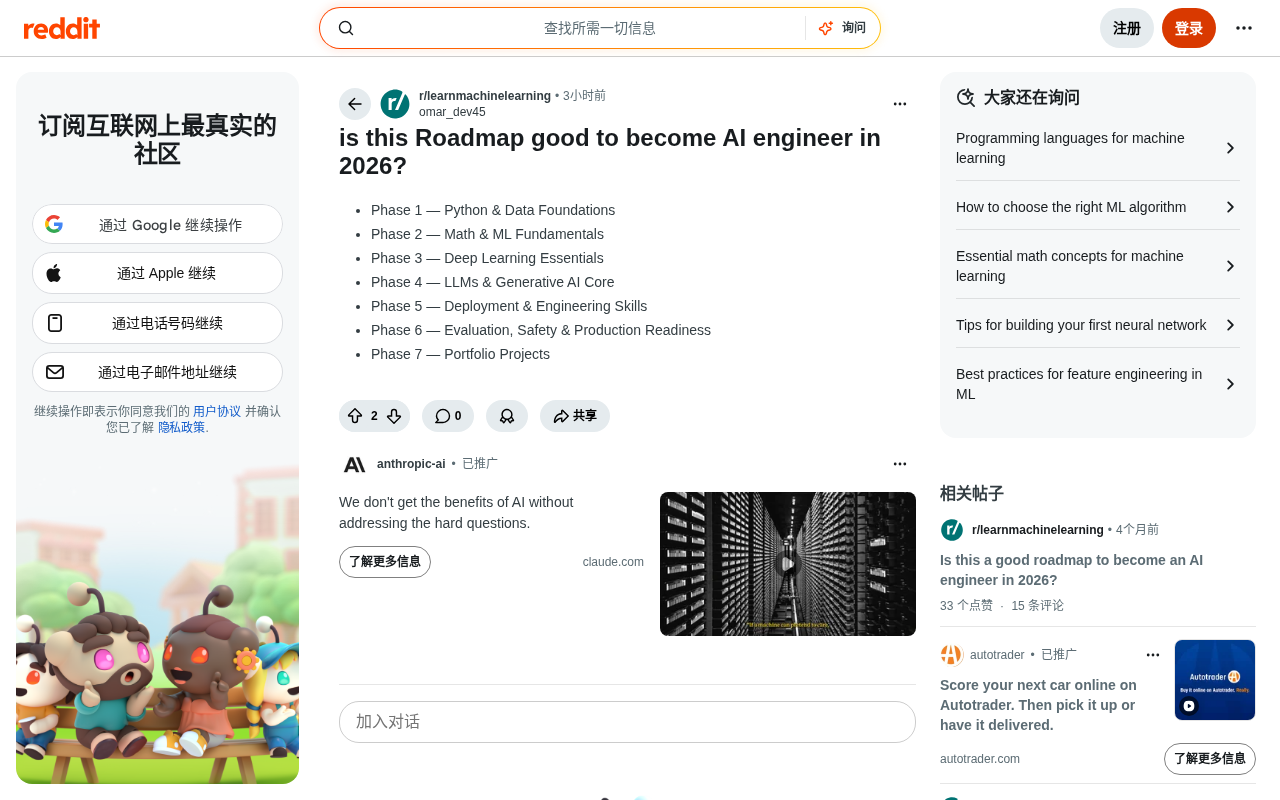
The Full Picture: An Overview of the Seven Phases
The overall structure of this roadmap is as follows:
- Phase 1 — Python and Data Fundamentals
- Phase 2 — Math and Machine Learning Fundamentals
- Phase 3 — Deep Learning Core
- Phase 4 — Large Language Models and Generative AI Core
- Phase 5 — Deployment and Engineering Skills
- Phase 6 — Evaluation, Safety, and Production Readiness
- Phase 7 — Portfolio Projects
Judging from its skeleton, this is a logically clear progression path: first build the foundations (programming, math), then move into model principles (machine learning, deep learning), then focus on today's hottest topics of LLMs and generative AI, and finally round out engineering deployment skills while consolidating results through projects. Overall, it follows the learning principle of "theory before practice, principles before applications," and it holds up well directionally.
Foundational Phases: Don't Skip Them, But Don't Linger Too Long Either
Python and Data Fundamentals
Python remains the first language of AI engineering, and mastering it—along with NumPy, Pandas, data cleaning, and visualization skills—is an undisputed starting point. The key at this stage isn't "how long you study," but whether you can use code to solve real data problems. It's advisable to develop the habit of writing production-grade code right from this step, rather than staying at the level of toy scripts in a Notebook.
Math and Machine Learning Fundamentals
Many beginners agonize over "just how much math do I need to learn?" For an AI engineer, the core concepts of linear algebra, probability and statistics, and calculus are essential, but you don't need to pursue math-department-level rigorous proofs. A more practical approach is to understand the intuition behind concepts like gradient descent, loss functions, and overfitting—enough is enough, and you can circle back to fill in gaps when you hit a wall.
The Most Critical Phase Today: LLM Application Development and Engineering
Deep Learning and LLM Core
It's reasonable that the roadmap splits deep learning and LLMs into two separate phases. In current AI engineering practice, the focus has clearly shifted toward large language models and generative AI. What you need to master here isn't just the principles of the Transformer architecture, but also hands-on skills like prompt engineering, RAG (Retrieval-Augmented Generation), fine-tuning, and vector databases.
It's worth emphasizing that training large models from scratch is not a core skill for AI engineers—the vast majority of roles require "making good use of existing models" rather than "building models." Therefore, this phase should place greater emphasis on API calls, the use of mainstream frameworks (such as LangChain and LlamaIndex), and the ability to build applications around LLMs.
Deployment and Engineering Skills
This is precisely the part that many self-taught learners most easily overlook, yet it's also the part that most sets candidates apart in the job hunt. Docker, cloud platforms, turning APIs into services, CI/CD, model inference optimization—these "engineering" skills are the key differentiator between an "AI engineer" and an "AI researcher" or a "library-copy-paster." The fact that the roadmap lists this as a standalone phase shows the planner already recognizes the importance of engineering deployment, which is a clear plus.
An Often Underrated Phase: Model Evaluation, Safety, and Production Readiness
The sixth phase covers model evaluation, safety, and production readiness. This part is often glossed over in traditional tutorials, yet it is critically important in real enterprise environments.
Detecting model hallucinations, evaluating output reliability, defending against prompt injection attacks, and ensuring data privacy compliance—these topics are receiving increasing attention as AI applications are deployed at scale. A candidate who can clearly describe "how to evaluate the accuracy of a RAG system" or "how to do monitoring and regression testing for LLM applications" holds a distinct advantage in today's job market. The fact that this roadmap dedicates a whole phase to this reflects a keen sensitivity to the real needs of the industry.
The AI Engineer Portfolio: The End of the Roadmap, and the Start of the Job Hunt
The "portfolio projects" in Phase 7 may appear to be a wrap-up, but they are in fact the key to realizing the value of the entire roadmap. Recruiters find it hard to judge a candidate's abilities from a checklist of "I've studied X and Y," but a project that's deployed and live, can be demonstrated, and comes with clear technical documentation is often worth a thousand words.
It's advisable to integrate everything learned in the first six phases into 2–3 in-depth projects, for example: a RAG Q&A system with evaluation metrics, a fine-tuned domain-specific application, or a complete AI service deployed to the cloud. Projects need engineering completeness rather than staying at the demo stage.
Overall Assessment: The Direction Is Right, But Three Points Deserve Attention
Overall, this AI engineer learning roadmap is well-structured with appropriate emphasis, especially in that it incorporates commonly overlooked engineering aspects like deployment, evaluation, and safety, making it clearly closer to real-world needs than roadmaps that "only talk about algorithms and never about deployment."
That said, a few points are worth adding:
-
Don't grind through it linearly: The roadmap looks linear, but actual learning should be "learn while doing." You can start building small projects as early as Phase 3—there's no need to wait until Phase 7.
-
Beware of dwelling too long on foundations: Math and machine learning fundamentals can easily turn into an "indefinite holding zone." Set a time limit and move into more feedback-rich hands-on stages as soon as possible.
-
Keep up with ecosystem changes: The AI tooling ecosystem iterates extremely fast. The roadmap is just a skeleton; the specific frameworks, models, and platforms you use need to be continuously updated.
Conclusion
As a blueprint for growing into an AI engineer, this seven-phase roadmap is clear in direction and comprehensive in coverage, and can be adopted as a learning framework. But what truly determines success has never been the roadmap itself—it's the hands-on ability and project accumulation during execution. Rather than agonizing over whether the roadmap is perfect, it's better to start writing the first line of code in Phase 1 as soon as possible.
Related articles

Felix Rieseberg Personal Homepage
Felix Rieseberg's personal homepage sparks attention on Hacker News. This article covers the Slack engineer's technical background, the rise and fall of nativefier, and the value of a developer homepage as a tech calling card.

@ai-sdk/vue 3.0.306 Patch Release Syncs with [email protected] Update
@ai-sdk/vue 3.0.306 released, synced with [email protected]. A routine patch release for the Vercel AI SDK ecosystem with no public API changes; the Vue adapter layer stays version-aligned with the core package.

Gemini 4 Argon API Launches: The Era of Million-Token Output Begins
Google launches Gemini 4 Argon with sparse MoE architecture, up to 1M output tokens, and a 68.90% Vals Index score, available across API, AI Studio, and the Gemini app.