The 85K-Star DevOps Interview Question Bank: Covering Everything from Linux to Kubernetes
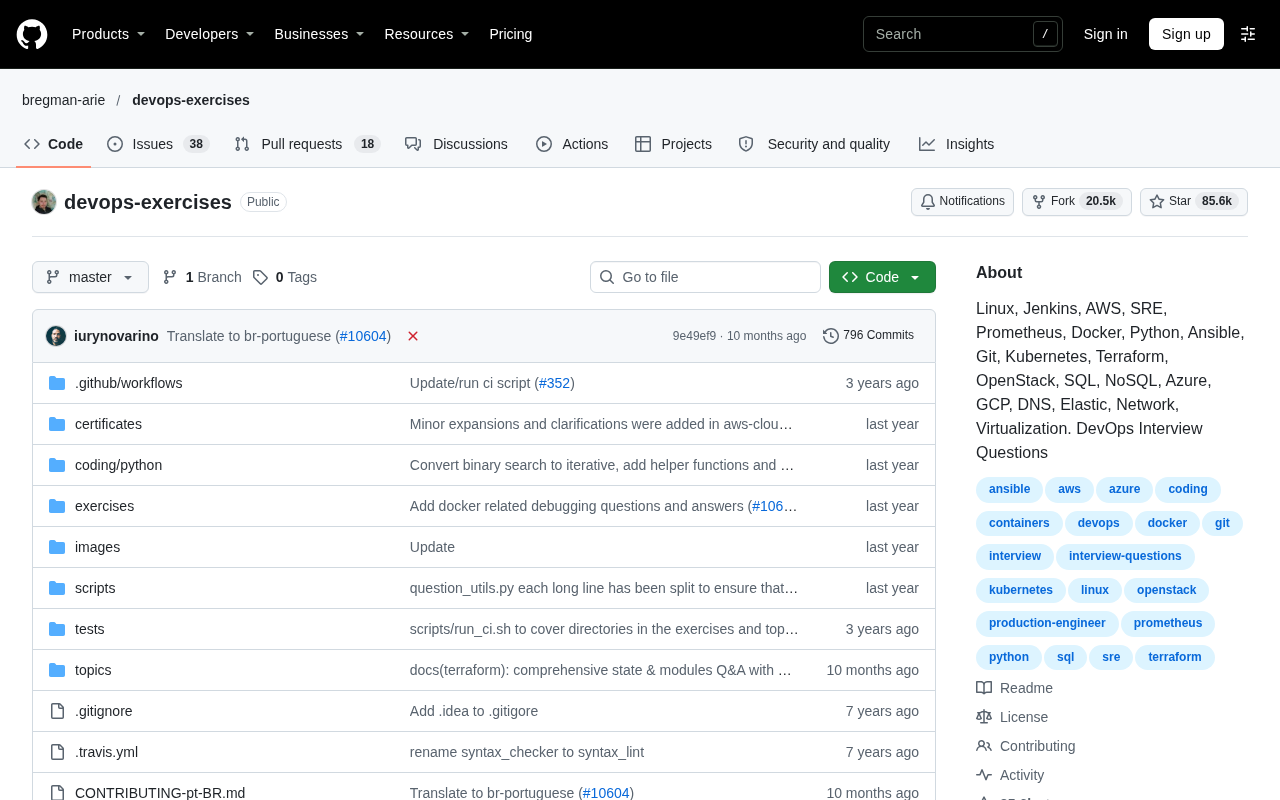
An 85K-star DevOps interview question bank on GitHub covering 20+ technical topics for engineers at all levels.
This article introduces the popular open-source project bregman-arie/devops-exercises on GitHub, which has earned over 85,000 stars and 20,000+ forks. Written primarily in Python, it covers 20+ DevOps topics including Linux, AWS, Jenkins, Kubernetes, Terraform, SRE, and Prometheus, organized into categories such as infrastructure and cloud platforms, automation and CI/CD, and reliability and monitoring—combining breadth with structure. The article analyzes why the project is popular, offers differentiated usage advice for different career stages, and notes that the high fork count indicates widespread use for team training and further development.
The 85K-Star DevOps Interview Question Bank: Covering Everything from Linux to Kubernetes
On GitHub, a project called bregman-arie/devops-exercises has accumulated over 85,000 stars, making it one of the most popular learning resources in the DevOps field. Written primarily in Python, the project offers interview questions and exercises covering a wide range of topics including Linux, Jenkins, AWS, SRE, Prometheus, Docker, Python, Ansible, Git, Kubernetes, Terraform, OpenStack, SQL, NoSQL, Azure, GCP, DNS, Elastic, networking, and virtualization.
Why Is This Project So Popular?
The DevOps knowledge landscape is extraordinarily vast—from infrastructure to continuous integration, from monitoring to cloud-native, every direction has content that runs deep. Beginners often struggle to find a clear path, while interview candidates are frustrated by the lack of a systematic question bank. devops-exercises fills exactly this gap.
The core value of the project lies in its breadth and structure. It doesn't just list questions—it categorizes them by technical domain, allowing learners to dive deep as needed. Whether you're preparing for an interview or doing day-to-day gap-filling, you can benefit from it. Moreover, the project is maintained as open source, with community contributors continuously adding new content, ensuring the question bank stays current.
Content Coverage: From Fundamentals to Advanced
As the project description shows, it covers virtually all the mainstream technologies a DevOps engineer needs to work with.
Infrastructure and Cloud Platforms
Topics such as Linux, AWS, Azure, GCP, and OpenStack cover everything from traditional operations to cloud computing. For engineers looking to understand multi-cloud environments, these exercises help build a cross-platform knowledge framework.
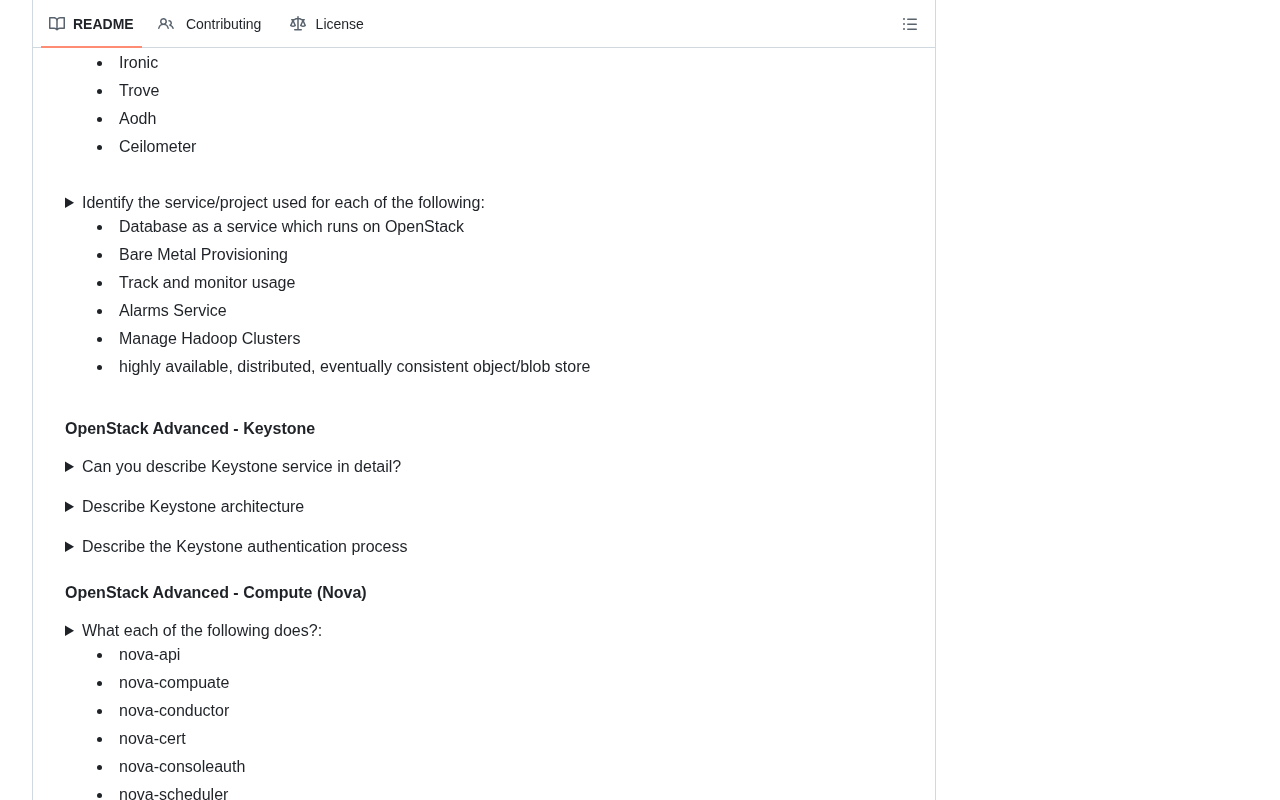
Multi-cloud and virtualization form the implicit technical backdrop of this chapter. Virtualization uses a hypervisor (such as KVM or VMware) to abstract virtual machines on physical hosts—resource isolation is complete but startup is slower and overhead is higher. Containers (Docker) share the host kernel, offering fast startup and high density, but weaker isolation than virtual machines. OpenStack is an open-source private cloud IaaS platform with many components (Nova for compute, Neutron for networking, Cinder for storage, etc.), commonly used to build enterprise private clouds; AWS, Azure, and GCP are the public cloud representatives, each with different service naming and billing models. Understanding the positioning differences between "public cloud / private cloud / hybrid cloud" and the layering of IaaS, PaaS, and SaaS is a prerequisite for answering cross-cloud and migration questions.
Automation and CI/CD
Tools like Jenkins, Ansible, Git, Docker, Kubernetes, and Terraform are the cornerstones of modern DevOps pipelines. The related questions in the project cover key practices such as configuration management, container orchestration, and infrastructure as code, testing learners' mastery of the automation toolchain.
Infrastructure as Code (IaC) is the key background for understanding this chapter's automation toolchain. IaC means defining, configuring, and managing computing resources (servers, networks, storage, etc.) using code files rather than manual operations in a console. Terraform uses declarative configuration (the HCL language) and records the mapping between real resources and desired configuration through a "state file," enabling repeatable, versionable infrastructure deployment; Ansible leans toward configuration management and application deployment, describing tasks in YAML playbooks in an agentless manner. The difference between the two is a common interview topic: Terraform focuses on "resources from nothing and their lifecycle," while Ansible focuses more on "configuration convergence once machines are ready."
Reliability and Monitoring
Topics such as SRE, Prometheus, Elastic, DNS, networking, and virtualization focus on system reliability and observability. This content is essential for building highly available architectures and troubleshooting production issues.
SRE (Site Reliability Engineering) is a set of engineering practices introduced by Google, whose core is to solve operations problems using software engineering methods. Its key concepts include: SLI (Service Level Indicator, such as request latency or error rate), SLO (Service Level Objective, i.e., the threshold an SLI must meet), and error budget (1 minus the SLO, used to balance release speed and stability). Prometheus is the de facto standard for cloud-native monitoring, using a pull model to collect metrics, storing data as time series, and working with the PromQL query language and Alertmanager for alerting; Elastic (ELK/Elastic Stack) excels at logging and full-text search. Interviews often require distinguishing the applicable scenarios of "metric monitoring" versus "log analysis," as well as the similarities and differences in responsibility boundaries between SRE and DevOps.
Project Popularity and Community Ecosystem
As of now, the project has received 85,538 stars and 20,517 forks, with 341 new stars today. Such figures show that it is not only a personal learning resource but also used by many teams as internal training material. A high fork count means a large number of developers have cloned it locally or built on it, further expanding its influence.
The project's open-source nature allows anyone to submit questions or answers, and this crowdsourcing model enables the question bank to keep growing. For technologists who want to contribute to the community, this is also a great starting point.
How to Use This Question Bank Efficiently
Faced with such a vast amount of content, blindly grinding through questions is not advisable. It's recommended to develop a strategy based on your career stage:
- Beginners: Study topics in order—first solidify Linux and networking fundamentals, then gradually move into containers and cloud platforms.
- Interview candidates: Focus on the modules relevant to the target role's tech stack, and try answering aloud to simulate interview scenarios.
- Team leads: Extract questions as material for internal tech sharing or assessments.
In addition, the exercises in the project often come with detailed answers. When reading the answers, consider whether there are alternative approaches to deepen your understanding.
Conclusion
With its comprehensive knowledge coverage and active community maintenance, bregman-arie/devops-exercises stands as a beacon on the DevOps learning path. Whether you're a newcomer just getting started or a seasoned engineer seeking a breakthrough, you'll find valuable content in this project. As cloud-native technology evolves, the value of open-source question banks like this will only become more prominent.
One-line Summary
An 85K-star DevOps interview question bank on GitHub, covering 20+ technical topics for engineers at all levels.
Paragraph Summary
This article introduces the popular open-source project bregman-arie/devops-exercises on GitHub, which has earned over 85,000 stars and 20,000+ forks. Written primarily in Python, it covers 20+ DevOps topics including Linux, AWS, Jenkins, Kubernetes, Terraform, SRE, and Prometheus, organized into categories such as infrastructure and cloud platforms, automation and CI/CD, and reliability and monitoring—combining breadth with structure. The article analyzes why the project is popular: the DevOps knowledge landscape is vast, beginners lack a clear path, and interview candidates lack a systematic question bank, while the project continuously updates through crowdsourcing. It also offers differentiated usage advice for beginners, interview candidates, and team leads, and notes that the high fork count indicates widespread use for team training and further development.
Related articles

Anthropic Files S-1: $16.3B Revenue, $80.7B Net Loss in Half a Year — Who Controls the Company?
Anthropic files S-1 for a Nasdaq IPO: H1 2026 revenue of $16.3B, an $80.7B net loss from valuation remeasurement rather than cash burn, founders' Class F shares holding 50.1% voting power, and no price or date yet.

Anthropic Files S-1: The Truth Behind $16.3B Revenue and $80.7B Loss
Anthropic's S-1 reveals $16.3B revenue and $80.7B net loss in H1 2026, with $72.4B from accounting effects. The filing also discloses $265.6B compute commitments, cloud deal details, and a 50.1% founder voting control structure, while IPO pricing remains blank.

Anthropic Financials Leaked: Revenue Far Exceeds Compute Costs, Claude Inference Gross Margin Hits 68%
Leaked Anthropic financials show revenue roughly twice total compute costs, Claude inference gross margin at 68%, while frontier training burns $2.8B per quarter. This article breaks down the two accounts and analyzes shifts in AI company valuation logic.