The AI Arms Race in Biosecurity: How Radical Numerics Is Reimagining Biology with AI

Radical Numerics is turning biosecurity into an AI arms race — whoever masters biological modeling wins.
Radical Numerics CEO Eric Nguyen frames biosecurity as an AI arms race: as generative AI gains the ability to design genomes and predict protein function, both offense and defense will be driven by AI capability. The company's approach centers on two innovations — biological chain-of-thought, which transplants step-by-step LLM reasoning into biological causal chains for more transparent and verifiable decisions; and multimodal perception, which integrates heterogeneous biological data (sequences, structures, images) to build a richer understanding of living systems. Its three goals build on each other: keeping pace with biodefense, actively designing new genomes, and ultimately achieving deep scientific insight into biology itself.
Biosecurity Is Becoming an AI Arms Race
Radical Numerics CEO Eric Nguyen has put forward a sharp claim: biosecurity is fundamentally an AI arms race. As generative AI becomes capable of designing entirely new genomes, predicting protein function, and even grasping the underlying logic of living systems, these capabilities serve as both defensive tools and potential threats. Whoever gains mastery over AI-driven biological modeling first will hold the upper hand in this offense-defense dynamic.
This view is grounded in the rapid convergence of biology and deep learning over the past few years. From AlphaFold cracking the protein folding problem to the rise of genomic language models, AI has moved beyond being a mere analysis tool — it is now taking on the role of a "designer." Radical Numerics is betting heavily on this trend, aiming to use AI to match — and ultimately outpace — the iteration speed of biological defense.
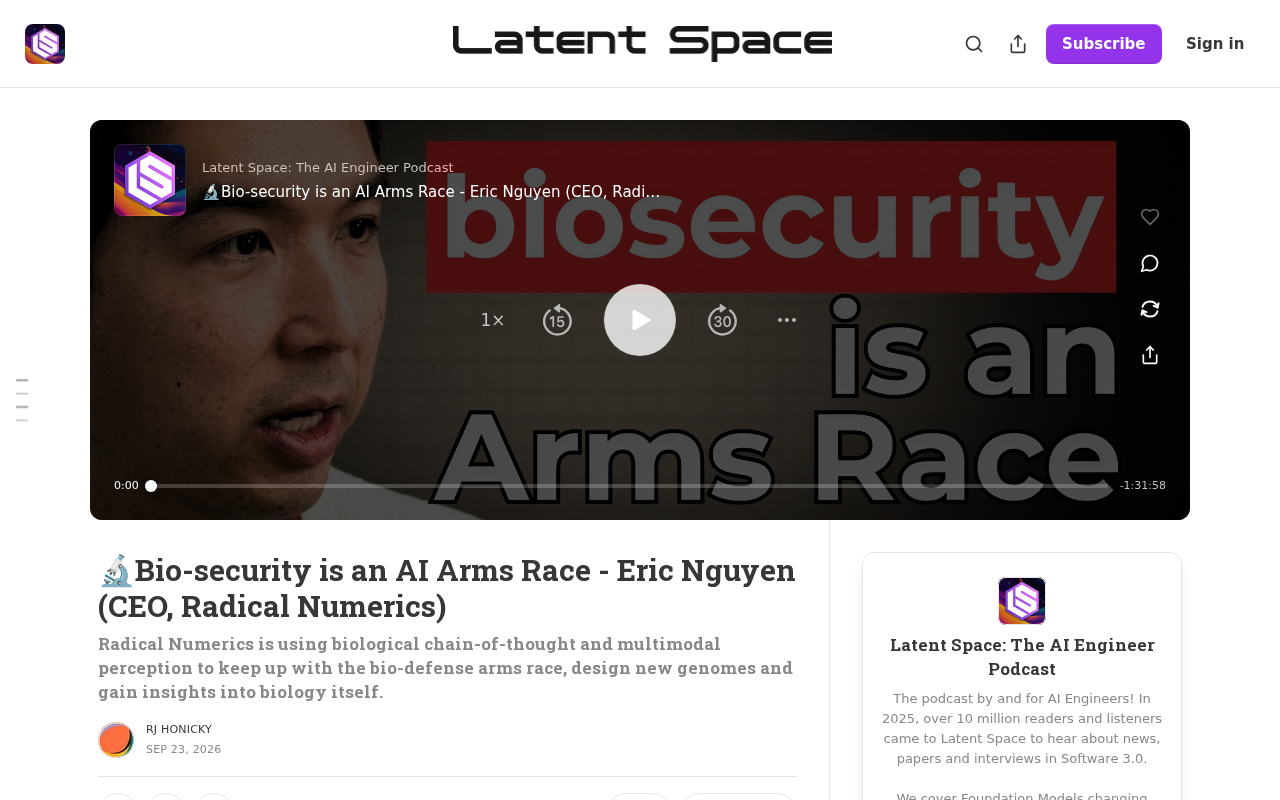
The Biological Chain-of-Thought: Teaching AI to Reason Like a Biologist
One of the core methods Eric Nguyen highlights is the biological chain-of-thought. The concept draws from chain-of-thought reasoning in large language models — rather than jumping directly to an answer, the model works through its reasoning step by step.
Applied to biology, this means that when an AI is designing a genome or predicting biological function, it simulates a reasoning path similar to that of a biologist: from sequence to structure, from structure to function, and then to system-level interactions. The value of this step-by-step approach is that it brings the model's decisions closer to actual biological causal chains, rather than relying on simple pattern matching. For biological design tasks that demand high interpretability and reliability, this kind of reasoning transparency is critical.
In other words, biological chain-of-thought tries to bridge the gap between "black-box prediction" and "scientific understanding." It doesn't just deliver results — it provides a logical trail that can be verified.
Chain-of-thought reasoning was first proposed by a Google Research team in 2022. Their key finding was that prompting large language models to write out intermediate reasoning steps significantly improved accuracy on complex reasoning tasks. This mechanism is believed to activate implicit reasoning structures the model has learned, rather than simply retrieving answers through pattern matching. Transferring this to biology introduces additional challenges: biological causal chains often span multiple physical scales (from atomic bonds to cellular networks), and many intermediate steps are difficult to verify experimentally. Biological chain-of-thought is therefore not just an engineering technique — it also involves encoding known biological priors (such as the central dogma and thermodynamic constraints) into the reasoning path, so that the model's "step-by-step process" aligns with real physicochemical mechanisms rather than producing plausible-sounding but causally hollow pseudo-explanations.
Multimodal Perception: Integrating the Multi-Dimensional Information of Living Systems
Beyond innovations in reasoning, Radical Numerics also emphasizes multimodal perception. The information in biological systems is inherently multimodal — DNA sequences, RNA expression, protein structures, metabolic pathways, microscopy images — each layer carries biological meaning along a different dimension.
Single-modality models can only capture partial information, while multimodal approaches aim to integrate these heterogeneous data types into a unified representational space. Only then can AI build a more complete, three-dimensional understanding of biological systems. For example, by combining sequence data with structural information and even imaging data, a model may uncover patterns that no single data source could reveal.
This multimodal integration capability is a critical step forward — from "predicting individual proteins" toward "understanding entire biological systems." It enables AI to not only answer "what is this," but to progressively approach "why is this the case."
The core technical challenge of biological multimodal integration is heterogeneous data alignment: DNA sequences are discrete symbols, protein structures are 3D coordinate systems, microscopy images are pixel matrices, and metabolic fluxes are continuous values — each with vastly different statistical distributions and semantic granularities. Two main approaches currently dominate: the first trains independent encoders for each modality, then uses contrastive learning (such as biology-adapted variants of CLIP) to pull representations into a shared latent space; the second designs a unified tokenization scheme that converts different modalities into sequences over a shared vocabulary for joint Transformer training. The former is more flexible, while the latter has theoretical advantages for cross-modal generation tasks (such as "directly generating structure from sequence"). AlphaFold2 is essentially already a dual-modality sequence-structure model, and extending such frameworks to incorporate imaging, transcriptomics, and other modalities is the current frontier of "foundation model for biology" research.
Designing New Genomes and Gaining Insight into Life Itself
Radical Numerics' ambitions go beyond defense. Eric Nguyen explicitly names three goals: keeping up with the biosecurity arms race, designing entirely new genomes, and gaining deep insight into biology itself.
Designing new genomes means AI transitions from passive analyst to active creator — a long-held goal of synthetic biology. If models can reliably generate gene sequences with specific functions, this would dramatically accelerate the development of new drugs, materials, and therapies. "Gaining insight into biology itself" points to an even more fundamental scientific value: AI as not just an engineering tool, but a cognitive partner that helps humanity understand the laws of life.
These three goals are deeply interconnected: only by truly understanding biology can AI design genomes safely and reliably; only with powerful design and comprehension capabilities can it hold its own on both sides of the biosecurity divide.
Genome design is one of the ultimate engineering goals of synthetic biology. Current technical approaches fall into two broad categories: rational design relies on known gene regulatory rules to manually assemble functional modules — the landmark achievement being Venter's team synthesizing the first artificial bacterial genome in 2010; AI generative design attempts to have models learn from large numbers of natural genomes and then directly generate new sequences satisfying specific constraints (such as eliminating toxin-producing capability or activating specific metabolic pathways). The central challenge of the latter is the sparsity of the fitness landscape — viable, functionally coherent genomes are exceedingly rare in the vast space of possible sequences, and models must learn to navigate this rugged landscape rather than simply reproducing the statistical patterns of their training data. At the same time, the dual-use nature of this capability makes it a core concern for biosecurity governance: the same generative model that can design beneficial microorganisms could potentially be used to enhance pathogens.
A Signal Worth Watching
Based on the limited public information available, Radical Numerics represents an important direction in the AI for Science space: combining the reasoning paradigm of large models (chain-of-thought) with the multimodal characteristics of domain-specific data, to enter the high-value, high-risk arena of biosecurity and synthetic biology.
Framing biosecurity as an "AI arms race" is both an optimistic judgment about technological potential and an implicit warning about governance and safety — when AI can design life, the line between defense and misuse is razor thin. This is precisely why the technical trajectory of companies like this deserves sustained attention from the entire industry.
(Note: This article is based on Eric Nguyen's public statements. Specific technical implementation details have not been fully disclosed.)
Related articles

Workbuddy for Absolute Beginners: How a Desktop AI Agent Fits Into Real Workflows
A beginner's guide to the Workbuddy desktop AI agent: installation, claiming credits, file management, and building automated workflows—compared with CodeX for fit and cost, helping professionals shift from AI question-askers to AI managers.

OpenAI's New Agent Stack: Computer Use, Decisions API, and Ultra-Fast Workflows
OpenAI Dev Day unveiled a new agent stack: Computer Use outperforms humans, Decisions API delivers ultra-low-latency classification via Luna, Agents API opens the same Computer Use capabilities, and GPT-6.1 Sol costs only one-seventh of Astra. Core updates, benchmark data, and developer insights.

Liang Wenfeng Open-Sources DeepInfo Inference Framework, Takes On U.S. Ban
DeepSeek open-sources its DeepInfo inference framework after its models, featuring GPU/CPU cross-pipelining, small-model prediction with large-model verification, and full Huawei Ascend and NVIDIA chip support—facing the U.S. federal ban head-on. This article analyzes its significance for AI deployment and open-source strategy.