The AI Big Crunch: A Deep Dive into Bubble Deflation and the Return to Rational Value

The AI Big Crunch explains why inflated AI valuations may soon compress back to rational levels.
Borrowing from cosmology, the "AI Big Crunch" argues that the gap between AI hype and real commercial value is unsustainable. Soaring LLM training costs, rampant product commoditization, and weak monetization are key warning signs. Like the dot-com bust, a contraction would punish storytellers while rewarding companies with genuine moats, sustainable unit economics, and deep vertical integration.
After the AI Frenzy: A "Big Crunch" Is Taking Shape
Since ChatGPT ignited the global AI wave, the entire tech industry has been swept up in an unprecedented capital and technology frenzy. From startups to tech giants, nearly everyone rushed to buy into the AI narrative. Yet recently, a concept known as the "AI Big Crunch" has been circulating widely in technical communities — borrowing from the cosmological idea of a "Big Crunch" to suggest that this expansionary AI boom may be approaching a critical inflection point of contraction and restructuring.
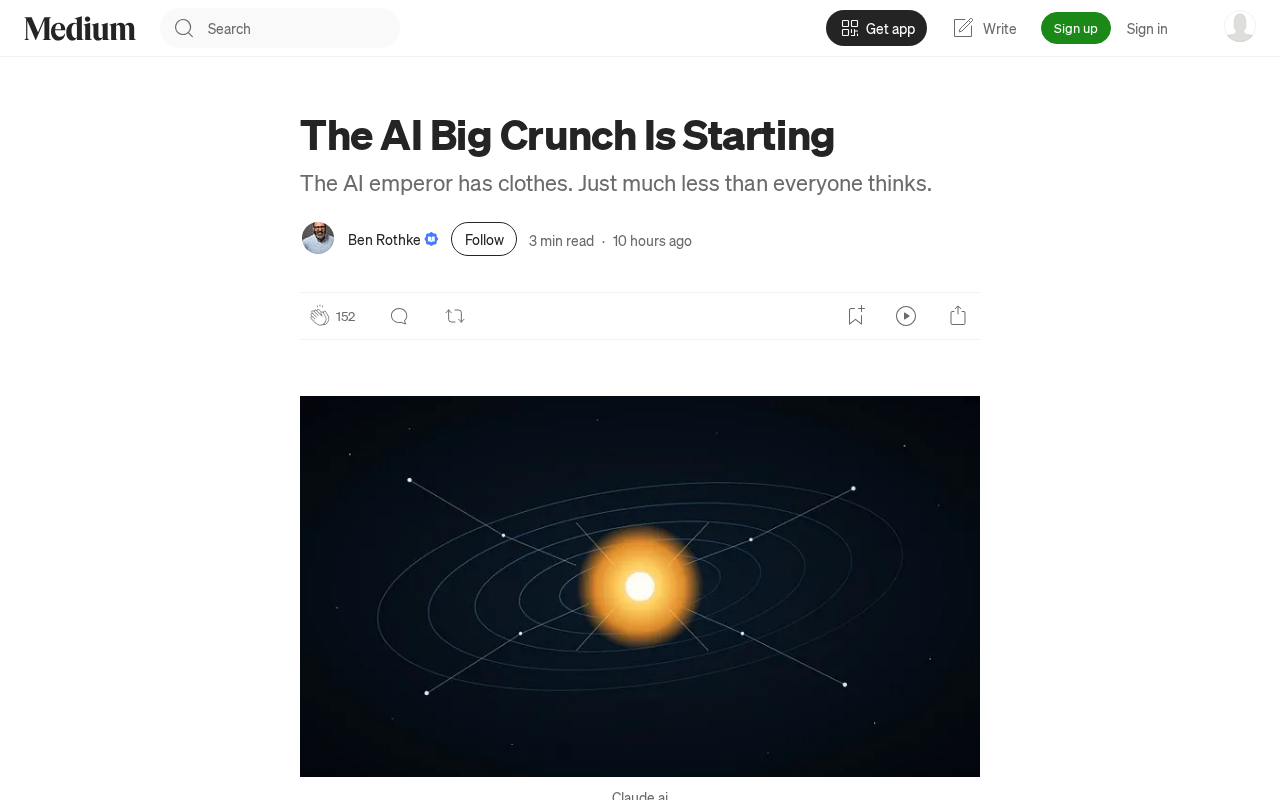
In cosmology, the "Big Crunch" refers to the hypothetical scenario where the universe, after expanding to its limit, collapses back in on itself due to gravitational forces. Originally proposed by physicists in the 20th century, it forms a symmetric narrative with the "Big Bang": if the density of matter in the universe is high enough, gravity will eventually overcome the momentum of expansion, collapsing all matter back into a singularity. While the discovery of dark energy and observational evidence of the universe's accelerating expansion have largely removed the Big Crunch from mainstream cosmological predictions, as a conceptual framework it precisely captures the dynamic logic of "structural contraction following over-expansion" — not destruction by external forces, but self-reorganization driven by internal imbalance. Mapping this metaphor onto the AI industry, the core argument is this: a massive chasm exists between current AI valuations and expectations on one side, and actual commercial value on the other. That gap will inevitably be "compressed" back to rational levels by the market.
Signals of the AI Bubble: Contraction Has Already Begun
Assessing whether the AI industry is entering a contraction phase requires examining several key dimensions. First, there are signs of fatigue at the capital level. Over the past two years, many AI startups could secure massive funding rounds based on nothing more than a demo and a few PowerPoint slides. Now, investors are starting to ask harder questions: Where is the real revenue? What is the sustainable moat?
Severe Imbalance Between Training Costs and Commercial Returns
The persistently high costs of training and running inference on large models is one of the foundational pillars of the "Big Crunch" thesis. Understanding this requires recognizing the unique cost structure of large language models (LLMs): training is a massive one-time capital expenditure — GPT-4, for example, is estimated by industry observers to have cost over $100 million for a single training run, driven primarily by the compute rental of tens of thousands of high-end GPUs (such as NVIDIA A100s and H100s). Inference, by contrast, is an ongoing operational cost — every time a user calls the model to generate a response, real computational resources are consumed. This "pay every time it runs" cost structure is fundamentally different from the traditional software logic of "build once, replicate at near-zero cost." Compute investments in the hundreds of millions of dollars require a corresponding scale of monetization to sustain. Yet the reality is that many AI products remain at the "subscription tool" stage, priced far below their true cost of service, reliant on venture capital to subsidize users, with limited user willingness to pay while underlying compute bills keep climbing. When marginal costs cannot be covered by marginal revenue, contraction becomes inevitable.
Intensifying Product Commoditization
Another clear signal is severe product commoditization. Hundreds of "AI writing assistants," "AI customer service bots," and "AI image generators" have flooded the market, most of them built on top of a handful of foundation models with no genuine differentiating capabilities. This phenomenon has deep technical roots: the vast majority of AI applications globally call foundation models via API — OpenAI's GPT series, Anthropic's Claude, Google's Gemini, or Meta's open-source Llama family — and build product interfaces and scenario wrappers on top. This "a thousand products sharing the same engine" structure means that without proprietary data, exclusive workflows, or deep industry integration, the core capabilities of different products effectively come from the same source, making differentiation extremely difficult. When a market segment is crowded with functionally identical players, price wars and industry consolidation become inevitable — a classic precursor to market contraction.
The Big Crunch Is Not a Collapse: A Healthy Revaluation
It is worth emphasizing that the "AI Big Crunch" does not mean AI technology itself is heading toward failure or obsolescence. On the contrary, this is more likely a rational process of squeezing out the bubble and returning to fundamental value. Looking back at internet history, the dot-com bubble burst of 2000 offers the most compelling historical parallel. Between 1995 and 2000, the Nasdaq rose more than 400%, with countless internet companies completing IPOs on nothing more than a domain name and a business plan. After the bubble burst, the Nasdaq fell nearly 80% from its peak and thousands of companies vanished. Yet companies like Amazon, Google, and Salesforce — those that genuinely solved user problems — used the rubble to evolve their business models and ultimately grew into industry giants. The deeper historical lesson is this: the excessive investment of the bubble era, while wasteful, also completed the buildout of foundational infrastructure — broadband, servers, payment systems — and educated the market, paving the way for value realization in the next phase. The current large-scale compute infrastructure investment in the AI space may be playing a similar historical role.
The logic in AI follows the same pattern: once the bubble clears, what remains will be built on more solid commercial foundations and clearer technical pathways.
Who Survives and Thrives During the Contraction
In this industry restructuring, the companies likely to survive and continue growing typically share the following characteristics:
- They have real, sustainable business models rather than "burn-to-grow" strategies dependent on continuous capital infusion.
- They have built deep moats in vertical domains, tightly integrating AI capabilities with proprietary industry-specific data (such as medical imaging databases or legal document corpora) and core business processes — rather than simply wrapping a model in a UI.
- They maintain clear-eyed awareness of their cost structure, able to find a dynamic balance between compute efficiency and commercial returns.
- They do not blindly chase parameter arms races, but instead focus on solving genuine user pain points.
In other words, the contraction period is a reckoning for storytellers — and a coronation for those who actually build things.
Key Implications for Practitioners and Investors
For practitioners navigating the AI wave, the "Big Crunch" discussion offers an important warning: don't get swept up in the industry's collective euphoria. The value of technology must ultimately be expressed through the real benefits it creates for users — not measured by fundraising totals or valuation figures.
For investors, this means recalibrating expectations. AI is genuinely a profound technological transformation, but realizing that transformation takes time, and the path is far more winding than imagined. Internet bubble history also reminds us that contraction periods are often windows where quality assets get unfairly punished — investors who held their positions in Amazon through the peak of the bubble ultimately earned returns far above market averages. Maintaining clarity and judgment during a contraction may actually surface high-quality opportunities that the market has mispriced, offering more attractive entry points.
Conclusion: Contraction Is the Beginning of What Comes Next
The "AI Big Crunch" is less a pessimistic prophecy than a rational analytical framework for understanding the natural rhythms of technology cycles. Expansion and contraction are two sides of the same coin in any technological revolution. When market noise fades and the bubble deflates, AI applications and companies genuinely rooted in value creation will find themselves on far more solid ground for long-term growth.
For the AI industry as a whole, this "crunch" may be the necessary passage from frenzy to maturity — and the starting point for the next wave of real growth.
Key Takeaways
Related articles

DeepCell: One-Click AI Generation of Documents, Spreadsheets, and Slides
DeepCell tops Product Hunt with one-click generation of documents, spreadsheets, and slides, using the .deepcell format for linked updates, designed for System 2 tasks like modeling and sales reviews.

Doneas: 15-Minute Daily Accountability Calls That Keep Indie Developers From Procrastinating
Doneas is a daily accountability tool for indie developers: plan tasks on Monday, join a 15-minute call with five builders each day, and log deliveries on a public progress page. This article analyzes its core mechanics, effectiveness, and potential issues around retention and matching.

Fastlane 2.0: Fully Automated AI Ad Campaigns, From Creative to Optimization
Fastlane 2.0 is an AI ad automation tool: enter your website and it learns your brand, generates video and image ads, and runs and optimizes them on Meta, TikTok, Instagram, and YouTube.