The AI Bubble Debate: Why Some Insist There Is No Bubble

The original article argues AI has real revenue and infrastructure support, not a typical bubble.
The article examines *I'm not convinced the AI bubble exists*, outlining three core arguments: leading AI firms have real revenue and demand; GPU/cloud infrastructure is general-purpose, unlike dark fiber; and AI penetration is early on the S-curve. It also covers Hacker News debates on capex, customer concentration, and demo bias. A consensus is that 'bubble' is ambiguously defined. Takeaways: focus on fundamentals, use infrastructure flexibility as a buffer, and stay aware of AI's limits.
Introduction: A Debate About the AI Bubble
Recently, an article titled I'm not convinced the AI bubble exists sparked heated discussion in the tech community, garnering 202 upvotes and 269 comments on Hacker News. The author, Matteo Raso, argues from multiple angles that the current AI boom is not a bubble—a view that stands in sharp contrast to the concerns of mainstream media and some investors.
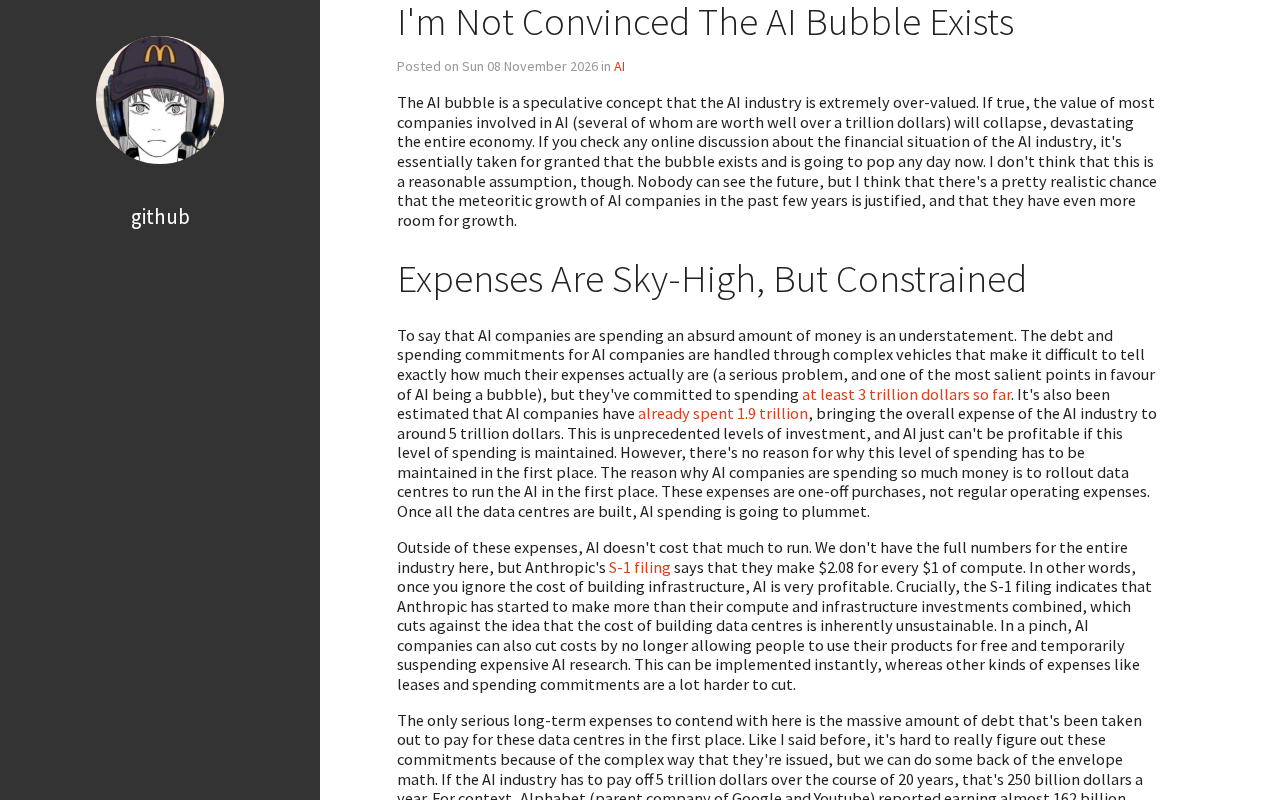
The core of this debate is: are we experiencing a technological revolution, or yet another capital bubble hyped beyond reason? This article starts from the original article's arguments, combines them with community discussion, and takes a deep dive into this controversy.
The Original Article's Core Arguments: Why the Bubble Theory Doesn't Hold Up
Argument 1: Revenue Growth and User Demand Are Real
The original article points out that, unlike the dot-com bubble era, the major players in today's AI space already have substantial revenue streams. Companies like OpenAI and Anthropic generate real revenue through API calls and subscription services, and enterprise demand for AI tools is not fabricated out of thin air. The author argues that a bubble is characterized by asset prices detaching from fundamentals, and while AI company valuations are high, they are supported by user growth and revenue.
Dot-com Bubble: Refers to the period between 1995 and 2000 when a large number of internet companies lacking profit models saw their valuations soar. The Nasdaq index peaked in March 2000 and then plummeted by about 78%. Its typical features: companies supported valuations with non-financial metrics like "eyeballs" and "page views," with meager or zero revenue, kept alive by venture capital and IPOs. After the bubble burst, many companies went bankrupt, but a few with real business models, such as Amazon and Google, survived and thrived. The original article compares today's AI companies with that period to make the point that the core criterion of a bubble is not "high valuations" but "valuations disconnected from fundamentals." Companies like OpenAI have verifiable revenue streams from API calls and subscriptions, which is structurally different from the many revenue-less concept stocks of 2000. However, critics would point out that revenue during a high-growth phase does not equal sustainable profitability, and whether unit economics are healthy still needs to be observed.
Argument 2: Infrastructure Investment Has Long-Term Value
In response to skepticism about overinvestment in data centers and compute, the original article argues that this infrastructure is not a one-time expense. GPU clusters and cloud computing resources can be flexibly reallocated, and even if some AI applications fail, the underlying compute can still serve other computing needs. This differs from the dark fiber left idle during the fiber-optic bubble—compute resources have greater demand elasticity.
Dark Fiber is a signature legacy asset of the dot-com bubble: telecom carriers laid far more fiber-optic cable than actual demand in the late 1990s, much of which was never "lit" for use, ultimately leading to industry overcapacity, price collapse, and the bankruptcy of multiple telecom companies. The original article uses this case as a contrast to emphasize that the key difference between GPU clusters and dark fiber lies in general-purpose applicability and schedulability—once fiber is laid, routing and bandwidth are bound to a specific network topology, limiting reuse scenarios; whereas GPU compute can be dynamically allocated via cloud platforms to different workloads such as training, inference, rendering, and scientific computing, giving it significantly higher demand elasticity. In addition, compute resources have depreciation cycles (typically 3-5 years), which implies both technology iteration risk and that capital expenditure is not a permanent sunk cost. What warrants caution is that if compute supply growth continues to outpace demand growth, idle risk also exists—just in a different form than dark fiber.
Argument 3: Technology Penetration Is Still Early
The author emphasizes that AI technology penetration on the enterprise side is far from saturated. From coding assistance to customer service automation, from content generation to data analysis, AI application scenarios are still expanding rapidly. Bubbles typically appear after technology adoption peaks, whereas AI is currently still in the first half of the S-curve.
Divergences and Consensus in Community Discussion
Divergence 1: Is Capital Expenditure Excessive?
The Hacker News comment section shows a clear split in opinion. Some commenters agree with the original article, arguing that while big tech's capital expenditure is aggressive, it remains manageable relative to cash flow. Others point out that hardware vendors like Nvidia are highly dependent on continued purchasing by a handful of hyperscale customers, and this concentration itself is a risk signal.
Hyperscalers typically refers to companies that build large-scale data centers themselves, such as Amazon AWS, Microsoft Azure, Google Cloud, and Meta. The "revenue highly concentrated among a few customers" mentioned in the community discussion corresponds to Customer Concentration Risk: when a supplier (like Nvidia) derives a large proportion of its revenue from a few buyers, any buyer slowing purchases has an amplified impact on the supplier. This risk is especially typical in the semiconductor and equipment industries. Common metrics for judging whether capital expenditure is excessive include: capex-to-revenue ratio, free cash flow coverage, and the revenue increment corresponding to new compute (i.e., "how much AI revenue is generated per dollar of compute investment"). If capex growth remains significantly higher than AI-related revenue growth for an extended period, capacity absorption pressure will gradually accumulate—which is the core logic behind some commenters' concerns.
Divergence 2: Is the Productivity Gain Overestimated?
Some commenters argue that AI's efficiency gains in areas like coding suffer from "demo bias"—impressive in carefully selected examples but still requiring substantial human intervention in complex real-world scenarios. Opponents argue that technology maturation takes time, and current imperfections do not negate the long-term trend.
Demo Bias refers to showcasing technical capabilities in carefully selected, clearly bounded examples, thereby overestimating their general performance in real production environments. In AI coding assistance, this bias is especially pronounced: benchmarks usually target isolated functions or standard algorithm problems, whereas real engineering tasks involve legacy code, ambiguous requirements, cross-module dependencies, and team collaboration—so the actual efficiency gains from AI tools are often lower than the demo impression. Academia and industry commonly use controlled experiments (e.g., having two groups of developers complete the same task and comparing time and defect rates) to correct for this bias; results show that efficiency gains vary by task type and developer experience, and in some scenarios the burden even increases due to reviewing AI output. This suggests that evaluating AI productivity should distinguish between "task-level efficiency gains" and "organization-level efficiency gains," the latter being influenced by process integration, trust building, and other factors, with a longer realization cycle.
Consensus: The Definition of a Bubble Is Itself Ambiguous
An interesting consensus in the discussion is that the term "bubble" is itself unclear. Does it mean excessively high valuations? Or technology failing to deliver on its promises? Or an excessively long return-on-investment cycle? Different definitions lead to completely different conclusions. The original author also acknowledges that if "short-term valuation correction" is the standard, market volatility is normal—but that does not equal a bubble bursting.
Implications for AI Industry Practitioners
Focus on Fundamentals, Not Narratives
Regardless of whether the bubble theory holds, practitioners should focus on verifiable metrics: user retention, paid conversion rates, and whether unit economics are healthy. The original article reminds us that media narratives often lag behind reality, and both excessive optimism and excessive pessimism can mislead decision-making.
Infrastructure Flexibility Is a Buffer
Compared with the specialized assets of the dot-com bubble era, today's AI infrastructure is more general-purpose. This means that even if some application-layer companies fail, the value of underlying compute assets will not go to zero. This structural difference is one of the key bases for the original article's argument that no bubble exists.
Maintain a Clear Awareness of Technology's Limitations
A recurring reminder in the community discussion is: AI is not omnipotent. When evaluating AI projects, one should clearly define their capability boundaries and avoid equating demo performance with production-environment performance. This cautious attitude is not contradictory to believing in AI's long-term value.
Conclusion
The article I'm not convinced the AI bubble exists offers a counterpoint worth taking seriously. In the AI boom, one should neither blindly chase highs nor throw the baby out with the bathwater. As the Hacker News discussion demonstrates, rational debate itself is more valuable than taking sides. Bubble or not, time and the market will ultimately decide—but continuous attention to technological fundamentals is always the best strategy for navigating cycles.
One-line Summary
The original article argues that the AI boom is supported by real revenue and infrastructure and is not a typical bubble, while the community is clearly divided on this.
Paragraph Summary
The article centers on I'm not convinced the AI bubble exists and outlines its three core arguments: leading AI companies have real revenue and user demand; GPU and cloud infrastructure are general-purpose, unlike the dark fiber of the dot-com bubble; and enterprise penetration of AI is still early on the S-curve. It also presents the divergences in the Hacker News discussion: whether capital expenditure is excessive, whether customer concentration constitutes a risk, and whether AI productivity gains are overstated by demo effects. One consensus reached in the discussion is that the definition of "bubble" is itself ambiguous, with different standards leading to different conclusions. The article concludes with implications for practitioners: focus on fundamental metrics such as user retention, paid conversion, and unit economics; use infrastructure flexibility as a buffer; and maintain a clear awareness of technology's limitations.
Related articles

LLM Interview Focus Shifts to Agents: Harness Engineering and Langfuse Tracing Become Must-Know Topics
2026 LLM application interviews now focus on AI agents: multi-agent systems, Harness engineering, Langfuse tracing/evaluation, and security mechanisms are must-know topics. This article covers interview trends and resume tips.

Claude Code Advanced Guide: 10 Tips to Stop Approving Manually
Based on The Benmore Brief's Claude Code tutorial, 10 practical tips: from Auto mode, effort levels, and side chats to phone remote control and scheduled tasks—stop approving every step.

Why Did ByteDance's Coze Suddenly Go Quiet? Outdated AI Workflows and Shifting Internal Priorities
ByteDance's Coze went from a must-learn AI tool to fading out. A Bilibili creator analyzes its outdated workflow model, failed coding pivot, and ByteDance's resource reshuffling among Doubao, Feishu, and Tree Work under Workbody pressure—with the Coze team possibly facing merger or dissolution.